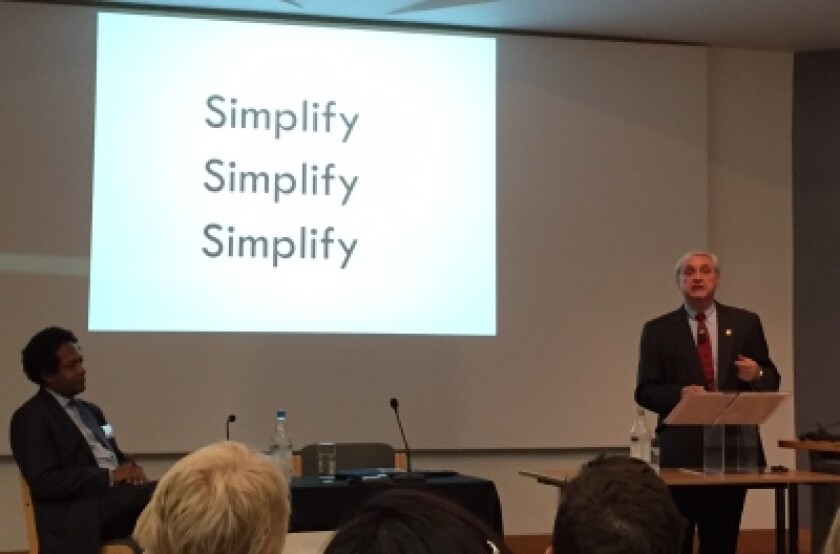
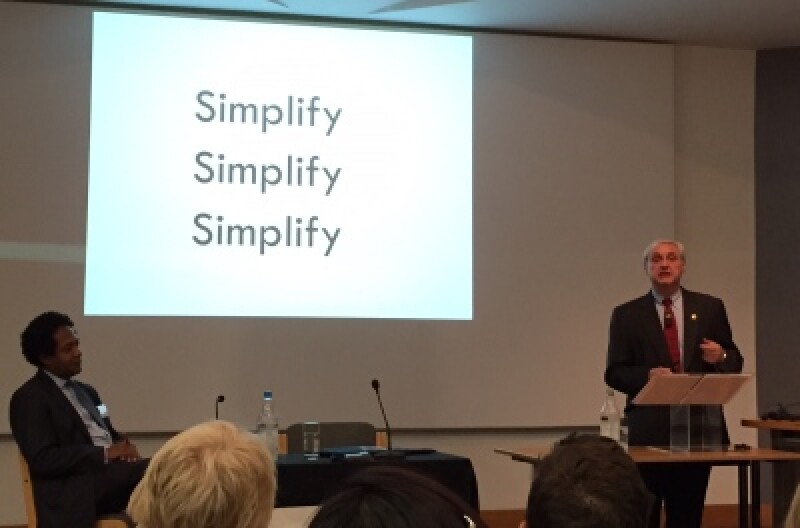
Kozinski is known for his bold, eloquently written and often controversial opinions on what has become known as the “Hollywood Circuit”, where he was Chief Judge until last year.
During the lecture, he discussed many of the IP and right of publicity cases he has heard or observed, including Facebook v ConnectU (between Mark Zuckerberg and the Winklevoss brothers), Mattel v MGA (the Bratz case), Galoob v Nintendo (Game Genie), Fisher v Dees (over the song “When Sonny Sniffs Glue”), Mattel v MCA (the “Barbie Girl” case), Vestron v HBO (over the distribution of the movie Platoon), White v Samsung (regarding the image of Vanna White of Wheel of Fortune) and San Francisco Arts & Athletics v USOC (over the Gay Olympics, which went to the Supreme Court).
Concrete examples v abstract arguments
“Good advocacy can make a big difference” in IP cases, said Kozinski, especially where generalist judges are hearing a case. He added: “The easiest path to understanding is with concrete examples. Abstract minds tend to wander.”
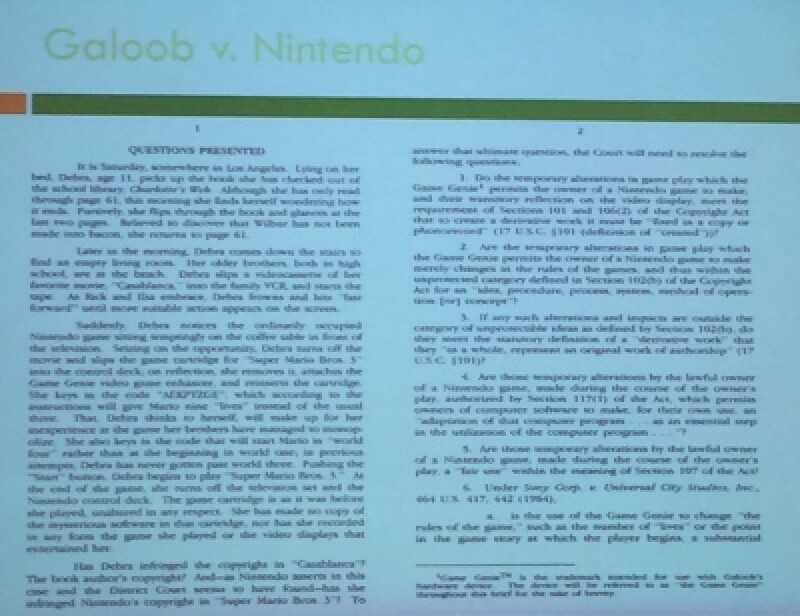
As an example, he quoted the introduction to the brief written by Jerry Falk in the Galoob v Nintendo copyright case concerning the Game Genie. The brief begins: “It is Saturday, somewhere in Los Angeles. Lying on her bed, Debra, age 11, picks up the book she has checked out of the school library, Charlotte’s Web. Although she has only read through page 61, this morning she finds herself wondering how it ends. Furtively, she flips through the book and glances at the last two pages. Relieved to discover that Wilbur has not been made into bacon, she returns to page 61.”
The story continues for a full page, before the copyright questions in the case are set out. Kozinski argued that this was a successful way to present the arguments in terms a judge would be familiar with. However, over drinks afterwards, at least some litigators and a UK judge doubted that such an approach would always be well received.
Another example Kozinski gave was the case over whether the song “When Sonny Sniffs Glue” infringed “When Sunny Gets Blue” (Fisher v Dees). The oral arguments were finely balanced, he said, and it was only when the judges asked for recordings of both sings and listened to them that “a lightbulb came on” and they all agreed: “Of course it’s a parody!”
Nominative fair use |
One of Kozinski’s most famous contributions to IP law was the coining of the term “nominative fair use” as a defence to trade mark infringement in the New Kids on the Block case in 1992. Kozinski wrote: “[W]here the defendant uses a trademark to describe the plaintiff’s product, rather than its own, we hold that a commercial user is entitled to a nominative fair use defense provided he meets the following three requirements …” In his lecture this week, he said the term was coined to describe use that was not use as a trade mark: “We just made it up – because we could. Then I forgot about it.” Only years later did he discover there was “a whole body of case law” on nominative fair use, with majority and minority opinions, briefs and legal articles. |
Control freaks
Kozinski suggested that the Fisher case was an example of the tendency of IP owners “to be complete control freaks” and their desire to use the courts to teach defendants a lesson.
In this context, he discussed several cases brought by Mattel, noting: “For a friendly girl, Barbie sues a lot!” One was a dispute with the band Aqua (Mattel v MCA) over the “Barbie Girl” song, in which the Ninth Circuit famously advised both parties “to chill”.
When Mattel tried to take the case to the US Supreme Court, sales of the record took off. But years later Mattel used the song (with slightly modified lyrics) in a commercial. “Why couldn’t they have done this in the beginning?” asked Kozinski.
Thought control
Kozinski also cautioned that right of publicity cases “can control speech and control thinking” adding that “Much IP law is about that. There is a considerable tension between robust trade mark and copyright law and free society values”.
From his own experience he cited a case where the Supreme Court (in an appeal from the Ninth Circuit) allowed the US Olympic Committee (USOC) to stop the use of “Gay Olympics”. Kozinksi had written a dissent arguing that the USOC was seeking to limit free speech. “I still think they were wrong. I would like think it would be different today,” he said this week.
The judge also defended his controversial decision (subsequently overturned) in the Garcia v Google case to order YouTube to block the movie “The Innocence of Muslims”, noting that he was swayed by the fact that actress Cindy Garcia’s life was under threat and that she had been deceived about her role. (He also said that he has still not watched the controversial film.)
Answering a question after the lecture about the law and morality, Kozinski expanded on this theme, saying judges are driven by “rightness and wrongness”, even though that is not part of the legal argument: “Morality is not part of the legal equation but it underpins everything we do.”
Court of public opinion
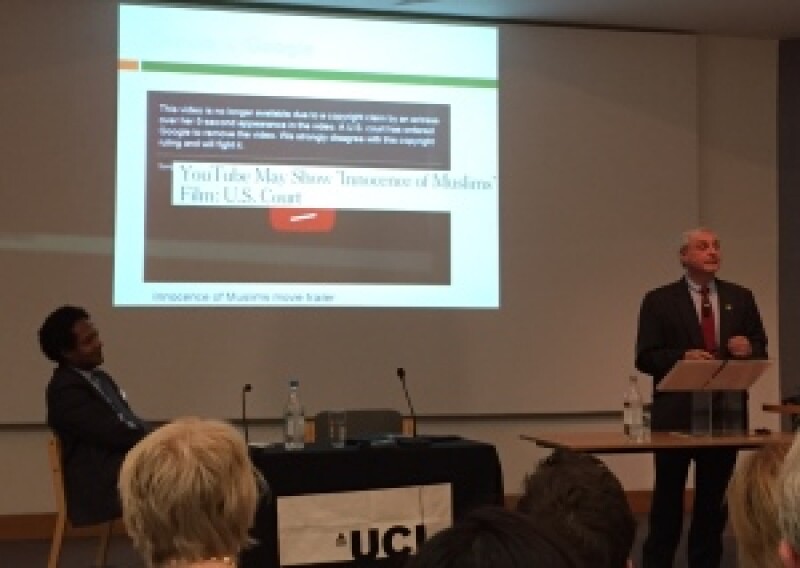
His ultimate message was one of caution, though. Despite warnings about the implications of cases, said Kozinski, “disaster almost never happens”. The decision to delay distribution in the Platoon case had little or no commercial impact, and, contrary to some predictions, even though “The Innocence of Muslims” was blocked for 13 months, “the internet still stands”.
He also urged lawyers to look beyond judges to the court of public opinion, citing the Streisand effect and noting how the internet and social media can be powerful weapons in disputes. As examples, he cited the Vermonster v Monster case where a local brewery mobilised public opinion after it was sued by the energy drink manufacturer, and Nestlé’s decision to stop using palm oil following an internet campaign by Greenpeace.
Concrete examples help to persuade generalist judges, said Kozinski, adding: “That’s every bit as true of public opinion where the stakes are often higher.”
A video of the lecture will be available on the UCL website next week.
You can also read a report on the Ipso-Jure blog written by Peter Groves.