Revealed: Chinese companies’ IP strategies

Managing IP is part of Legal Benchmarking Limited, 1-2 Paris Gardens, London, SE1 8ND

Copyright © Legal Benchmarking Limited and its affiliated companies 2026

Accessibility | Terms of Use | Privacy Policy | Modern Slavery Statement

Revealed: Chinese companies’ IP strategies

cover-puff.jpg

Managing IP’s biggest ever survey of Chinese in-house counsel reveals their IP filing plans, experience with litigation and policies on hiring foreign firms. Peter Leung spoke to ZTE, JK Sucralose, Livzon Pharmaceutical and other respondents to get the details

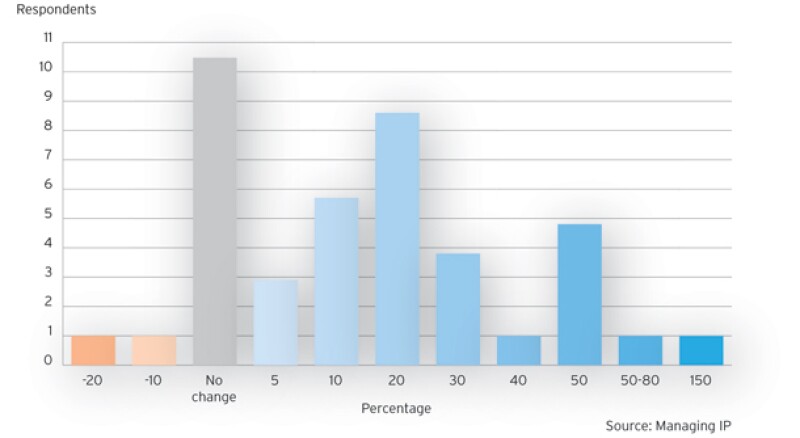
How much do you expect your foreign filing budget to grow next year?

null

null

The 2012 Chinese in-house survey was conducted at Managing IP's third IP Forum for Chinese IP counsel in Beijing, which was attended by more than 400 companies. The results underscore the increase in Chinese outbound work, revealing much about the types of companies making the move overseas and how they manage their IP portfolios. Four out of five of the 130 respondents said their budget for protecting IP rights abroad had increased in the past year, with some saying it had more than doubled (see chart, above).

There is no single profile that fits the Chinese companies looking to expand overseas; they come from a wide variety of industries and they structure their IP in a range of ways. However, the data and subsequent interviews do reveal some common themes.

Chinese businesses contemplating overseas expansion are cautious and diligent in the way they manage their IP. What sets them apart from peers in more developed economies is a particularly strong emphasis on the need for preventative measures and research that allows them to anticipate problems and minimise litigation risks. Chinese companies also seek external counsel who understand their business goals, and that the legal work is just one part of a larger strategy.

Analysis of the results of the survey, the raw data and case studies with companies ZTE and JK Sucralose are available at the links below. The first is free to access but you must be a subscriber to see the data and the case studies.

As ever, there is discussion of the results on the Managing IP Twitter account. Use the hash tag #MIPChinaSurvey. Please tell us your opinion on China and its IP either there or using the comment button at the top of this story.

We are also preparing the survey for next year, which will be used at the 2013 Beijing and Shanghai events. If there are any questions you think would be interesting to add to the survey, please email us at mip@managingip.com. Anyone suggesting a question will receive free access to the sections of the survey otherwise only available to subscribers. 

China in-house survey contents

1. Introduction and methodology

2. Analysis: aggressive expansion, cautious IP

3. Case study: Alex An, JK Sucralose on winning at the ITC

4. Case study: Alvin Shen, ZTE on managing its IP abroad

5. The data:


more from across site and SHARED ros bottom lb

More from across our site

Vaping dispute, in which Stobbs and Brandsmiths are the representatives, tested how the UK's Human Rights Act can apply to injunctions restraining unjustified threats
An AI platform being sold for £40m, and lateral hires involving law firms Womble Bond Dickinson and Cadwell Thomas were among the top talking points
With the London Annual Meeting behind us, we look back at some of the lessons learned this week and ahead to what 2027 will bring
In-house counsel aren’t impressed with law firms’ international networks, but practitioners say they are crucial for business
Publication of the UPC’s annual report and adoption of the procedural rules of the Patent Mediation and Arbitration Centre were also among major developments
With the INTA Annual Meeting drawing to a close, we asked attendees for their top tips on how to close business after a meeting
Senior UK judges discussing the impact of AI on the judiciary, and the role of in-house IP lawyers during corporate transactions and carve-outs were among the top talking points
Tarun Khurana, founding partner of Khurana & Khurana, discusses juggling tasks, why every hour has a value, and the importance of ‘trusting the process’
Annual Meeting hears that IP firms are targeting hires with technical literacy in a fragmented landscape, and that those that build an online presence will distinguish themselves from the digital chaos
How law firms can secure themselves in a technology-driven IP landscape and how IP teams can develop future leadership were among the top talking points
Gift this article