
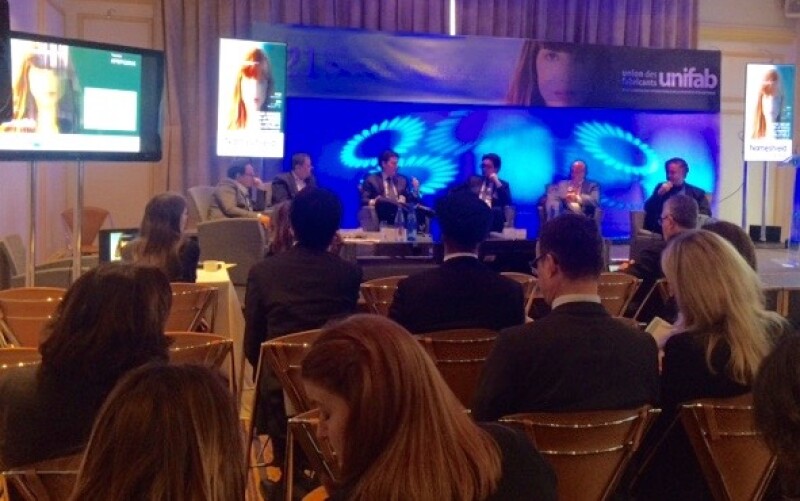
The recent UNIFAB report Counterfeiting & Terrorism set the tone of the debates during the 21eme Forum Européen de la Propriété Intellectuelle, which took place in Paris on February 12 and 13.
The Union des Fabricants : Pour la protection internationale de la propriété intellectuelle (UNIFAB) is a central actor in the fight against counterfeits advocating on behalf of the private sector before French and European authorities, agencies and institutions.
Broadly speaking, the Report proposed 10 recommendations to be incorporated in legal frameworks, including:
- Harmonisation of criminal offences in Europe and alignment of criminal sanctions with international standards.
- Condemnation of counterfeiting as a means of financing terrorism.
- Specialisation of judges in criminal courts.
- Enforcement of a “duty of care” on internet actors.
- Implementation of accountability rules for all actors in agreements/procedures applicable to trade shows and salons.
- Creation of civil actions for industry associations, establishment of zero tolerance areas, as well as improvement of innovations tools.
- Development of anti-counterfeiting cooperation actions in international meetings and sensitive countries.
- Implementation of imprisonment and monetary penalties committed by organised crime groups in all countries, and autonomous infringement with increased penalties for counterfeits affecting human health and safety.
- Enhancement in the exchange of information between agencies and addition of counterfeit indicators to policy making priorities.
- Implementation of awareness initiatives before schools and tourism operators.
During the session “The Proven Links with Organised Criminality and Terrorism” Senator Richard Yung, Member of the French Labor Party and President of the Comite National Anti-Contrefaçon (CNAC) briefly expressed his views on the 10 recommendations.
In respect of an increase of French legislation and specialisation of judges, Senator Yung inferred there are no needs for legal and judiciary modifications. Concerning the French Bill on the financing of terrorism – Projet de loi de lutte contre le terrorisme et son financement – there will be provisions regulating Customs and counterfeit provisions can be endorsed. On cybercrime, he proposed the follow-the-money approach. Additionally, he agreed that international and European partnerships are the way to go from now on.
Hélène Crocquevieille, General Director for Customs and Excise in France, highlighted that:
Recent results from the Customs demonstrate, like the Report of UNIFAB, [it] exists some links between counterfeit trafficking, organised crime and radicalised people who can commit terrorist attacks. The links, however, must be approached with caution: only the investigation following a terrorist act or a criminal conspiracy from a terrorist enterprise, carried out by specialised services such as the Service National de Douane Judiciaire (SNDJ), can validate these links with certainty. Furthermore, so far, there is no evidence that counterfeit trafficking would be a more specific means for financing terrorist acts than other illicit traffics such as tobacco, drugs or protected species.
She also said:
Pending the results of intelligence services analysis and current investigations, the French Customs continue their action in the fight against counterfeiting in order to protect consumers, as well as licit economy, and to increase the possibilities to dismantle criminal activities in our country. In particular, the Customs administration will accelerate the establishment of an inter-ministerial structure in order to strengthen the national strategy and action against counterfeit. French Customs will also act for a rapid implementation of the EU trade marks package that will allow a more efficient fight against transnational counterfeit traffic.
Magda Voltolini is an independent writer based in Paris






