
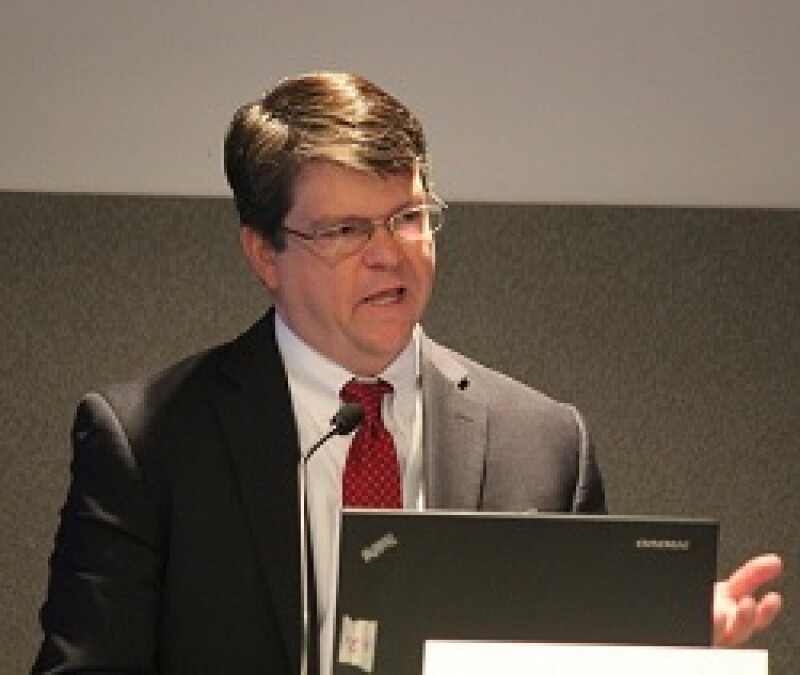
At Managing IP’s PTAB Forum 2016 held in New York last month, the then acting chief judge of the Patent Trial and Appeal Board defended one of the most controversial issues at the Board since it was established.
In a keynote speech at the forum, Nathan Kelley – who has since returned to his position as deputy general counsel of IP law and solicitor in the USPTO’s Office of the Solicitor following David Ruschke taking over as PTAB chief judge – defended the Board’s record on motions to amend.
He pointed to a PTAB report released in May that found that 192 motions to amend had been filed, with 118 of them reviewed by the Board, and six granted or granted-in-part.
Kelley said the report was the result of the PTAB wanting to delve deeper into motions to amend. “I have seen blogs that say they are summarily denied because we don’t like patentees or we don’t like claims,” noted Kelley. “We didn’t conduct this study to push back on people, we did it to figure out what was actually happening. What ended up emerging is that there are some [motions] that we deny on procedural grounds. But most of them – more than 81% of them – were non-procedural … where we simply disagree with the patentee.”
He continued: “To me, that is exactly what prosecution looks like. Yes, you have an unfettered right to amend in prosecution but you are not amending your patent, you are amending your application. You are not getting any exclusive rights.”
He added: “The motion to amend issue I think has taken on a life of its own because it drives a completely different issue – the claim construction standard issue.”
This followed similar comments Kelley made in a blog post announcing the report. Of the 112 motions that had been denied, including the denial portion of those granted-in-part, 22 were denied solely on procedural grounds. One of these was because the patent owner failed to state that the substitute claims were patentable over the prior art "in general". Some 94 were denied after identifying specific grounds of patentability that the proposed amended claims did not satisfy.
"To use conventional prosecution as a comparison, this latter category is like an examiner rejecting an amended claim because it is anticipated, obvious, not described, etc," explained Kelley in a blog post. "But unlike in the examination context, the PTAB proceedings must be completed within a year, and there is no time for the back-and-forth between the applicant and the USPTO that happens during prosecution. Instead, the PTAB acts as the final arbiter of these newly proposed claims based solely on the briefing presented to it by the parties – if the PTAB grants such a motion, the new claims will issue (and be enforceable against the public) without any examination to ensure compliance with the statutory requirements for patentability. A disappointed patent owner who believes the PTAB erred in refusing to allow a claim amendment can, of course, seek review from the Federal Circuit.”
Enough to convince the doubters?
Sceptics may not be convinced. The study confirmed that patent owners rarely file motions to amend and, when they do, they are rarely successful, with 5% of the reviewed motions granted or granted-in-part.
“The treatment of these 118 motions to amend will do nothing to quiet critics of the PTAB,” Marshall Gerstein noted on its PTABWatch blog.
It added: “While Judge Kelly’s explanation makes sense, it is unlikely to provide much comfort to (former) patent owners after their motions to amend have been denied, their claims have been canceled, and their only recourse involves an expensive and time-consuming appeal to the Federal Circuit.”
Gene Quinn on the IPWatchdog blog posted strong criticism of the report on motions to amend.

He took the Board to task for saying it has only a limited amount of time for each case when 80% of the motions to amend are being denied for substantive reasons of specific grounds of patentability. “The position taken by Kelley here is not new,” said Quinn. “This is the position taken by the Patent Office since the beginning. Essentially, the PTAB is telling the patent owner – sorry, we just don’t have the time it takes to allow you to amend so we won’t. A terrible reason to refuse a patent owner the ability to amend, but this has consistently been the justification provided by the Office."
Quinn said the USPTO uses the one-year timeframe as an excuse. He pointed out that proceedings can be extended for six months for "good cause".
In his blog post, Kelley revealed that the PTAB is on course to receive about the same number of motions to amend as in the first year of proceedings. "[A]lthough we sometimes hear that motions to amend are no longer being filed because parties think they’re futile, we are currently on track to have about 50 motions filed this year, which is consistent with the level they were filed in 2013 and 2015," he said.

Quinn responded: "If Kelley is right and there are never going to be many motions to amend filed it is utterly unbelievable that the Patent Office would cling to the nonsensical argument that they can’t possibly provide those 50 patent owners a year with an honest, full and fair examination of amended claims. For crying out loud, the Patent Office is in the business of patent examination and we are talking about 50 amendments a year that they say they can’t handle with special dispatch? That is pathetic."
Others offered a more sympathetic appraisal of the report.
Oblon’s Scott McKeown on the Patents Post Grant blog, commented: “Plainly the lack of a large number of successful amendments to date is not rooted in any reluctance of the agency to accept amendments, but instead, a reflection of the impossibility of saving low quality patents with trivial amendments that lack technical distinction.”
What is clear is that patent owners should not hold their breath when trying to get their claims amended at the PTAB.
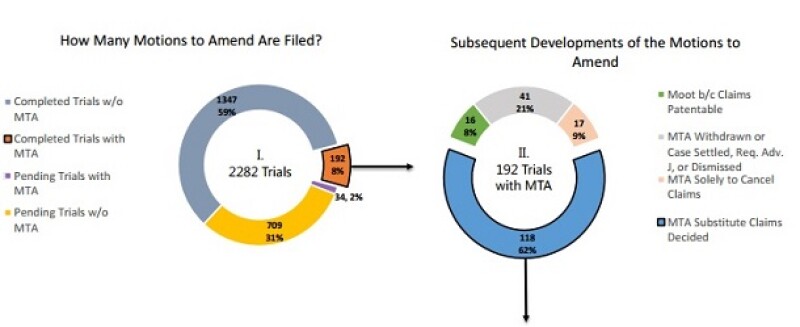
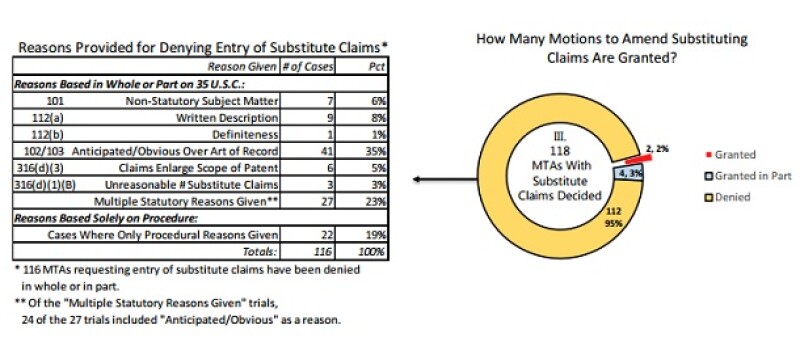
Source: USPTO's Patent Trial and Appeal Board Motion to Amend Study