
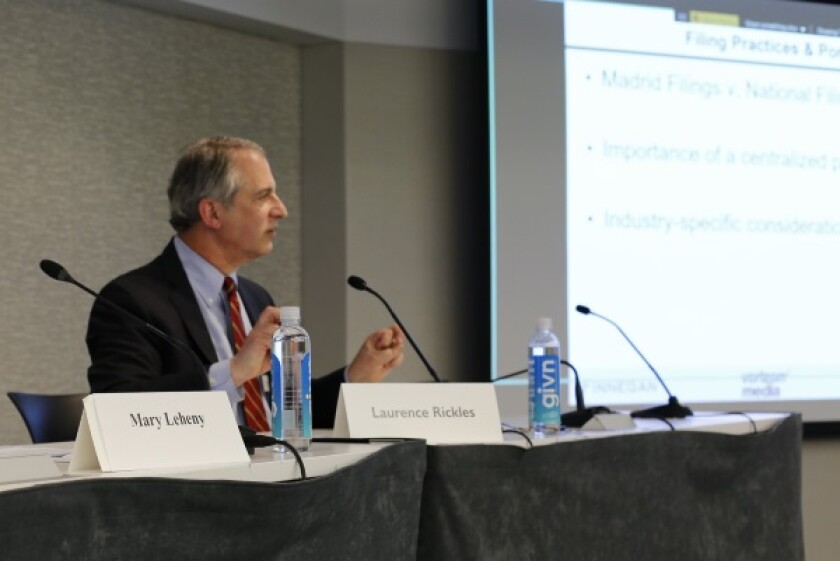
At this year’s Managing IP Global Trademark Forum in New York, Teva’s chief trademark counsel delved into the tumultuous world of foreign trademark work and gave advice on the best way to handle it
Laurence Rickles, who has been at Teva in New York since 2015, kicked off the session on Tuesday by advising delegates to choose their foreign external counsel carefully.
“Outside the US, it becomes difficult to work with local laws and customs, and you must rely on good external counsel to a certain extent,” he said.
He said that membership of INTA is probably the lowest bar for entry for a new outside counsel partner, and that if a law firm was not a member of that organisation, he would probably question how much trademark work it really did.
Beyond that, he said, he has found referrals to be particularly useful when picking law firms in the past. “Often I will go to contacts or former colleagues at Novartis or Johnson & Johnson and say: ‘Hey, who do you use here?’”
Another industry speaker on the panel noted that an in-house lawyer’s choice is also likely to be influenced by the law firm’s client service record. If the firm can offer fixed fees and is known for being communicative, it is far more likely to be picked by an in-house person who doesn’t know a jurisdiction particularly well and has few pre-existing relationships with other practices.
“I imagine I’m not the only in-house person who gets pressure from finance to find firms that offer fixed fees. Those fee arrangements are quite common in the US, but are often difficult to find elsewhere.”
Country of choice
The next piece of advice speakers gave was not to conduct searches in every foreign jurisdiction. “You’re not going to do full searches in every country,” said Rickles at Teva. “Searching in 220 countries would be incredibly time consuming and expensive, and there are various ways to cut down this effort to make it more cost-effective.”
Speakers noted that counsel should also be aware that there more cost-effective ways to file trademark registrations than on a traditional country-by-country basis. Rickles said that in the EU, for example, it is a no-brainer to apply for EU trademarks rather than individual French, German or, until recently, UK marks.
“We’ve also been trying to nudge paralegals and get them comfortable with Madrid filings,” he said. “We’re an Israeli company so we can take advantage of the Madrid Protocol more easily than a US-based company.”
He added: “The Madrid System is not as friendly towards US companies, but if you happen to work for a foreign firm, you can take advantage of the system to save money, which will help with your overall budget plan.”





