Within 24 hours, NGOs and mainstream news - from the Electronic Frontier Foundation to Knowledge Ecology International, The Guardian to Wired - highlighted provisions that seek to increase IP protections supposedly at the expense of consumers and developing nations.
Much of the focus has been on copyright, such as one provision (article QQ.G.6) looking to extend protection terms to US levels and another that would outlaw the circumvention of digital rights management schemes even when no infringement would take place (article QQ.G.10).
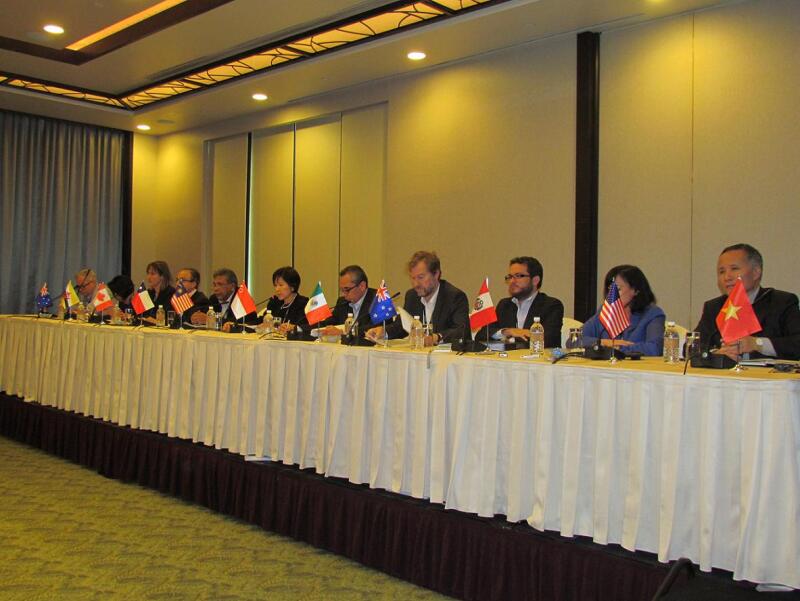
|
TPP negotiators in Singapore. Credit: Singapore Ministry of Trade and Industry |
It is worth noting that the perception that ACTA expanded copyright liability on the internet helped to mobilise the opposition that eventually defeated the treaty. This impression was reinforced by the belief that the treaty was negotiated in secrecy in a manner unbefitting democratic societies.
In addition to the copyright provisions, there is criticism of sections concerning access to medicines and patents. One section (articles QQ.E.17 to QQ.E.22) would extend data exclusivity periods, while another (article QQ.A.5) has been interpreted as a limitation on the rights afforded by the Doha Declaration. Another (article QQ.E.1) being pushed forward by US negotiators, according to Jamie Love of KEI, would expand the patentability of surgical methods beyond what is afforded by US law.
We learnt from ACTA
ACTA supporters were unprepared for the intensity of the opposition, and presumably have considered how to avoid making the same mistakes. For example, Bryan Mercurio of the Chinese University of Hong Kong said that rather than conducting discussions under the shroud of secrecy, the negotiating parties should consider releasing information more frequently in order to assuage transparency concerns.
Some governments appear to be trying to address this issue. Alejandro Luna of Olivares & Cía, who represents Mexico’s R&D pharmaceutical association AMIIF, told Managing IP that the Mexican delegation to the TPP negotiations has made considerable efforts to meet with stakeholders of all types and to keep them abreast of developments.
Despite these efforts, most if not all the criticisms directed at ACTA are being applied to the TPP as well. While observers had previously made some educated guesses about the provisions that would be in the TPP, the fact that the opposition moved so quickly to analyse the leaked draft shows that, despite claims of transparency, many still get the sense that it is being negotiated in small rooms under a haze of cigar smoke by nameless bureaucrats and barons of industry.
Imposing IP on developing nations
Similarly, those who claim that countries such as the US are using such treaties to impose their own vision of IP on developing nations will likely feel vindicated by the leaked draft. Article QQ.E.1, which is supported by the US and Japan but opposed by the other countries, appears to be designed to prevent signatories from adopting their own version of India’s section 3(d), the provision at the centre of the Novartis decision that holds that new forms of known substances are not patentable unless they show enhanced efficacy.
Indeed, for all the talk of transparency, the backers of the TPP have done a poor job mollifying these concerns. The US may have compelling arguments for its position, but you can’t very well make those claims if you can’t talk about the treaty openly.
ACTA supporters lamented that their opponents were uneducated about the facts and misunderstood the treaty, but it’s arguable that any ignorance was exacerbated by the lack of information made available. And at the end of the day, that supposedly ignorant opposition carried the day.
The full text of the leaked draft can be found here.