
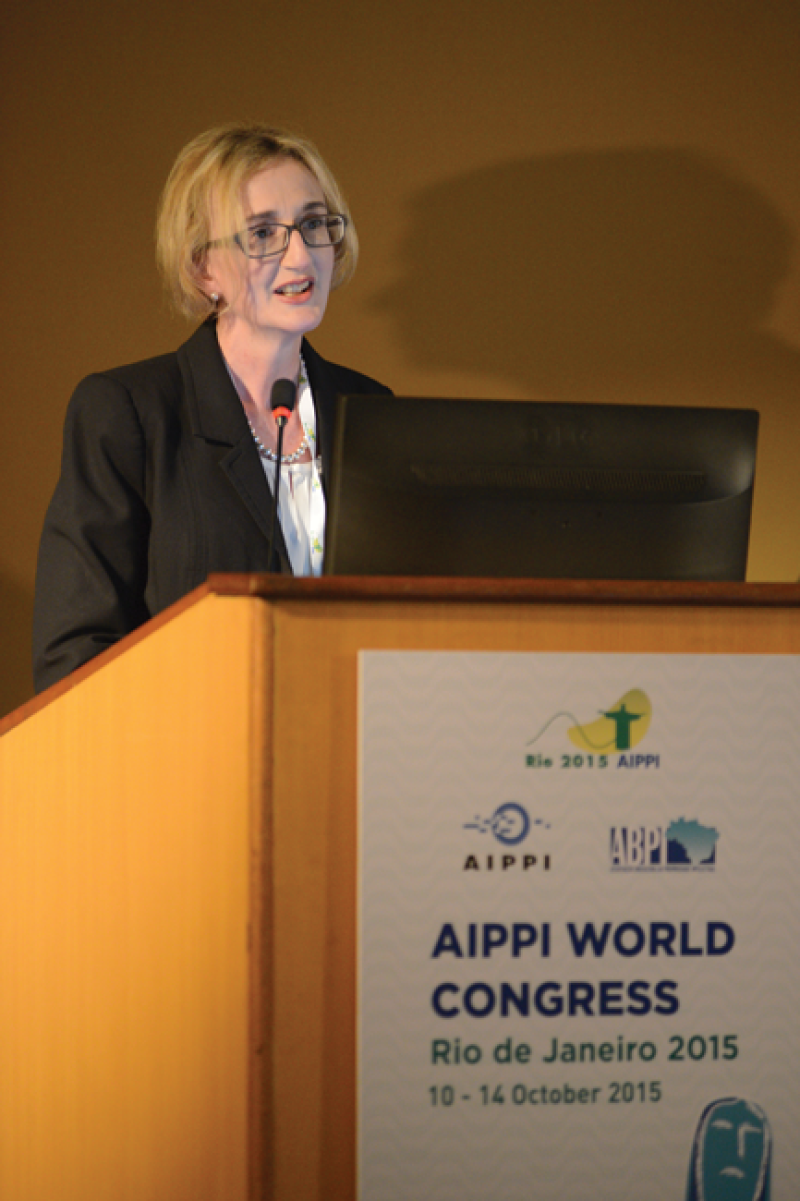
“It’s a lot of work but very satisfying,” says Sarah Matheson, a partner of Allens in Australia who is mid-way through her first time as AIPPI Reporter General. Along with her team, she is responsible for all the policy, consultation and external representation work of AIPPI. This comprises what she calls the “three pillars” of the working questions and resolutions, the educational sessions at the Congress and the work of the 21 standing committees.
And the work never stops. Yesterday, the working questions for next year’s Congress in Milan were introduced (see article opposite). Then, soon after this year’s Congress, the national and regional working groups will be invited to submit suggestions for topics that will eventually form the educational sessions in Milan and the working questions for the following Congress in Sydney in 2017.
“We get an amazing, sometimes overwhelming response from the national and regional groups, with over 100 proposals,” says Matheson. The Reporter General team narrow those down by focusing on issues that are topical and relevant, of practical interest and in an area where AIPPI can make a contribution to the development of the law. When it comes to deciding the four working questions to be tackled each year, they aim to cover the four areas of patent, trade mark/design, copyright and general IP issues. This year, two alternatives for each area were put to the Executive Committee before the final four were chosen.
However, not all the groups’ suggestions will lead to working questions being debated. Some lend themselves to educational sessions, perhaps because they warrant more analysis or are more particularly suited to interests in the host country. Sometimes, topics that are discussed in workshops this year will develop into working questions in the future. That is true of the panel on industrial designs and functionality this year.
This year, Matheson notes that once again there is a stream of pharmaceutical workshops, spanning trade mark, patent and technology transfer issues as well as the topical issue of personalised medicine. Expect that to address the recent Australian High Court decision in Myriad, which Matheson says took many Australian practitioners by surprise. There is also a double session on FRAND issues, which includes in-house counsel and judges and will look at the many recent developments worldwide on this thorny issue. And of particular interest to local practitioners will be the workshops on green technology and plant variety protection. “I know these are both big topics here in Brazil,” says Matheson.
There are two ticketed lunchtime panels, taking place today and tomorrow. Today’s will feature officials from the Australian, Brazilian and Japanese IP offices and will look at improving IP systems. Tomorrow’s panel will have an industry focus with speakers from Embraer, Canon and 3M and will be chaired by Matheson herself. “We will be addressing how to manage innovation in an anti-IP climate,” she explains. “IP has become much broader, there is greater politicisation and more recognition of its economic significance. This creates a new environment and raises questions about how strong, and how open, IP systems should be. I am looking forward to getting different perspectives on these questions.”



