
|
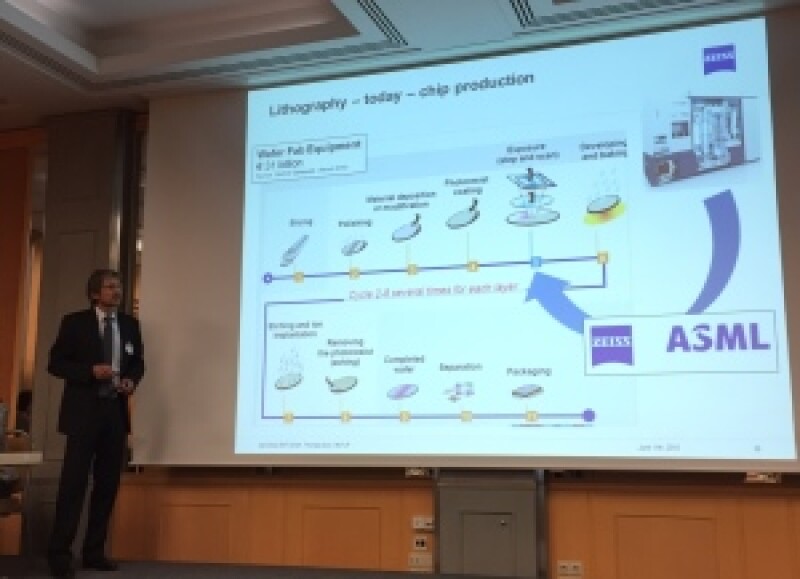
Thomas Okon of Carl Zeiss giving a presentation at the IP in Asia Forum in Munich |
Emma Barraclough recently posted about our first 2015 IP in Asia event in London. Here are a few further thoughts from the second forum, held in Munich on June 11
Don’t neglect utility models!
Perhaps because they are familiar in both Germany and China, utility models were a popular subject of discussion in Munich. Several speakers encouraged non-Chinese companies to consider filing them (at present, the vast majority of applications are by domestic entities), including Azadeh Mehrabi of ABB and Axel Tillmann of Kuka (both pictured below). The latter described utility models as “visible, ad hoc and fast” and added that one under-appreciated advantage is that they can be a cost-effective way to create prior art in Chinese. And, to many people’s surprise, the data suggests that utility models are only slightly more likely to be invalidated than invention patents.
How to prove infringement
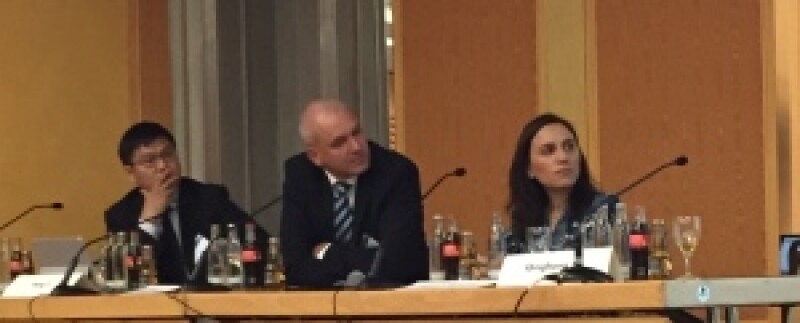
One challenge that many patent owners face when enforcing their rights in China is collecting and presenting evidence of infringement. As Xiaolin Dang of Sanyou said: “The standard of proof is very high.” In many cases, this means the collection of the evidence has to be witnessed by a government representative, notarised and carefully preserved. This also applies to evidence collected at trade fairs and in test purchases. But providing the court with examples of allegedly infringing products is not always straightforward, as Oliver Pfaffenzeller of Siemens said (only partly tongue-in-cheek I think): “Many of our cases involve technology in power plants. You would not buy a whole power plant to prove patent infringement.”
Looking north

The IP in Asia Forum covered Japan and South Korea as well as China, and both countries are introducing important changes that will affect patent owners and third parties: a post-grant opposition system in the former and changes to patent invalidation procedures in the latter. As Jehyun Kim of YP Lee Mock & Partners said, the aim is to improve the “legal stability” of granted patents, something that I’m sure all IP owners will welcome. It will be interesting to monitor developments and see whether these changes have the kind of fundamental impact on IP strategies that the PTAB procedures have had in the US.
Back to school
Akira Fujii of Sonoda Kobayashi arguably wins the prize for the most inventive slide at IP in Asia (pictured right). Noting that patent filings in the country have been falling lately, he reminded attendees of the benefits of protection in Japan, with a simple algorithm illustrating the various costs and risks involved. (At least, the patent attorneys in the room all told me it was simple …)


