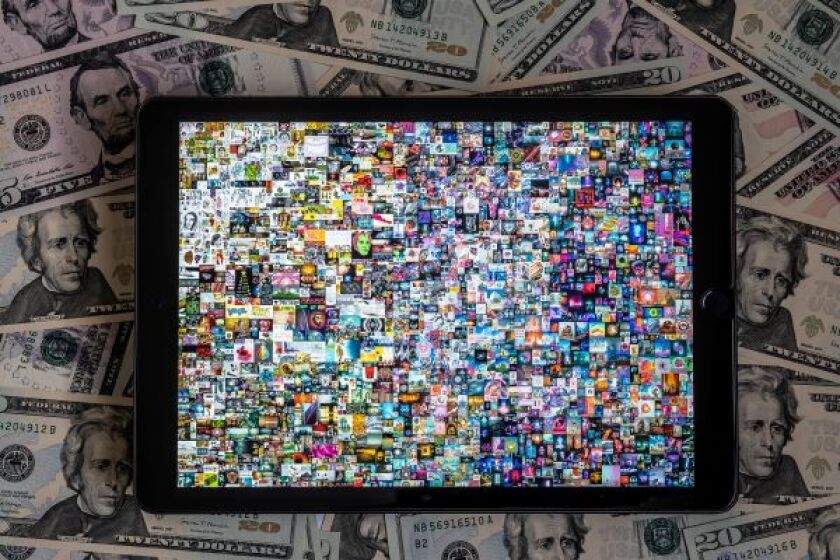
With the digital art ‘Everydays: The First 5000 Days’ selling for $69 million, Twitter co-founder Jack Dorsey’s first-ever tweet auctioning for $2.9 million, and IBM announcing plans to tokenise patents, some people’s interest in non-fungible tokens is at an all-time high.
But NFTs, a term which broadly covers unique digital assets or tokens on a blockchain, have a long way to go before they transform the trade in intellectual property assets, say sources.
Companies are mostly riding on the NFT hype and tangible changes may take time as the market is largely unregulated.
Counsel say that NFTs have huge potential when it comes to transacting and monetising IP and maybe even physical assets, but most people are uninformed and practical challenges currently overshadow the possible benefits.
Copyright case study
The NFT boom started earlier this year with digital art transactions, and the tokens are now being used by many entities from art auction houses to sports memorabilia companies.
Sources say that NFTs have helped to increase sales of digital art as they can be used as seals of authenticity.
Ezra Tay, general counsel and compliance head at cryptocurrency platform Cake DeFi in Singapore, says most digital art transactions now take place online through NFT marketplaces.
However, there is some misinformation around NFTs such as that buying an NFT grants complete ownership over the purchased asset. This is because lawyers are usually not involved in the related transactions and parties are often unaware of their rights.
“Transfer of NFTs does not represent transfer of ownership of linked assets, and typically does not result in the transfer of any underlying ownership rights, such as copyright,” adds Tay.
Guy Maevsky, Belarus-based legal adviser at Guy Maevsky Legal who has previously worked at a crypto trading platform, agrees and adds that there can be two scenarios.
“Where an NFT does not have any underlying asset, for example, if it is a collectible or a ticket, ownership right in the NFT is transferred within the transaction.”
“In the second case, where the NFT has an underlying asset such as digital artwork or music, along with ownership rights in the NFT the token may additionally represent ownership rights, an exclusive licence or a limited licence over the underlying asset,” he adds.
Simply put, an NFT can serve as an authentication certificate representing either ownership or a licence.
Sources agree that, mostly, the buyer will get a limited licence to use a work and ownership rights will not be transferred. However, much depends on the agreement between the parties.
Tay adds: “Like cryptocurrency, NFT is all about supply and demand. An NFT’s value is determined by the desirability of its linked asset, thus taking into account market demand and resale potential.”
NFTs also drive sale of art as one can attach commissions in an NFT, and in certain cases the original creator can make money every time their art is resold, thus making way for smooth royalty payment arrangements.
Patent possibilities
Trading in patents by tokenising them as NFTs is relatively new compared to NFTs’ use in digital art and copyright.
Some of the highlights, from April this year, are IBM’s announcement to collaborate with IP transaction platform IPWe to create a patent marketplace on blockchain, and Jack Fonss and his technology consulting firm True Return Systems listing US patent 10,025,797 on the NFT marketplace OpenSea.
But counsel doubt whether these developments mark a paradigm shift on the patent front.
James Wan, general counsel at an AI company in Sydney, wonders whether IBM and IPWe will be able to successfully deploy the project or add any value to the patent community. He believes that the move might be more of a publicity stunt.
“The early movers who are getting a lot of focus are trying to capitalise on the NFT hype, but we’ll have to wait and see if there’s high value for stakeholders in the future.
“What have they produced so far? How will it be an improvement over the systems that are already in place?” he asks.
He adds: “It’s not like they have addressed any burning questions around NFTs or provided any guidance on deployment of patents as NFTs.”
Wan says there are already lots of entities that auction their patents in online marketplaces and IBM’s move adds nothing new.
He also points out that despite True Return Systems having listed its patent on OpenSea in April, it has not yet been sold.
“Bringing in blockchain and NFTs is likely to further complicate issues than solve them,” says Wan. “Entities may be worse off trying to trade in patents as NFTs, as the process will be more complex than regular transactions.”
Tay believes that the scope for NFTs in patent protection is limited, as several international organisations have already developed relatively reliable and accessible online platforms.
“Putting patents on the blockchain can help with verifying content and authenticity, but would not by itself address pain points such as territorial limitations and enforcement difficulties.”
Digital disputes
Even putting aside deployment issues, there are many questions that need to be answered.
Maevsky wonders how ownership of patents represented as NFTs and bought and sold on blockchain marketplaces would be recorded before regulatory bodies or IP offices.
“If a patent certificate lists someone as its owner and an NFT represents ownership by a different entity, it is likely that IP offices and courts will accept the patent certificate as valid – and not the NFT.”
Even for recordal of ownership purposes, it is unlikely that patent offices will count NFTs as valid proof.
Additionally, most jurisdictions do not have any regulatory framework in place for dealing with NFTs.
“Unless use of NFTs becomes more commonplace and proper regulations are in place, it is unlikely that NFTs will have any impact on contentious IP issues or be used ordinarily for IP transactions,” Maevsky adds.
“IP offices need to come up with some mechanism to actually recognise NFT-based transfers. Until that happens, NFT owners will not be able to initiate infringement proceedings.”
Wan at the Sydney-based AI company agrees there are too many nuances that need to be addressed in the intersection between NFTs and IP, including regulation of royalties.
“It is technically possible to trade in assets through smart contracts within NFTs, however, will electronic signatures really be sufficient for courts when it comes to enforcement?”
Tay says another challenge is that lawsuits involving digital assets go to regular dispute resolution forums, adding: “It may take some time for judges around the world to understand blockchain and crypto, especially those in less developed countries.”
The way forward
Before NFT’s relevance in the IP space becomes clearer, counsel say that the first step is to educate people as there is a lack of knowledge about what NFTs are and how they work.
Max Ng, managing director at Gateway Law in Singapore, says people do not understand NFTs’ value proposition yet. Even buyers and sellers do not completely comprehend what they are transacting and the associated risks.
“NFTs are like status symbols to investors, who believe that they have acquired a one-of-a-kind collectible, and NFT purchases are akin to trophy purchases.”
However, he believes that the situation will change in the future as NFTs develop and stakeholders have more clarity.
Abhishek Singh, Bangalore-based senior legal counsel at cryptocurrency trading platform CoinSwitch Kuber, predicts NFTs will follow a similar path to cryptocurrency and will be used for buying many more products and services in the future, and that traders will need regulated exchanges.
Much also depends on how NFTs are categorised – whether as a currency, an asset, security or stock – he adds.
While NFTs may offer exciting opportunities for some, they do not seem to be setting the IP world alight – for now, at least.