
Generics find creative solution to ‘divisional game’
Intellectual property lawyers from generics companies claim that innovators game the system by filing divisional applications and then withdrawing a parent patent just before an opposition hearing on its validity.
In February this year, Mylan asked the Munich District Court for an injunction against Teva to stop the company from withdrawing patents to MS drug Copaxone before any future appeal hearings on validity at the EPO.
The German court granted the injunction and ruled that Teva had previously demonstrated anti-competitive behaviour by withdrawing a patent from an opposition hearing because it denied generics the opportunity to get final certainty on the patent’s validity.
Other Managing IP stories we published this week include:
New USPTO trademark head: leading in COVID is ‘a marathon’
DoJ antitrust head: ‘my resolve on SEP rights is even stronger’
AIPPI: ‘What is overly broad is in the eye of the beholder’
Don’t rely on social media usernames, brands told
AIPPI: Copyright fair use exemptions will expand after COVID
Lawyers ponder impact of COVID cocktail lawsuit
Exclusive: DoJ antitrust chief reveals plans to leave in 2021
In-house: AI patenting is becoming more challenging
Panel: ‘Don’t get branded as just an IP person’
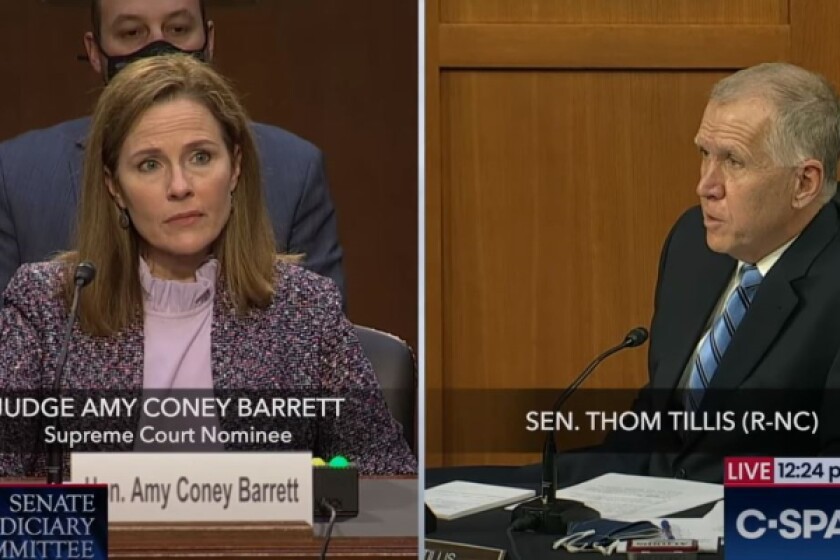
Senator Tillis: trailing by five points in one poll; questioning Coney Barrett on IP
The Republican senator for North Carolina has been confronted by a steady lead from Democratic candidate Cal Cunningham since September, according to the same poll. A loss for Tillis would be a huge boon for the Democrats but a considerable loss for the IP subcommittee.
On Wednesday, October 14, Tillis questioned US Supreme Court nominee Amy Coney Barrett on IP matters, including antitrust and patents, patent eligibility and copyright.
“There is no question that we are the leader in the world, but in recent years we’ve seen a lot of Supreme Court cases that have weighed into patent eligibility produce a series of opinions that have really muddled the waters and in some cases,” he said.
“I think that I agree with the decisions, but I worry about the methodology they use to get there.”
Tillis also noted that during recent sessions on copyright reform, one witness said that the US’s current laws are 'Myspace laws in a TikTok world'.
Coney Barrett admitted that she wasn’t well versed on the antitrust case in question, FTC v Qualcomm, nor on matters of patent eligibility. She noted that the points Tillis raised on copyright seemed to be a matter of policy that should be addressed by the legislature.
German parliament refers UPC bill to committees
A second decisive reading in the Bundestag is expected later this month or early in November. If all goes well, UPC ratification should go through parliament during the discussion on the 2021 budget, which a large number of members of parliament are guaranteed to attend.
The UPCA’s first ratification was declared to be invalid by Justice Peter Huber. He broke the news to Managing IP last year that he would decide the UPC case in early 2020, because it wasn’t approved by the requisite two-thirds majority of the members of the Bundestag in 2017.
Only 35 parliamentarians were present at the time.
That ruling was held up for more than two years by a constitutional challenge, filed by Düsseldorf IP lawyer Ingve Stjerna in 2017. Should the UPCA be ratified again, another constitutional challenged is expected to swiftly follow.
SCOTUS accepts Arthrex petition
The high court consolidated the cases and chose to consider only the first two questions in the federal government’s memorandum of July 22 in both Smith & Nephew v Arthrex and Arthrex v Smith & Nephew.
The first question is whether APJs at the USPTO are either principal officers who must be appointed by the president with the Senate’s advice and consent or inferior officers who can be appointed by a department head.
The second question, if administrative patent judges are principal officers, concerns whether the Court of Appeals for the Federal Circuit properly cured any appointments clause defect in the current statutory scheme.
SCOTUS declined to consider the third question, however, which asks whether the appellate court erred by adjudicating an appointments clause challenge in Arthrex that had not been presented to the agency.
Managing IP will publish further analysis on this topic, including why SCOTUS chose to accept this petition and how its ruling could change the IP landscape, next week.
IP senior associate becomes one of UK’s youngest judges
Jason Raeburn, who is 32, will work part time in his new position in the court’s Chancery Division while continuing to practise for Baker McKenzie in the firm’s London office.
Raeburn, who represents clients on complex technology disputes and has a particular focus on copyright, patents, trade secrets and the global co-ordination of IP litigation strategies, has a postgraduate diploma in IP law from Oxford University.
He trained at Baker McKenzie and qualified as a solicitor in 2012.
Trump targets e-commerce counterfeits
Trump’s presidential order, called the Memorandum on Stopping Counterfeit Trafficking on E-Commerce Platforms Through Fines and Civil Penalties, sets out that the attorney general and the secretary of homeland security should seize counterfeit goods imported to the US.
They should do this by imposing the maximum fines and civil penalties permitted by law on any e-commerce platform that directs, assists with, or is in any way concerned in the importation of counterfeit goods into the US.
Trump also directed the secretary of homeland security and attorney general to develop a legislative proposal to promote the policy objectives of the memorandum.




