Who's up, who's down - the EPO reveals its filing figures

Managing IP is part of Legal Benchmarking Limited, 1-2 Paris Gardens, London, SE1 8ND

Copyright © Legal Benchmarking Limited and its affiliated companies 2026

Accessibility | Terms of Use | Privacy Policy | Modern Slavery Statement

Cookies Settings

Who's up, who's down - the EPO reveals its filing figures

patent-filings-45.jpg

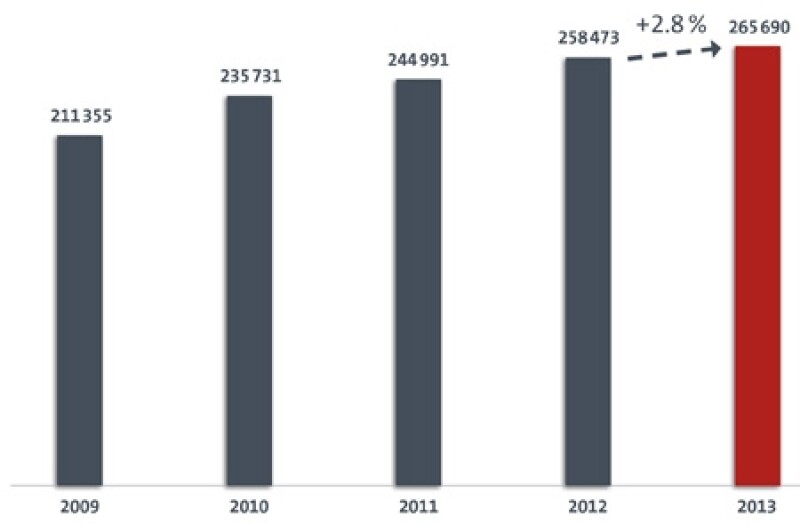
Patent filings at the EPO have continued their steady upwards growth, with the Office reporting the fourth consecutive year of highest-ever patent filing figures

filings20small.jpg

The EPO received 266,000 patent applications last year, up 2.8% on 2012. It granted 66, 700 European patents, which was 1.6% more than in 2012 and the highest number ever.

Applicants from the EPO’s 38 member states made up just over one-third of patent filers at the Office, a figure unchanged from last year. Of non-EPO country applicants, those from Asia continue to file growing numbers of applications. Those from China were up more than 16% and those from Korea up 14% on the year before.

The figures present a mixed picture for innovation within Europe. Of the big filing nations, applications from the Netherlands soared by 17%, with figures from Denmark up 7% and Sweden up 7.5%). From a rather smaller base, filings from Portugal and Turkey grew by around one-third, from the Czech Republic by one-quarter and from Ireland by almost 10%.

Filings from Belgium, Germany, the UK, Italy, Switzerland and Spain fell in 2013, however, with falls ranging from 7.4% (Belgium) to 1% (Spain).

With 2,883 applicants, Samsung easily beat its nearest patent filing rival (Siemens, with 1,974 applications) into second place. Philips, LG and BASF took the next three spots.

In nine of the 10 top technical fields, applicants from Europe filed the greatest numbers of applications with the EPO, which the Office said reflected Europe’s “balanced and wide-ranging patent portfolio”. European companies took over the top spot from US applicants in the field of medical technology, while the computing category was dominated by the US, which filed more than one-third of applications. Japan was strong in electrical machinery (with 25% of the EPO’s applications) and transport (22%), but China led in digital communication (15%).

The full data is contained in the EPO's Annual Report.

more from across site and SHARED ros bottom lb

More from across our site

The firm says it hopes to capture patent litigation work in Texas by arming itself with experienced trial lawyers with venue expertise
Ken Iijima's arrival continues a trend of ex-Pizzeys practitioners joining RnB IP, whose co-founder says independent ownership and a lucrative compensation model have become attractive in a consolidating market
McDermott Will & Schulte lawyers explore why the UPC is seeing rapid adoption by medtech for fast-moving disputes, while pharma and biotech take a cautious, selective approach over revocation risks
IP firms may be growing more comfortable with external capital, but uncertainty over who could ultimately own the business is complicating the investment pitch
The former Western District of Texas judge addresses perceptions of his courtroom, reveals what comes next as he returns to practice at A&O Shearman and explains why marathon running is ‘cathartic’
International Anti-Counterfeiting Coalition says it has been blocked from hosting its annual event in the city, ending a long tradition of holding the gathering in the days leading up to INTA’s flagship event
The ITC is a powerful tool for litigators, practitioners say, as the threat of an exclusion order on a critical tech component could mean disrupting the entire data centre's operations
Anna Toh plans to expand Rajah & Tann’s soft IP capabilities, leveraging its Southeast Asia network to support clients on cross-border portfolio management and commercial strategy
The Canadian boutique’s new IP lead says he wants to build a tech-enabled IP practice aimed at giving startups senior expertise away from the traditional ‘big law’ set-up
Qantm IP’s acquisition of Henry Goh & Co shows shifting attitudes towards private equity, with firms increasingly viewing external backing as a normal route to expansion rather than a source of concern
Gift this article
