Discount supermarkets make trade mark push

Managing IP is part of Legal Benchmarking Limited, 1-2 Paris Gardens, London, SE1 8ND

Copyright © Legal Benchmarking Limited and its affiliated companies 2026

Accessibility | Terms of Use | Privacy Policy | Modern Slavery Statement

Discount supermarkets make trade mark push

supermarkets-55.jpg

Discount supermarket chains may be associated with trade marks for all the wrong reasons, but new figures suggest they have been busy filing marks of their own

Supermarket trade marks

Many brand owners have become increasingly concerned about the way that some discount chains, including Aldi and Lidl, use so-called lookalike packaging to sell their own versions of market-leading products (Aldi famously used the tagline “Like brands. Only cheaper” in one of its advertising campaigns).

But figures published by law firm RPC show that discount supermarkets filing far more trade marks for new products than their market share would suggest.

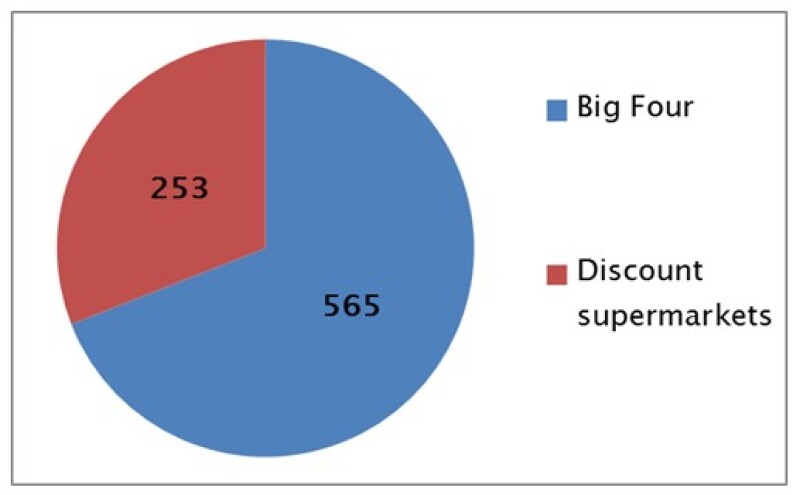
RPC says that Aldi and Lidl have registered 253 trade marks in the UK in the past five years – almost half as many as the 565 trade marks registered by their big four rivals (Tesco, Asda, Sainsbury’s and Morrisons), despite having a combined market share of just 8% compared to 73% for the big four.

The discount supermarkets also outperformed in registering Community trade marks, with Aldi and Lidl registering 112 trade marks in 2013, compared to just 40 trade marks registered by their big four rivals.

The trend reflects the rapidly changing grocery market in the UK, which is seeing the country’s large supermarket chains battling for market share with so-called hard discounters.

RPC’s Jeremy Drew, who heads the firm’s retail team, said that the data suggests that the discount supermarkets’ new product brand pipeline is running at a faster rate than that of their bigger rivals.

“Within discount retailers in particular the growth of own brand products, which often appear as if they are independent brands, can protect or increase margins and reflect innovation to meet consumer demand.”

“In retail, sometimes being able to develop a new product line quickly can be just as important as having a large number of different product lines on the shelf already.”

You can read more about litigation between brand owners and supermarkets in Managing IP, including an IP Clinic offering advice on dealing with lookalikes sold by discount stores.

more from across site and SHARED ros bottom lb

More from across our site

Ranjna Mehta-Dutt, who moved to Chadha & Chadha after 25 years at Remfry & Sagar, says the firm plans to expand its life sciences practice through targeted recruitment and dedicated teams for bigger clients
The initial contempt of court claim targeted Stobbs and the firm’s client for allegedly interfering with the administration of justice
Acquisition of platform developed by Boehmert & Boehmert lawyer set to create a combined platform for patent drafting and prosecution in Europe
Partner Rob Jacob unveils plans to offer a beginning-to-end trademark service, how to make prosecution profitable, and why IP ‘buy-in’ from the CEO stands the firm in good stead
Sponsored by CAS
CAS provides practical pointers on how intellectual property and R&D teams can work in tandem to unlock tangible benefits and avoid wasted spend
Sponsored by CAS
CAS explores how AI is transforming intellectual property, from inventorship and copyright disputes to new demands on patent attorneys
Sponsored by That.Legal
Gillian Tan of That.Legal discusses a recent decision by the Intellectual Property Office of Singapore and what it reveals about the evidential burden in bad-faith trademark claims
Attorneys at Di Blasi, Parente & Associados share how the protection of trade secrets strengthens innovation by bringing together legal practice, regulatory developments, and established international references
Jin Ooi, who joins as a partner today, said he is excited to offer a ‘rounded’ IP service as the firm deepens its litigation expertise in the UK and Europe
As generics celebrate, practitioners believe innovator companies should brace for an ‘uphill battle’ when trying to prove induced infringement
Gift this article
