
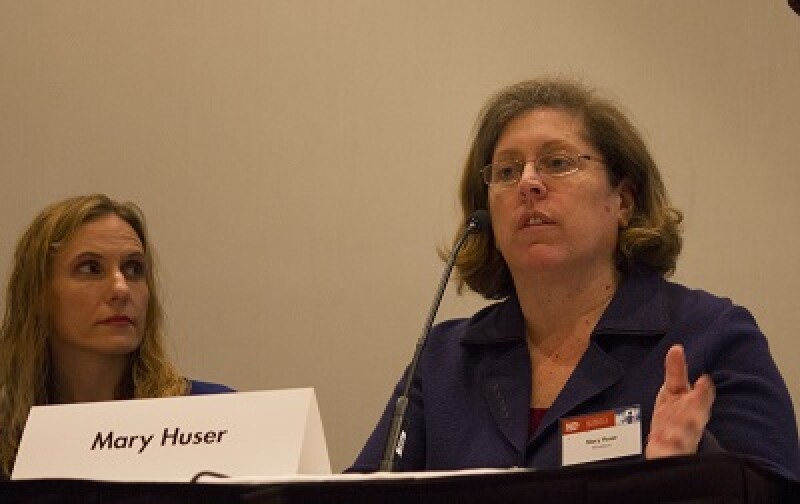
Speaking at the International Women’s Leadership Forum in San Jose last week, Mary Huser, general counsel, BlackBerry Technology Solutions (pictured, right of picture with Alexis Garcha), claimed there was a fatigue within the legal profession caused by having to deal with high numbers of lawsuits filed by non-practising entities.
“Last year was a watershed for the explosion of NPE activity. Maybe there was some nugget in some cases but most were completely frivolous,” she said.
Huser said that the America Invents Act (AIA) had provided operating companies with more tools to fight back, including new rules on fighting patent validity before the PTAB.
“Many NPEs are public companies that need to present quarterly reports just like any other company. The threat of a two-to-three-year delay is a real threat. The AIA presents a practical tool. If we can show prior art, the potential level of damages exposure and so on, and lay it out at the start, if we tell them we will go to the PTO and litigate for a few years – then that presents a nice little leverage for settling early.”
The downside of such an approach, said Huser, is the risk that the plaintiff will file amended claims: a risk that must be assessed strategically.
But while she welcomed the impact of parts of the AIA, she argued that courts must be more proactive in tackling frivolous litigation.
“I have encouraged judges to develop local rules to deal with the administration of cases. There has to be a real motion to dismiss stage. That would ensure that non-meritorious cases would not go forward.”
But Alexis Garcha, senior IP litigation counsel at Nokia, told the audience that there are important reasons for protecting innovation.
While she acknowledged that some people now no longer regard Nokia as an operating company, after it sold its handset business to Microsoft last year, she said that the company still has valuable intellectual property.
“I am wary of too much patent reform, Garcha said. “Patent aggregators actually have a value. Frivolous patent suits are an abuse but we don’t want to prevent everyone from enforcing their patents.”




