We generally perceive the trademark world as being relatively stable and resistant to change. National trademark legislation typically changes only once in a professional lifetime; official fees stay the same for many years (and in recent times are more likely to be lowered than increased); and because trademarks closely track commercial activity, trademark filing volumes follow economic trends and tend to grow at a steady but unexciting pace over time.
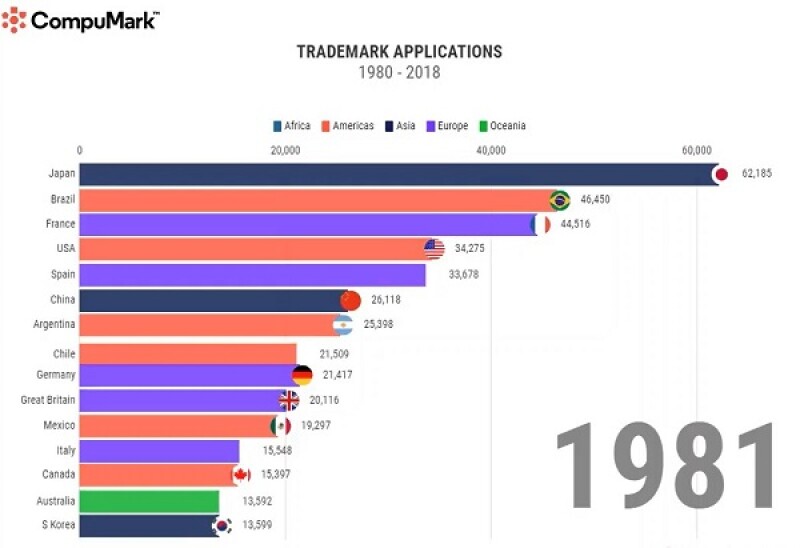
Looking at a snapshot from 1981 would look familiar to a trademark practitioner in 2019: the US, China, Japan, France and Brazil were among the world’s six largest trademark registers by filing volume, with Germany, Canada, Mexico, South Korea, Argentina and the UK in the top 15.
But a close look at the actual filing volume would be surprising. In 1981 the USPTO received just over 34,000 new trademark applications, while the Chinese Trademark Office (now CNIPA) received just over 26,000 applications – numbers that by today’s standards seem unbelievably low (see Figure 1).
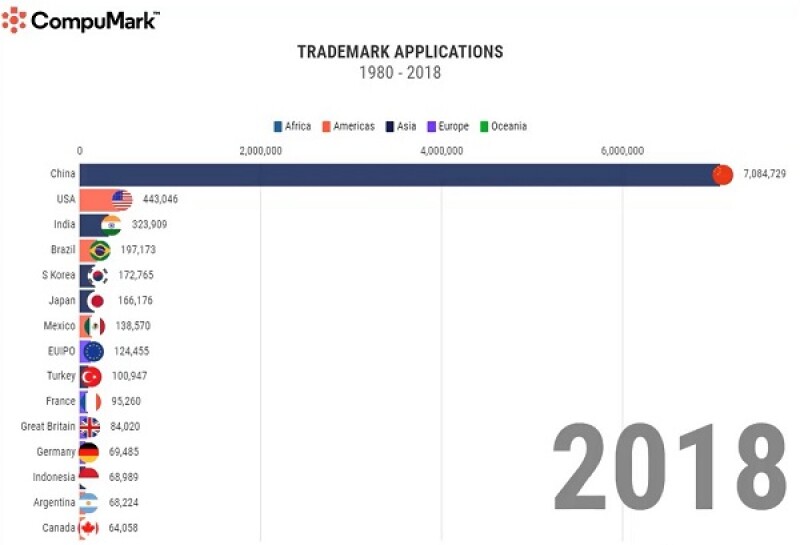
Fast forward to 2018, and the picture looks very different. While the same basic set of countries appear in the top 15, the relative volumes are unrecognisable in 1981 terms (see Figure 2). The USPTO received over 440,000 trademark applications in 2018 – nearly 13 times as many as were filed in 1981. Other major registers saw filing activity increase by a factor of three or four. And then there is China. The numbers are simply remarkable.
· In 2018 CNIPA received over seven million trademark applications, over 270 times more than in 1981.
· In 2018 the EUIPO – which did not come into being until 1996 and is now the eighth largest register in the world by annual filing volume – received 124,000 applications. To put things in context, China received 124,000 applications every week.
· In 1981 there were 26,000 applications filed in China; in 2018 China received 26,000 trademark applications each working day.
· There were 10 million trademark applications filed around the world in 2018 – 70% of these were in China.
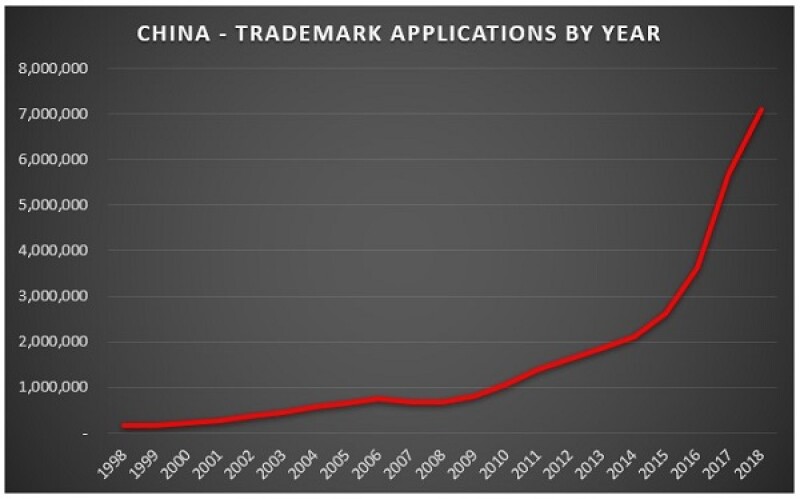
In 2010 China became the first register to receive one million trademark applications in a single year; four years later, in 2014, the two million mark was passed; and it took only two more years to reach three million applications. After 2016, volume was increased at an ever faster rate, with 5.6 million applications filed in 2017, and over 7 million in 2018. This accelerated growth was spurred by CNIPA’s decision, effective April 2017, to cut the official filing fee in half, which saw filing volume double in the second half of the year on the Chinese register (see Figure 3).
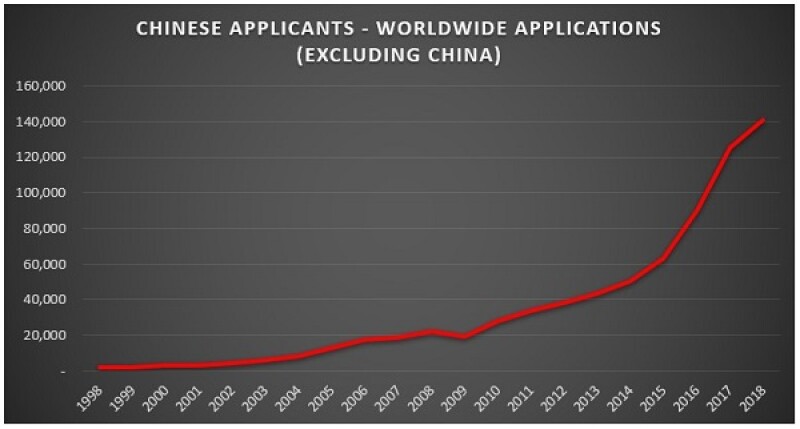
Chinese brand owners have also been increasingly active in foreign markets (see Figure 4), with trademark filing volume worldwide (excluding mainland China) showing a sharp increase in recent years. Chinese applicants filed over 140,000 ‘foreign’ trademark applications in 2018, including:
· over 50,000 applications on the US register (more than 10% of all applications received by the USPTO).
· over 12,000 EUTM applications (ahead of US-based applicants who filed 11,000 EUTM applications in 2018).
· 7,500 applications in Japan.
· 6,500 applications at WIPO for international registrations.
· 6,000 applications on the UK register.
Even the change to allow the filing of multiclass applications in China in 2014 failed to slow down growth, although this is in part due to filing behaviour not changing significantly – in 2018 over 98% of trademark applications in China only covered a single class.
While the huge increase in Chinese trademark activity – both on the Chinese register and on registers around the world – is generally viewed positively, there are signs that the exponential rate of growth may be having an impact on quality. Trademark filing activity around the world generally tracks economic activity, with a good correlation between economic expansions and contractions in each country and activity on the national trademark register.
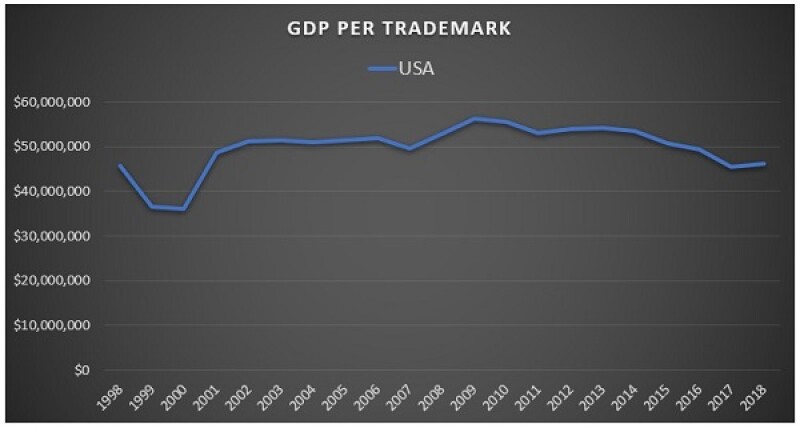
Using Gross Domestic Product (GDP) as a measure of economic activity, we can see that there has been a relatively stable correlation in the US between GDP and trademark filing volume at the USPTO, with each trademark application in the US representing approximately $50 million of GDP (see Figure 5).
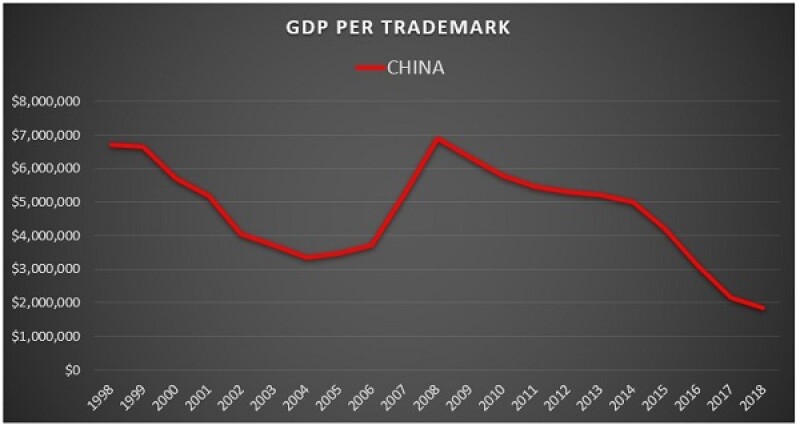
The position with China is very different. Although the Chinese economy has experienced phenomenal growth for over 20 years, each Chinese trademark still only represents less than $7 million of GDP, and the trend since 2008 has seen that value fall to a low of under $2 million of GDP per trademark. This suggests that the value of a typical trademark in China is significantly lower than a US trademark, and the gap is increasing (see Figure 6).
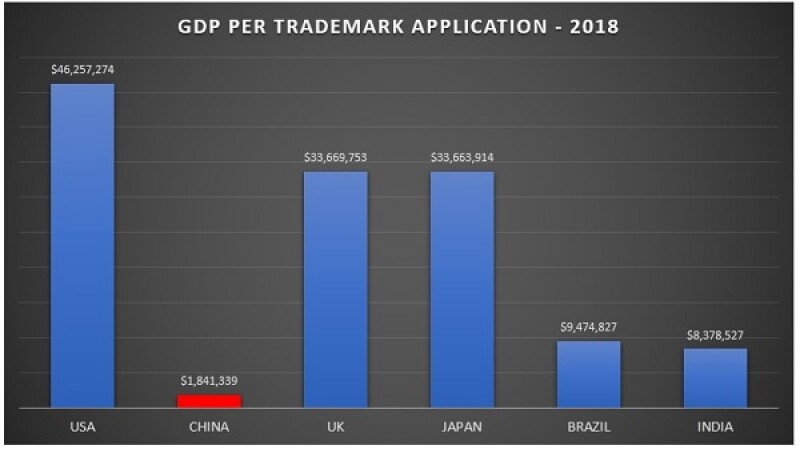
And it’s not just the US that is well ahead of China in terms of GDP per mark. The UK and Japan both had an average of $33 million of GDP per trademark application in 2018, while fellow BRIC members Brazil and India were both nearly $10 million of GDP per application (see Figure 7).
The final indication that the spectacular growth from China might not be a clear-cut success story stems from the recent changes announced by the USPTO:
· A possible requirement to use a US-qualified attorney as a representative for new US trademark applications (there is strong recent trend for Chinese applicants to self-file in the US and provide a correspondence address in China).
· The use of technology to monitor for edited photos submitted as specimens of use to support a US trademark application.
· An amended growth forecast by the USPTO for 2019/2020 for minimal or even negative growth in filing volume against double-digit growth in recent years.
Taken together, the evidence suggests that the USPTO believes that they need to improve the standard of applications received from foreign applicants, and that a significant factor in the growth we’ve seen in recent years on the US trademark register has been activity that is not necessarily felt to be positive.
The indications from the first quarter of 2019 suggest that growth in Chinese trademark activity – both domestic and international – is starting to slow, but such is China’s current dominance, that it may be many years before the 2018 picture starts to look any different.
Robert Reading is director of professional services and strategy at CompuMark, a trademark research and protection provider.