

Powell Gilbert made a statement of intent when it announced in September last year that it was opening in Düsseldorf.
The UK firm’s first office in continental Europe also heralded the arrival of renowned patent litigator Andreas Kramer, who joined from Vossius & Partner.
Setting up shop in one of the Unified Patent Court’s (UPC) busiest jurisdictions, and with a marquee hire, was a clear signal of intent from the UK-headquartered firm that it was taking the UPC seriously.
However, the firm’s UPC vision in fact dates back many years.
When Powell Gilbert was set up in 2007, formed by five breakaway Bristows partners, it was already adopting a strategy that lent itself well to what was to come, according to Alex Wilson, one of those co-founders.
As Wilson explains, the firm was doing a lot of international strategy and litigation work. It would handle the UK side of proceedings but also help to coordinate and implement clients’ strategies across Europe with partner firms.
“Our approach was always to embed ourselves with local teams,” Wilson notes.
“By doing that, you build up a sense of what makes a case successful in a jurisdiction. You become part of the team, rather than merely telling another firm: ‘Run this case’.
“You also get to understand the nuances and advantages of each system, which lends itself well to how the UPC operates,” he adds.
The firm was involved from the earliest stages of UPC development. It helped to draft ethics and conflicts rules and assisted with the training of judges. Another co-founder, Penny Gilbert, was a former president of the European Patent Lawyers Association.
After the UK opted to leave the EU and subsequently the UPC, there were fears that UK-based firms could have their UPC capabilities curtailed. According to the UPC’s rules, lawyers seeking to appear before the court must be authorised to practise before a contracting member state.
This led to the firm opening a Dublin office in the days leading up to the UPC’s launch in June 2023. The firm’s lawyers also obtained Irish practising certificates to ensure it could handle UPC work.
Here and now
Today, the firm is one of the key players at the forum.
All 16 partners, as well as several associates, are UPC representatives. The firm has been involved in multiple cases before the court’s various divisions, acting for clients including Ocado, BioNTech, Edwards and AIM Sport Vision.
In a major win in July last year, Powell Gilbert (working alongside the German firm Thum & Partner) represented Edwards Lifesciences in its wide-ranging enforcement against Meril.
Its success at the forum led to it winning ‘UPC Firm of the Year – UK’ at Managing IP’s EMEA Awards 2026, held last month.
Wilson believes the firm’s spread of activity across the various local divisions (see chart below) can be traced back to those early years in which it developed pan-European expertise.
“We never believed that the UPC would be a uniform jurisdiction, which I think some people can be guilty of thinking,” he says.
“At the UPC, you are not dealing with a single jurisdiction; there are multiple judges from different legal traditions, each with different ways of doing things.
“To be successful, you must understand on a deep level how the different systems work and how to embrace the cultural mosaic,” he adds. “Often, we would spend many months embedded in teams.”
Wilson notes that while other firms might be working on multiple cases, in reality, these are sometimes restricted to just one or two divisions, notably in Germany.
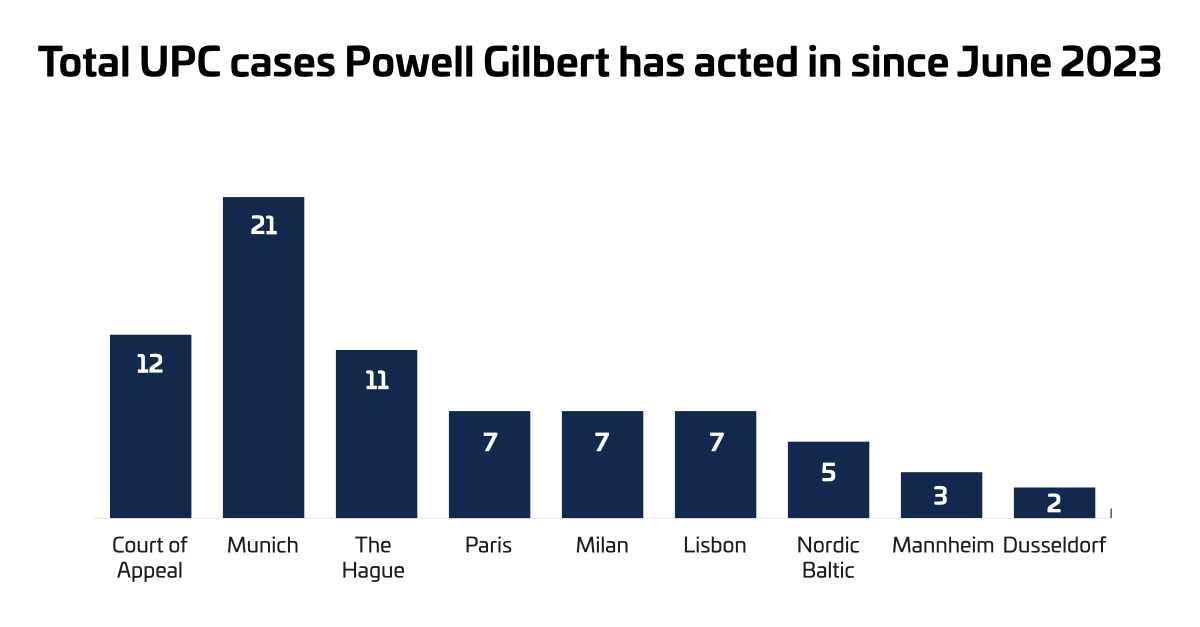
Some firms, the lawyers suggest, rely too much on an influx of cases in Germany or have siloed teams operating in different courts, but who have limited contact, instead of spreading their expertise.
On opening in Germany, Wilson notes the jurisdiction has “always been a very important patent litigation centre”, but that the firm didn’t want to set up an office for the sake of it.
“It was only if we found the right individuals who share our vision of the UPC. We did that with Andreas and his team,” he adds.
Kramer was seen as a coup upon his arrival, having joined from the renowned German litigation firm Vossius in September last year. Kramer, who had been a partner at the firm since 2018, has also been ranked as a ‘patent star’ by Managing IP’s IP STARS since 2019.
At the UPC, Kramer, Wilson and Powell Gilbert partner Ari Laakkonen are acting in a series of recent high-profile disputes for client Transsion against Ericsson, pitting them against Wim Maas of Winston Taylor. Other telecoms clients of Kramer include Oppo, while he also represents brands including Disney and Adobe.
Size matters … or does it?
Since opening in September 2025, the Düsseldorf base has grown from three to six lawyers, despite the firm acting in only two cases at that UPC hub.
Now almost a year into his new role, Kramer says he was attracted by the firm’s integrated approach to case management.
“I’ve been struck by how the firm has worked together as a team between the London and Düsseldorf offices … which confirms our integrated team approach,” he says.
Still, though, in terms of sheer European office presence, the firm is smaller than some of its counterparts competing for UPC work. Hoyng Rokh Monegier, Taylor Wessing, and Simmons & Simmons, for example, have presences in virtually every UPC member state.
But Kramer believes size isn’t always the answer.
“If you look at big international firms that have offices everywhere, but do not work as an integrated team – likely due to structure – that does not incentivise working across the teams.”
Indeed, Wilson sees Powell Gilbert’s lack of presence in some markets as an advantage.
“In a way, the geographic location of an office in the UPC should be irrelevant,” he says. “The location doesn’t really matter, but understanding national differences in approach is still important.”
He adds: “We didn’t have that legacy of having offices in several different cities with the risk of internal competition, which can come in the UPC world. There’s no sense in having silos.”
Some full-service firms operate the ‘eat what you kill’ model, whereby lawyers are individually compensated on the revenue they generate rather than the team as a whole.
Kramer notes: “The UPC is not well-suited to this model. You would assume there would be mixed teams handling UPC work [at big full-service firms], but often there isn’t.”
For Kramer, the early years of the UPC will be decisive in terms of perception about which firms are leading the way.
“We really appreciate that we have been actively approached for high-stakes UPC work by existing clients as well as those that have become clients in the meantime.”
Wilson adds: “We are often asked how we got here – it was commitment over a long period, knowing that the UPC would become a central component of international patent dispute resolution.”
For Powell Gilbert, the message to rivals is clear – it’s integration, not separation, that matters.





