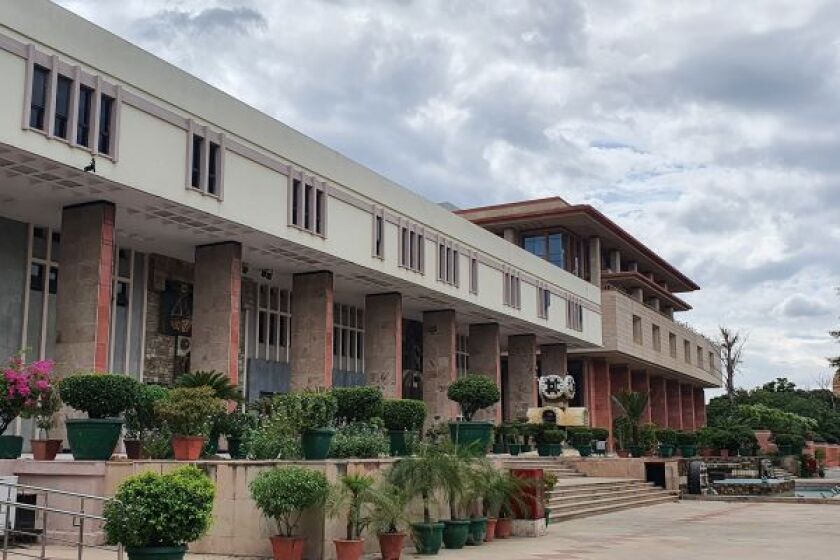
It’s been a year of records for patent litigation in India.
In April, the Delhi High Court handed down its largest-ever damages award for a standard essential patent case.
More recently, the same court has awarded a record ₹217 crores ($26 million) in damages to Canada-based technology company Communication Components Antenna (CCA) following its dispute against Chinese rival Mobi Antenna Technologies.
The award, handed down in court on May 16 but published on May 28, is believed to be the highest-ever patent damages granted in India based on lost profits.
The suit, which lasted for more than 14 years, was initially filed by TenXc Wireless in 2010. TenXc then sold its assets and transferred the patent-in-suit to CCA sometime between December 2011 and January 2012.
CCA was brought on record as the plaintiff in 2013.
The dispute concerned the company’s patent for ‘Asymmetrical Beams for Spectrum Efficiency’. The patent covered technology that allowed multiple users to use the same spectrum without compromising call quality.
Mobi Antenna sought to invalidate the patent to escape the infringement claim.
In 2021, the Delhi High Court found the defendant’s arguments on invalidity untenable. However, it went on to hold that CCA's patent was invalid because of insufficiency of disclosure, despite this ground not being pleaded by the defendant.
However, on appeal, a division (appellate) bench of the Delhi High Court overturned the decision on insufficiency of disclosure.
Finally, in last month's ruling, Justice Jyoti Singh ended the 14-year dispute by awarding record damages to CCA.
Sim & San partner Sidhant Goel and senior partner Mohit Goel represented CCA. Managing IP sat down with the pair to understand the strategy that led to securing the precedential win.
How did you come to work on this case?
While the case was filed in 2010, our clients engaged us in 2015. The clients directly reached out to us before the trial was set to begin. We are known for our trial experience and computation of damages is a sweet spot for us. Word of mouth spread, and that’s how we got the case.
What were the most challenging aspects of litigating the case?
The most challenging part was undoubtedly the computation of damages because this was a case in which the defendant was not forthcoming concerning the sales they had made. Our client had lost the entire market share it had before the infringing activities started. Reconstructing the market it had lost on a hypothetical basis was one of the biggest challenges.
But that’s also what tipped the scales in our favour because the robust evidence we presented helped establish that the market share lost by our client could not be ignored.
Eventually, a civil case is won or lost on a balance of probabilities. So, when information is not forthcoming from the defendant, and a plaintiff presents a plausible, reasonable, and conservative view of what the lost market share would have been, the court has no option but to accept that.
We believe over the past many years in the intellectual property litigation space in India, people have not made an effort to understand what is required to get an award on compensatory damages and lost profits.
You have to first prove the lost market, then prove the lost profit per unit, which can be calculated from the average retail price and the average cost price of the product. After that, computation of the lost market becomes simple maths.
How did you decide on the approach to take while estimating the lost market and the lost profits?
Where we may have an edge over other IP practitioners is that we also have a significant commercial litigation background and we've been involved in a lot of high-stakes arbitration work where computation of lost profits and damages claims are a run-of-the-mill situation.
So, it was like trying to merge two legal dimensions and come up with a solution that is tailor-made for IP cases. That is where we started with the research and building the evidence.
Of course, we got tremendous help from our client in terms of getting the documents and the right witnesses who could depose on the lost market share. We probed and dug out a presentation made to the board of the investors of the plaintiff and used the numbers from that presentation as the basis for calculating our client’s lost market share.
Of course, we corroborated those figures with other publicly available information that demonstrated that the numbers we had taken were conservative and reasonable.
Do you recall any times when things didn't go as planned? How did you deal with that situation?
There were definitely multiple situations like that.
The biggest blow came when our client’s patent was invalidated. Everything came down like a pack of cards.
But holding our position in that time of disarray helped show the character of our firm, the character of our client, and their trust in the firm. We went for an appeal and got the invalidation decision overturned. After that, as they say, the rest is history.
What was arguing the case at trial and cross-examination like?
Because we are trial lawyers, we were able to conduct cross-examination ourselves. We knew what we wanted to argue during the final arguments. So, we were able to imagine how to present the cases to the witnesses to get the correct answers that would eventually help in laying the landmines that could be detonated at the final argument stage.
The entire journey was enriching and very satisfying. That is the kind of preparation required to deal with a matter of such a scale that has many technicalities.
You will notice from the judgment that we have got admissions from the other side’s witness on every claim term that we wanted to eventually rely upon in the final arguments. This does not happen by chance, it happens by design.
You have to think about what you would eventually have to argue to win the case on merits and reverse engineer steps back.
One golden rule of cross-examination that we are all taught as trainees is never ask a question if you don't know the answer. So, preparing for the questions and having the depth of knowledge to know what the answer would be is what is required to win a trial.
What advice do you have for lawyers handling similar cases?
A legal case is like a drama – you have to be prepared and do rehearsals every day. To win a case, you need to play out the scenarios internally so that you are well-prepared for whatever contingencies may come up. It’s all about making sure that you are well-prepared for the case
To read the previous instalment of our ‘Behind the case’ series, in which we spoke to Lex Lumina about securing a precedential victory in a design patent case involving spare automobile parts, click here.