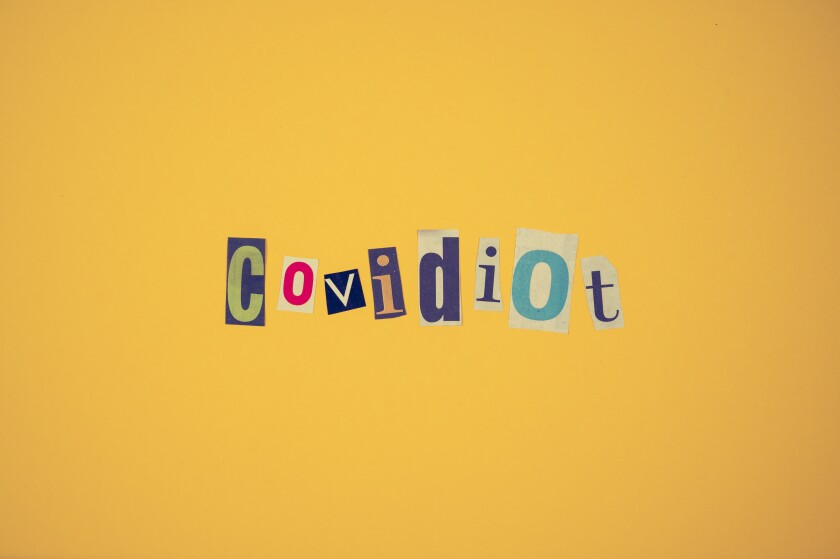
EUIPO’s Grand Board of Appeal rejects ‘Covidiot’ application

Managing IP is part of Legal Benchmarking Limited, 1-2 Paris Gardens, London, SE1 8ND

Copyright © Legal Benchmarking Limited and its affiliated companies 2026

Accessibility | Terms of Use | Privacy Policy | Modern Slavery Statement

EUIPO’s Grand Board of Appeal rejects ‘Covidiot’ application

Ausgeschnittene Zeitungsbuchstaben auf neutralem Hintergrund bilden das Wort Covidiot

The Grand Board said the applied-for mark would ‘trivialise’ one of the deadliest pandemics in history

The term ‘Covidiot’ is contrary to accepted principles of morality and should not be registered as an EU trademark, the EUIPO’s Grand Board of Appeal has found.

In a decision handed down earlier this month but published on Sunday, May 26, the Grand Board (GBoA) said the applied-for mark must be refused because when used in conjunction with goods and services including games it would “trivialise” one of the deadliest pandemics ever “in a way that is contrary to human dignity and accepted principles of morality”.

The board also found that the applied-for mark was devoid of any distinctive character, which was another ground for rejecting the mark.

The case has attracted much attention among commentators. In 2022, INTA submitted an amicus brief that suggested a legal rethink over the morality debate might be required.

A portmanteau of Covid and idiot, the term ‘covidiot’ has been used to describe people who reject, ignore or question public health advice about Covid. It is often used in a derogatory fashion on social media.

The application, filed by German games developer Matthias Zirnsack, was rejected by the EUIPO in December 2020. The trademark filing covered classes 6, 9, and 28. Those classes include, among other things, software and games.

The examiner refused to register the mark at issue on the basis that it would be contrary to accepted principles of morality and would fall within the absolute ground for refusal set out in Article 7 (1)(f) EU Trademark Regulation.

The applicant appealed against that finding and, by interim decision in December 2021, the First Board of Appeal referred the case to the GBoA because of its legal complexity and importance.

The GBoA usually only hears cases that have a particular legal difficulty, importance, or special circumstance, or those that could shape future case law. It only takes on a handful of cases each year.

more from across site and SHARED ros bottom lb

More from across our site

As generics celebrate, practitioners believe innovator companies should brace for an ‘uphill battle’ when trying to prove induced infringement
A team from Cooley shares how they overturned a massive damages award by emphasising that the opposing company’s trade secrets claims were time-barred
A decision finding Google liable for trademark infringement and the launch of a new IP services group were also among the top talking points
Law firms across the world are seemingly united in their reluctance to give juniors a chance, which shouldn’t be the case
In-house counsel say they want more visibility for the next generation of lawyers, but private practice practitioners believe jurisdictional challenges stand in their way
IP STARS, Managing IP’s accreditation title, reveals this year’s first rankings, showing how firms in Asia-Pacific are performing across a range of practice areas
A dispute over buggies, a decision on the UPC’s jurisdiction, and the formal launch of the Patent Mediation and Arbitration Centre were among the top developments
Sofie McPherson says she is excited to work at a firm that offers an integrated approach between attorneys and litigators
Personality rights are among several measures the government must take to maximise the potential of the music licensing market, say lawyers
Pascal Faure, director general of INPI, explains why keeping a cool head is key, and discusses plans to leverage IP assets to secure funding
Gift this article