Patentees will need to adapt quickly to the latest turn in UK standard essential patent jurisprudence after another bruising defeat, litigators say.
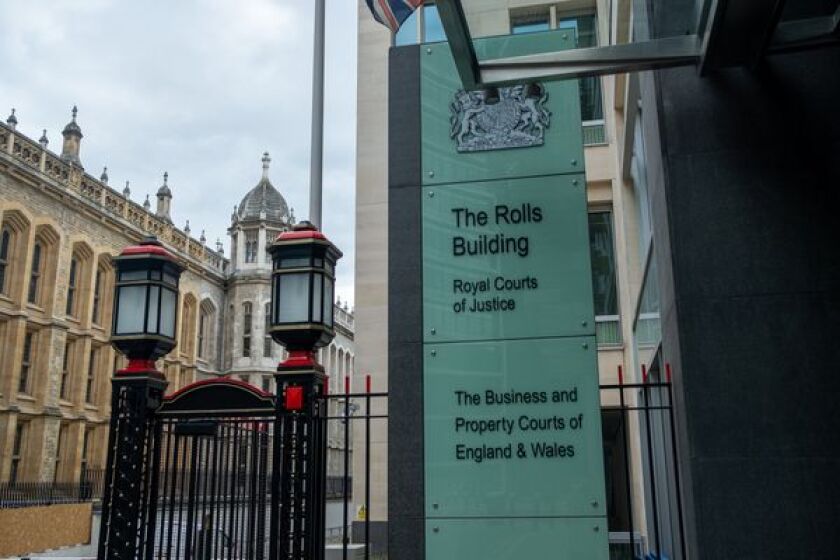
The England and Wales High Court issued its long-awaited judgment in Optis v Apple last Wednesday, June 7.
Mr Justice Marcus Smith ordered Apple to pay a fair, reasonable, and non-discriminatory (FRAND) royalty of $60m for Optis’ SEP portfolio, including interest.
The figure is understood to be well below what Optis was seeking and follows a disappointing royalty award for InterDigital against Lenovo in February.
The UK has long been thought of as a generally pro-patentee jurisdiction and a favoured venue for SEP owners in FRAND litigation.
But the latest judgments, just the second and third decisions to set a FRAND royalty, have seen courts unconvinced by SEP owners’ key arguments.
“Everyone is surprised at how low the number is,” says one patent litigator with experience representing SEP owners.
The judgment was not a total victory for Apple.
Smith rejected the handset maker’s claim that the price of a royalty should be based on the smallest saleable unit of a device, in this case, a chipset.
But the judgment undoubtedly made much better reading for implementers, who will be encouraged by how the judge arrived at his royalty award.
Unequal deals
There is also a clear signal to patentees that they must think carefully about the evidence they submit in support of their royalty demands.
The case turned largely on the judge’s choice of what comparable licences to base his royalty calculations on.
The judge’s approach was to work out what a FRAND rate would be to the implementer question.
He, therefore, focused on Apple’s licensing deals rather than Optis’s.
Optis’ comparables, meanwhile, came in for heavy criticism.
“In a nutshell, the Optis comparables are worse than useless at deriving a rate for Apple to pay,” Smith wrote.
The royalty rates suggested by Optis’ comparables were “remarkably high”, the judge found, and not reflective of what would be FRAND in the current case.
The judgment, which is still heavily redacted, suggested Optis’ comparables were deals with smaller parties who were not effectively as able to fight their corner as the bigger companies.
“The relationship between Optis and these counterparties was such that Optis was able to exert significant pressure to get the deal it wanted. These were not deals between equals,” he wrote.
Smith went as far as to suggest that Optis struck the deals in question not for their economic significance but because they made for useful comparable licences in cases such as these.
Another key problem Smith found with the Optis comparables was that they had to be “unpacked”, in order to be made useful.
In other words, the licences had to be subjected to extensive expert analysis in order to figure out how they might help lead to a FRAND rate.
For example, some of the comparables might have been calculated according to different methodologies.
The exact details are unclear, given the amount of redactions in the latest version of the judgment.
But Smith was clear that he thought the amount of “unpacking” required meant the supposed comparables were not really all that comparable.
Optis’s conduct in negotiations also came in for criticism, with Smith describing the NPE’s approach to licensing talks as “inept”.
“It is difficult to escape the sense that Optis’s ‘offers’ were no more than a series of demands for money, not underpinned by any particular effort at persuading the purchaser that the price represented proper value,” he wrote.
Implementer fightback
Implementers will point to Smith’s findings as evidence of their claims of patentee hold-up and excessive royalty demands.
Lobbyists in favour of the European Commission’s proposed SEP reforms, bitterly opposed by patent owners, have already cited the InterDigital judgment in support of their case.
Evelina Kurgonaite, secretary general of the Fair Standards Alliance in Brussels, says the Optis judgment is further, tangible evidence of patentee hold-up.
“We believe this judgment, as well as the recent InterDigital v Lenovo judgment, add to evidence that the current SEP licensing system is broken, warranting urgent EU policy and legislative solutions,” she says.
James Fox, senior associate at Allen & Overy in London, says implementers will take particular notice of both judgments’ findings on the SEP licensing market.
“Both Justices [James] Mellor and Smith have found that smaller implementers are, broadly speaking, paying more in relative terms than larger implementers like Apple and Lenovo.
“I think many of these smaller implementers will take notice of this and may start pointing to these judgments to fight their corner in future negotiations,” Fox says.
The UK courts also permit implementers to bring “free-standing” FRAND actions and the jurisdiction could be an attractive venue to resolve their disputes, Fox adds.
SEP owners, meanwhile, have been left wondering how they can turn the tide.
The lawyer with experience representing SEP owners says it’s clear patentees will have to get their evidence on comparables right.
“You need to disclose as much as you can around the circumstances of the deal, but that’s very difficult as they’re often under a non-disclosure agreement,” the source says.
The judges’ contrasting approach to certain key issues, such as comparables, also makes it hard to predict how future cases will play out, the lawyer adds.
“If you’re a patentee, you won’t know what your case was about until you get the disclosure of your defendant’s licences."
Future trends
One obvious question is whether the trend is towards the UK becoming less SEP owner-friendly and less of a significant venue for FRAND disputes.
One in-house telecoms litigator says SEP owners will learn from the two judgments but still bring cases in the UK, especially where they are trying to renew licences.
Disputes over the renewal licence avoid some of the thorny issues over comparables that arose in InterDigital and Optis, as there are already older deals involving the parties.
“The good news is that the patentees lost on very fact-specific points in these two cases,” the in-house lawyer says.
Mark Marfé, partner at Pinsent Masons in London, is also confident UK courts will continue to hear high-profile FRAND cases.
“The UK is one of very few jurisdictions that will determine a global FRAND rate and so will continue to be an important forum, particularly in light of the EU’s SEP proposals,” he says.
The future of SEP dispute resolution in the EU is uncertain, given the commission’s plan to require SEP owners to register their patents at the EUIPO.
SEP owners would be unable to bring enforcement actions, including at venues such as the Unified Patent Court, until the EUIPO had checked patents for essentiality and recommended a FRAND rate.
Such plans, combined with the untested approach of the new UPC, can only make the UK more attractive to potential litigants, Marfé says.
Fox of Allen & Overy says the level of rigour that went into the latest two judgments can only strengthen the UK’s position as a FRAND venue.
But there has been extensive grumbling among SEP lawyers at how long it took for the InterDigital and Optis judgments to appear (about a year after the FRAND trial, in both cases).
The UPC, meanwhile, has pledged to resolve cases, from start-to-finish, in 12 to 15 months.
Given the question marks over SEP owners’ ability to use the UPC in future, the UK may be the best option they’ve got.
Smith’s findings in Optis will therefore be required reading for SEP owners to make sure they can avoid similar defeats in future.