Exclusive: Most Canada IP cases to be held in person again

Managing IP is part of Legal Benchmarking Limited, 1-2 Paris Gardens, London, SE1 8ND

Copyright © Legal Benchmarking Limited and its affiliated companies 2026

Accessibility | Terms of Use | Privacy Policy | Modern Slavery Statement

Exclusive: Most Canada IP cases to be held in person again

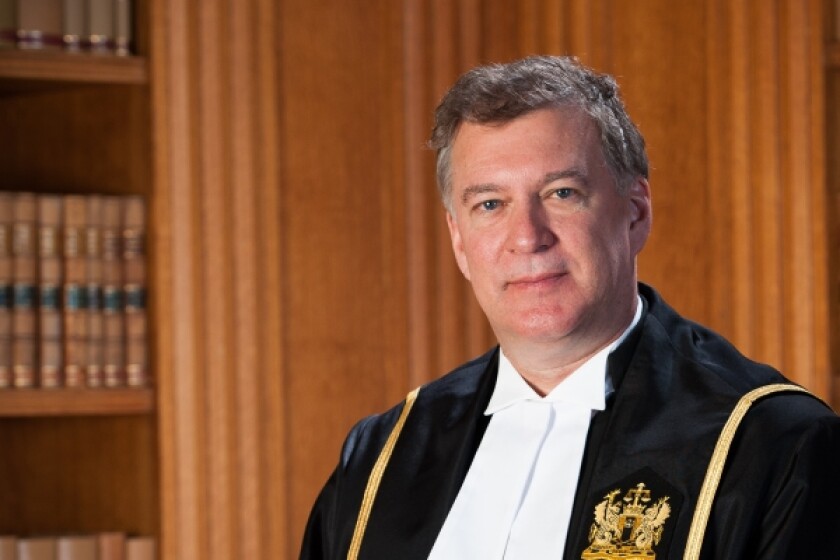
Michael Manson, the senior IP judge at the Canada Federal Court

The senior IP judge at the Canada Federal Court says in-person litigation will become the default again by May, subject to judges’ discretion

The Canada Federal Court plans to update its COVID guidelines by May to mandate that most cases be held in person again, after which it’s expected that the majority of intellectual property matters will be litigated in courtrooms, according to the court’s senior IP judge.

The Federal Court, where most IP cases are first litigated in Canada, has required its judges to manage most matters virtually and only hold in-person proceedings in exceptional circumstances since January 2021.

Judge Michael Manson told Managing IP this week that the court would update its practice direction, which was first issued on March 17 2020 and last updated on January 18 2021, sometime between late April and early May to make in-person proceedings the default once more.

The court decided to make this change in light of declining COVID cases and the subsequent removal of pandemic-based restrictions such as vaccine, travel testing and mask mandates from public life, he added.

Related stories

Manson emphasised, however, that judges would still have the discretion to hold virtual or hybrid proceedings if they were requested by counsel under the new guidelines.

“All three versions of hearings – in-person, hybrid and virtual – are the future of the Federal Court,” he said.

But he added that he expected most IP cases to go back to being in person over the coming months.

“Virtual will probably continue to be the dominant format for some areas of the law, such as immigration, where economics is a factor, hearings are short, and counsel tend to request virtual instead of in-person hearings.

“In IP cases, by contrast, hearings are often long and require lots of expert witnesses. They’re generally better done in person, and, based on my experience as an IP litigator, I suspect most IP counsel would agree.”

Remote possibility

Manson, who was appointed in 2012 and is based in Vancouver, pointed out that judges could use their discretion differently once the new guidelines were published, and that some might decide to hold cases in person regardless of input from counsel.

But he suggested that in practice, most judges would leave it to the parties to decide.  

“If both parties and counsel want to do cases virtually, I’m pretty sure most if not all of us judges will accommodate that,” said Manson.

He added that judges might choose to hold hybrid proceedings as a compromise in cases in which one side wanted to litigate virtually and another wanted to go to the courthouse.

The senior IP judge said his preference was to litigate in person.

“Some judges think virtual litigation is OK, but I suspect they weren’t litigators when they practised.

“As a litigator for 30 years, I liked the courtroom experience. As a judge, I like to watch what’s going on in the courtroom – seeing the mannerisms and credibility issues. You’re much more able to gauge those things by having parties and counsel in the room than looking at faces on a screen,” he said.

He pointed out that stakeholders could still watch proceedings virtually once the new guidelines were introduced.

Virtual workload

Since March 1 2020, the Federal Court has held 35 virtual trials for IP matters, including 14 patent infringements, one patent impeachment, one patent conflict, four trademark infringements and two copyright infringements.

Two more fell into an ‘other’ category and 12 were related to Canada’s Patented Medicines Notice of Compliance Regulations (PMNOCs), which are similar to the US Hatch-Waxman Act.

There have also been 17 virtual motions for summary trial or judgment in IP matters in the same time, including three patent infringements, seven trademark infringements, one trademark passing off, three copyright infringements, one ‘other’ and two PMNOCs.

The court held its first virtual patent trial between Rovi and Videotron in June 2020. The case was managed by Judge Roger Lafrenière, who has since semi-retired from the court and is credited with establishing the court’s virtual trial protocol.

The protocol set out directions for matters such as document sharing, documents to be put to witnesses, and loss of internet connection.

Lafrenière was recognised by Managing IP in its Top 50 Most Influential People in IP list in 2020 for that reason.

Like most courts across North America, Canada’s Federal Court severely limited the number of people that could enter its facilities and suspended most hearings when the pandemic first struck.

It had considered introducing its new in-person-default practice direction in late 2021 but held off because of rising Omicron variant infections.

The announcement of these new guidelines is the latest development in a growing trend of courts lifting COVID restrictions and reopening across North America.

The US Court of Appeals for the Federal Circuit similarly announced that it would resume in-person arguments in February.

more from across site and SHARED ros bottom lb

More from across our site

The Indian government announcing a fee waiver for sports-related IP registrations, and the US adding the EU to its IP 'watch list' were also among major developments
Sources say the judge could return to a disputes or mediation-focussed role, though others have questioned whether the Texas court will remain a litigation hotspot in his absence
Sheppard, which has hired 14 IP partners in the last 12 months, has cited client demand for expert counsel in SEP, ITC, and district court disputes
Tingxi Huo joins our ‘Five minutes with’ series to discuss boosting the value of clients’ IP and the importance of reflection
Hefty legal teams assembled for a three-day hearing in what was the court’s first foray into SEPs since Unwired Planet v Huawei
IP firm's new base will be located inside the tallest office space in the UK's ‘second city’
Practitioners at four firms across Asia and Europe share the do’s and don’ts of mindful networking ahead of the INTA Annual Meeting
Brand Action explains why the IP community can be a force for good in the world as thousands of professionals prepare to head to London for INTA’s Annual Meeting
The firm, which has also hired a senior trademark leader to lead operations in the region, believes greater China to be one of the most important IP jurisdictions
Attorneys at Gibson Dunn share why plaintiffs’ growing reliance on DMCA anti-circumvention claims in AI scraping cases exposes a critical vulnerability
Gift this article