The USPTO CBM process explained

Managing IP is part of Legal Benchmarking Limited, 1-2 Paris Gardens, London, SE1 8ND

Copyright © Legal Benchmarking Limited and its affiliated companies 2025

Accessibility | Terms of Use | Privacy Policy | Modern Slavery Statement

The USPTO CBM process explained

flowdiagramcbm-45.jpg

The USPTO Patent Trial and Appeal Board has given its first ruling in the new CBM review procedure. Managing IP explains how the process works

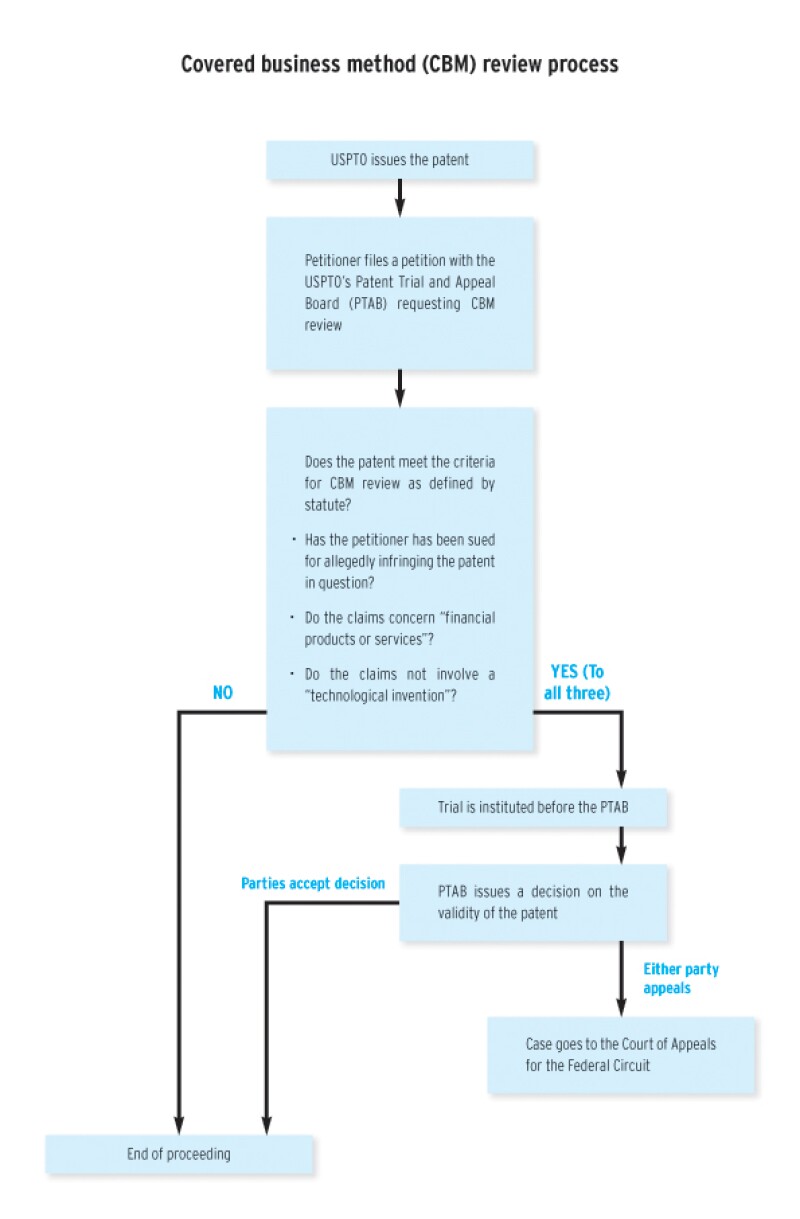
Covered Business Method (CBM) review is a post-grant procedure introduced under the America Invents Act (AIA). It allows alleged infringers to challenge the validity of business method patents “covered” under Section 18 of the AIA through the USPTO’s appeals system, rather than through litigation.

CBM review is only available for patents which relate to “a method or corresponding apparatus for performing data processing or other operations used in the practice, administration, or management of a financial product or service”. Patents concerning “technological inventions” are not eligible for the procedure.

In order to initiate a CBM review, the petitioner must have been sued for infringement of the patent in question.

CBM review is an interim measure which will be available until September 16, 2020. The USPTO will not accept any new petitions for CBM reviews on or after that date.

The chart below outlines the various stages a patent may go through under CBM review.

Opponents of CBM review claim that lobbyists from the financial services industry pressured Congress to include the provision as part of the AIA.
flowdiagramcbm.jpg

See also: analysis of the first CBM review decision in SAP v Versata (Managing IP subscription or free trial required).


more from across site and SHARED ros bottom lb

More from across our site

Two partners have departed DLA Piper to join Squire Patton Boggs and Blank Rome in San Francisco and Chicago, respectively
Practitioners say a 32% rise in court fees is somewhat expected to maintain the UPC’s strong start, but some warn that SME clients could be squeezed out
Swati Sharma and Revanta Mathur at Cyril Amarchand Mangaldas explain how they overcame IP office objections to secure victory for a tyre manufacturer
Claudiu Feraru, founder of Feraru IP, discusses the benefits of a varied IP practice and why junior practitioners should learn from every case
In the ninth episode of a podcast series celebrating the tenth anniversary of IP Inclusive, we discuss IP & ME, a community focused on ethnic minority IP professionals
Firms that made strategic PTAB hires say that insider expertise is becoming more valuable in the wake of USPTO changes
Aled Richards-Jones, a litigator and qualified barrister, is the fourth partner to join the firm’s growing patent litigation team this year
An IP lawyer tasked with helping to develop Brownstein’s newly unveiled New York office is eyeing a measured approach to talent hunting
Amanda Griffiths, who will be tasked with expanding the firm’s trademark offering in New Zealand, says she hopes to offer greater flexibility to clients at her new home
News of EasyGroup failing in its trademark infringement claim against ‘Easihire’ and Amgen winning a key appeal at the UPC were also among the top talking points
Gift this article