

The awards were held Tuesday night at the Willard InterContinental Hotel in Washington DC. Drewsen, who won the Lifetime Achievement Award, spent 15 years as executive director of INTA, and helped to assemble the task force responsible for drafting the Federal Anti-Dilution Statute. He was introduced by INTA past president and General Electric senior counsel for advertising and brand management, Kathryn Barrett Park, who has worked closely with Drewsen throughout his career (both pictured, right).
Park called Drewsen “a consummate diplomat”, and Drewsen said that being presented awards recently by Jerome Gilson, Thomas McCarthy and now Kathryn Barrett Park was equivalent to being handed “an Oscar by DeNiro, Pacino and Meryl Streep or a Grammy by Dylan, Springsteen and Beyonce”.
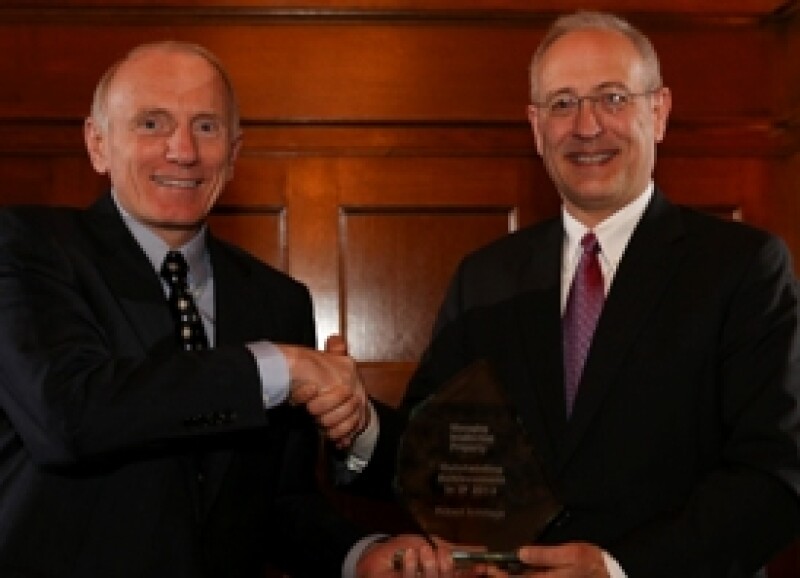
Robert Armitage retired as senior vice president and general counsel at Eli Lilly at the end of last year, and played a major role in the efforts leading to the passage of the America Invents Act.
His former colleague Douglas Norman of Eli Lilly presented Armitage with the Outstanding Achievement Award (pictured left: Armitage and Norman).
“Bob always made sure he had something ready at hand for any contingency that would arise,” said Norman in his introduction. “If you want a statutory fix to obvious-type double patenting, Bob has it. If you need a statutory fix for any weaknesses you see in inequitable conduct law, Bob has it on his computer. If you need to know how to turn the USPTO into a government-owned not-for-profit corporation, Bob has that on his computer as well – I’ve seen it.”
Finally, former USPTO director David Kappos, who spent more than three years as one of the busiest directors the Office has ever seen, also received an award for outstanding achievement.
Kappos was introduced by the Office’s acting director and deputy director Teresa Stanek Rea, who said she felt more emotional than she had anticipated having Kappos back with the team.
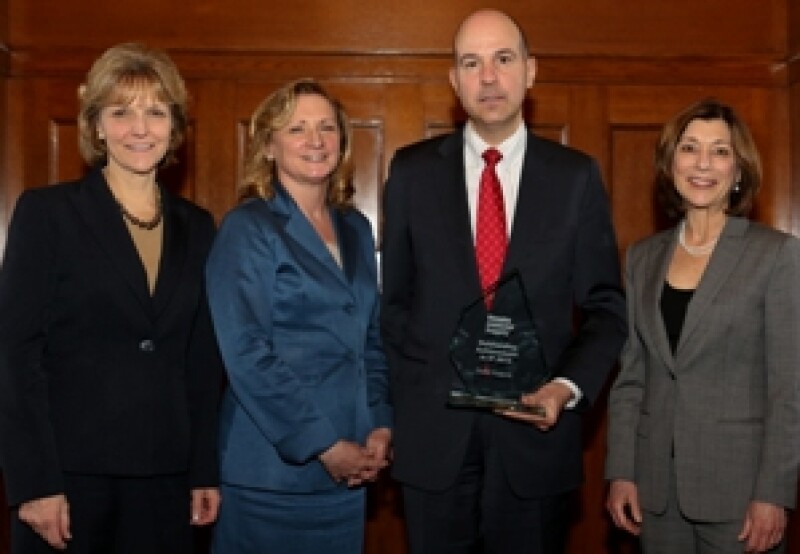
When presenting the award to Kappos, Rea invited USPTO commissioner for trade marks Debbie Cohn and commissioner for patents Peggy Focarino up to the stage (right), saying that much of Kappos’ contribution came in motivating and teaching his team to be better leaders.
Awards were also presented for the best in-house teams of the year in several areas. Microsoft won for best licensing team, while Apple won for both the in-house trade mark and patent team of the year. Time Warner was the winner for copyright.
The in-house awards reflect a combination of the companies’ innovative approaches to IP enforcement and protection, as well as recent successes in court and the strength of the companies’ IP portfolios.
Individual awards were presented to the leading litigators in 13 US states, as well as Canada. The winner in New York, Joshua Rosenkranz of Orrick Herrington & Sutcliffe, auspiciously won a closely-watched case at the Supreme Court – Kirtsaeng v Wiley & Sons - on the day of the awards.
Mark Lemley of Durie Tangri won the IP Thought Leader award for the second year in a row, in part for his paper on software patents that has sparked debate amongst the IP community.
Notable firm winners included Morrison & Foerster, WilmerHale and McKool Smith, all of whom have played key roles in some of the most prominent smartphone battles of the last year.
Milestone cases of the year included Apple v Samsung, Marlboro Canada v Phillip Morris, Already v Nike, Oracle v Google and Viacom v YouTube.
The full list of winners is available to subscribers or with a free trial here. All the photos from the evening are on Managing IP's Facebook page.
A winner's reaction - Matthew Penarczyk of Microsoft |
“Our licensing strategy is robust because it directly correlates to robust innovation. Licensing shortens development cycles and increases focus on bringing innovation to customers faster. Licensing is a collaborative approach and it shows what can be achieved when companies sit down and address IP in a responsible manner. When companies can do that and engage and collaborate, they can make contributions to the global market, to consumers, to technology quickly. This is why Microsoft has really emphasized building a licensing program that matches our R&D efforts" - Matthew Penarczyk, Associate General Counsel, Microsoft Intellectual Property Group |





