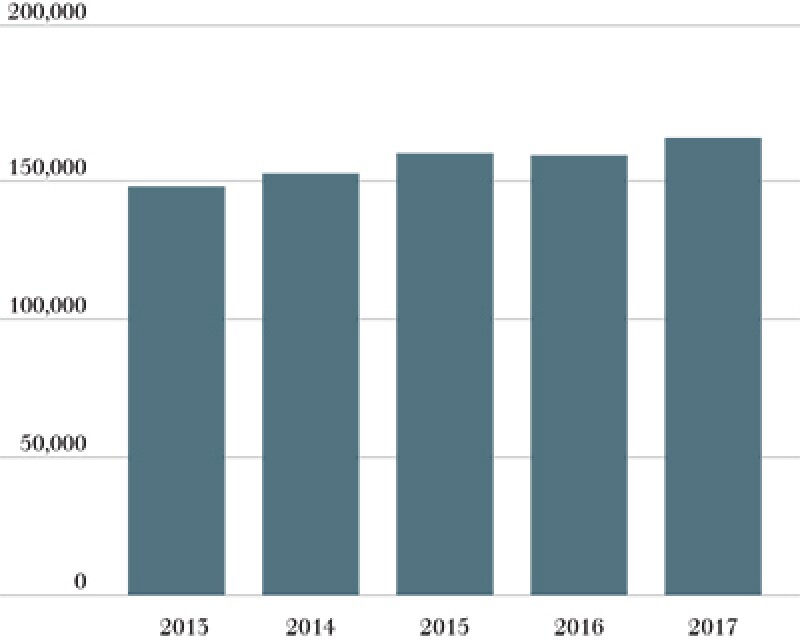
The European Patent Office (EPO) has revealed patent application figures for 2017. The office received nearly 166,000 European patent applications in 2017, an increase of 3.9% and an all-time high. The EPO published 106,000 granted European patents in 2017, up 10.1% on the previous year.
Benoît Battistelli, EPO president, commented: "In terms of patents, 2017 was a positive year for Europe. The growing demand for European patents confirms Europe's attractiveness as a leading technology market."
Country trends
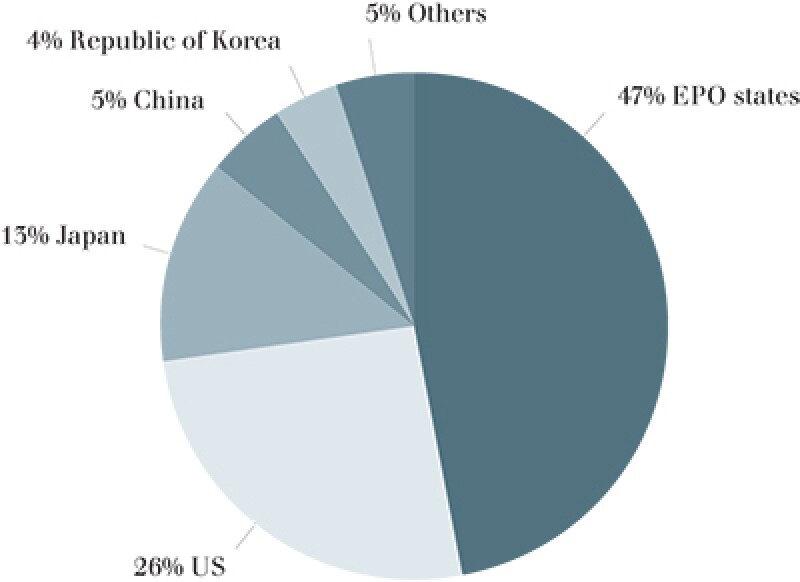
The five most active countries of origin in 2017 were the US, Germany, Japan, France and China. The US was the top single country filer by far, accounting for 26% of all EPO patent applications, and its share of EPO applications has been increasing over time. The US returned to growth in EPO applications – it was up 5.8% in 2017 – after a drop in 2016, which had been a knock-on effect of changes in US patent law under the America Invents Act.
Chinese patent applications at the EPO grew by 16.6% last year. This growth was slower than the 24.8% growth from China in 2016, however. It overtook Switzerland last year to make it into the top five for the first time. Japan, with 3.5% growth in applications in 2017, was up again after several years of declining figures. The main exception to the growth trend among the largest patent filing countries was the Republic of Korea. Its applications fell 8.2% in 2017 after two consecutive years of growth.
The EPO reported that European countries filed more patent applications at the EPO in 2017 than in the previous year. Among countries with larger volumes, patent applications from the Netherlands were up 2.7% (after falling 4.1% the previous year), and applications from Italy (up 4.3%) and the UK (up 2.4%) continued to grow.
Germany was Europe's largest patent filing country again, with nearly 500 more applications filed by German inventors and firms in 2017, representing 1.9% growth. Applications from France were up 0.5% after a drop of 2.4% in 2016. Belgium, with a 1.9% drop, was the only one of the larger European economies to have fewer patent applications in 2017, after a strong increase of 7% in 2016.
While patent applications from the US continue to represent a sizable portion of EPO filings, a Chinese company has secured the number one filing entity spot this year, for the first time ever. Information technology giant Huawei filed 2,398 applications in 2017, making up more than 1% of patent applications filed with the EPO last year.
Siemens moved up from sixth place to second, followed by LG, Samsung and Qualcomm. The top 10 list of applicants consists of four companies from Europe, three from the US, two from South Korea and one from China.
Breakdown by field
Medical technology was the technical field with the most patent applications filed at the EPO. Its 13,090 applications was up 6.2%. It was followed by digital communication and computer technology. The strongest growth of the top 10 fields was recorded in biotechnology (up 14.5%), followed by pharmaceuticals (up 8.1%) and measurement (up 6.6%).
In terms of fields of invention, the EPO annual report shows that the US accounts for 40% of applications in computer technology, 37% of patents filed in both medical technology and pharmaceuticals, and 32% in biotechnology.
"The analysis of the origin of patent applications in the largest fields of technologies shows that some countries such as China and South Korea are progressing strongly in specialised areas, in particular in the ICT [information and communication technology] field," commented the EPO in a release. "Other economies, such as most EPO member states and the US and Japan, showed a greater diversity in applications across technical fields."
The fourth industrial revolution
The EPO has reported growth in recent years in fields that it terms as related to the fourth industrial revolution (4IR). An EPO study released in December 2017 found European companies were particularly well represented in 4IR areas with a greater diversity, such as artificial intelligence and smart applications in vehicles, while Asian companies dominate in the ICT field.
European patent applications related to smart connected objects are rising rapidly, achieving a growth rate of 54% in the last three years, the "Patents and the Fourth Industrial Revolution (4IR)" report revealed. The EPO identified more than 48,000 patent applications filed until the end of 2016 and relating to three technology sectors of 4IR: the core technologies in the ICT field that make it possible to create connected objects; the enabling technologies that complement core technologies, such as artificial intelligence and user interfaces; and application domains of these technologies, such as vehicles, enterprise and home.
More than 5,000 patent applications for inventions relating to autonomous objects were filed at the EPO in 2016 alone and between 2014 and 2016 the rate of growth for 4IR patent applications was 54%. This is much greater than the overall growth of patent applications in the last three years of 7.7%.
In Europe, Germany and France are foremost in 4IR innovation. Germany stands out in the application domains of vehicles, infrastructure and manufacturing, while France leads in enabling technologies such as artificial intelligence, security, user interfaces and 3D systems.
The top 25 companies accounted for about half of all 4IR patent applications filed with the EPO between 2011 and 2016. The study shows that innovation in core technologies is mainly led by a limited number of large companies focused on ICT, while inventions in enabling technologies and application domains are less concentrated, and the top applicants in these sectors originate from a larger variety of industries.
EPO patent applications
Origin of patent applications 2017
Top 10 applicants 2017 |
||||
Rank |
Patent applications |
Region |
Patent applications at the EPO in 2017 |
Change |
1 |
Huawei |
China |
2,398 |
0.30% |
2 |
Siemens |
EPO states |
2,220 |
18.70% |
3 |
LG |
Republic of Korea |
2,056 |
-11.10% |
4 |
Samsung |
Republic of Korea |
2,016 |
-13.00% |
5 |
Qualcomm |
US |
1,854 |
8.80% |
6 |
Royal Philips |
EPO states |
1,733 |
-1.90% |
7 |
United Technologies |
US |
1,719 |
-16.80% |
8 |
Intel |
US |
1,435 |
13.20% |
9 |
Robert Bosch |
EPO states |
1,412 |
6.40% |
10 |
Ericsson |
EPO states |
1,373 |
16.10% |
Technical fields with the most applications 2017 |
||
Field |
Applications |
Growth |
Medical technology |
13,090 |
0 |
Digital communication |
11,694 |
0 |
Computer technology |
11,174 |
0 |
Electr. machinary, apparatus, energy |
10,402 |
0 |
Transport |
8,217 |
0 |
Measurement |
7,999 |
0 |
Organic fine chemistry |
6,462 |
0 |
Pharmaceuticals |
6,330 |
0 |
Biotechnology |
6,278 |
0 |
Other special machines |
5,548 |
0 |
EPO fee changes take effect
EPO fee changes for patent applications entered into force on April 1. The majority of fees remain unchanged. But the measures lower a number of costs in the patent application and examination process.
The EPO will not apply the inflation-based biennial fee adjustment for 2018-2020, which is expected to result in savings of €15 million in 2018 alone. The EPO also reduced both its PCT search and examination fees by €100 each, which is expected to bring about savings of €7 million to the users in the next year.
Thirdly, the EPO increased the existing discount on the European examination fees for files already examined by the EPO in PCT proceedings from 50% to 75%. In real terms, the increased discount on European examination fees means applicants will now only pay €456.24 instead of €912.50. For applicants that are using the EPO for search and examination in the PCT phase and that are entering the European phase, the various fee changes potentially result in a decrease of €656, which is a 14% reduction over the current situation.
The EPO estimates the combined effect of all reduced fees to result in a total of €25 million in savings for the user community in 2018 alone.
Some fees increased, however. A reduced search fee has historically been available for international applications where the international search report was drawn up by the USPTO, JPO, KIPO, SIPO, Russia's patent office or the Australian Patent Office –the reduction to the search fee in these cases was €190 since 2005. This reduction has been removed now and the same search fee is charged in all cases.
The EPO's appeal fee has increased to €2,255 for larger companies, from €1,880.
The fee for non-electronic filing has also increased to €250 whereas the electronic filing fee was held at €120. This is part of the EPO's effort to encourage electronic filing.