

We’ve also posted the following articles in the past week (log in via subscription or free trial):
CAFC rules PTAB’s CBM definition too broad in Unwired Planet
Schecter warns against upsetting balance between trade secrets and patents
USPTO could change direction under Trump administration – panel
Halo webinar reveals how courts are using their discretion over enhanced damages
Texas jury awards $20m patent damages against Medtronic
Puma loses Chilean Supreme Court trade mark case
WIPO study shows growth of women inventors
Interview: Mary Boney Denison, USPTO commissioner for trade marks
Philips to pay Masimo $300m patent settlement
TTAB reversed over “use” of a mark
The Federal Circuit has reversed a Trademark Trial and Appeal Board decision in Adidas v Christian Faith Fellowship Church, reports TTABlog. The appeals court ruled that the sale of two hats at the Church’s bookstore to an out of state purchaser constituted use in commerce of the applicant’s mark ADD A ZERO.

As John Welch (right) on the TTABlog explained: “In this case, the question was whether the Church made a sale of goods bearing the mark, in commerce regulable by Congress, before it applied to register its marks. The TTAB's interpretation of the Lanham Act and the ‘legal tests it applies in measuring registrability’ are subject to de novo review by the CAFC.”
The Board had granted adidas’s petition for cancellation of two registrations for the mark ADD A ZERO for "clothing, namely shirts and caps", finding that these sales were de minimis and insufficient to show use that affects interstate. The Lanham Act provides for the owner of a trade mark used in commerce being able to request registration of its mark, with commerce defined as
“all commerce which may lawfully be regulated by Congress”.
As the number of comments on the TTABlog article shows, this ruling is of great interest.
Welch asked: “After this decision, is there any ‘use’ of a trade mark or services mark that does not satisfy the ‘use in commerce’ requirement? Is the old ‘interstate/intrastate’ dichotomy dead, as far as ‘use’ goes? In other words, for application purposes are ‘first use’ and ‘first use in commerce’ now the same thing?”
Knobbe Martens noted: “While this ruling helps to settle the question of how much ‘actual use in commerce’ is needed to register a trade mark, the question remains as to how much use is required to avoid abandoning a trade mark, which was one of the other arguments that Adidas raised in the cancellation. Adidas also argued that the Church’s marks’ fail to function as trade marks.”
Maple Leafs and Snoop Dogg face off
In other trade mark news, the Toronto Maple Leafs and Snoop Dogg are battling over a trade mark application for the rapper’s Leafs by Snoop medical marijuana company, reports The Fashion Law blog.

The ice hockey team’s parent has filed an opposition with the Trademark Trial and Appeal Board, arguing it has used the mark LEAFS for nearly 90 years. “The LEAFS mark reflects a highly unusual and distinctive spelling, since the plural of the English language work ‘leaf’ is usually presented as ‘leaves’,” says the opposition.
The Fashion Law quoted a joint statement from the NHL/MLSE/Snoop’s representatives: “We have been actively discussing a possible resolution of this matter, and those discussions are ongoing. Facing a non-extendable deadline to file a trade mark opposition, the Maple Leafs made this submission in order to maintain the status quo. The parties have requested a suspension of the opposition proceeding to allow their discussions to continue.”
The Fashion Law also brings news of another trade mark opposition: Instagram is trying to stop Microsoft from registering the ACTIONGRAM mark.
We might overcome
A lawsuit challenging the validity in the song “We Shall Overcome” – which was embraced by the civil rights movement – has overcome one hurdle to trial. This week Judge Denise Cote in the Southern District of New York declined to dismiss the suit, reports The New York Times.
Cote declared the plaintiffs had “plausibly alleged” that the first verse lacked originality, as well as noting the song’s registered authors may not have made crucial changes to the lyrics such as changing “will” to “shall” in the title of the song. She said the “issues of originality and authorship will require discovery and a more developed record”.
The lawsuit was filed in April on behalf of a non-profit group We Shall Overcome Foundation. The producers of the 2013 movie Lee Daniels’ The Butler” later joined the suit. The defendants are The Richmond Organization and Ludlow Music. Folk singer Peter Seeger recorded a version of the song in 1963.
CAFC judges urge en banc rehearing in PTAB case
The Federal Circuit this week issued an important reversal of the Patent Trial and Appeal Board’s definition of covered business method, in Unwired Planet v Google.
However, it also issued an interesting PTAB ruling last week when it reconsidered its earlier decision in Click-To-Call Techs v Oracle in light of the Supreme Court’s Cuozzo decision. The Federal Circuit found it could not reverse its earlier ruling that issues under the one-year time bar (Section 315(b)) could not be appealed because it was bound by its own precedent.
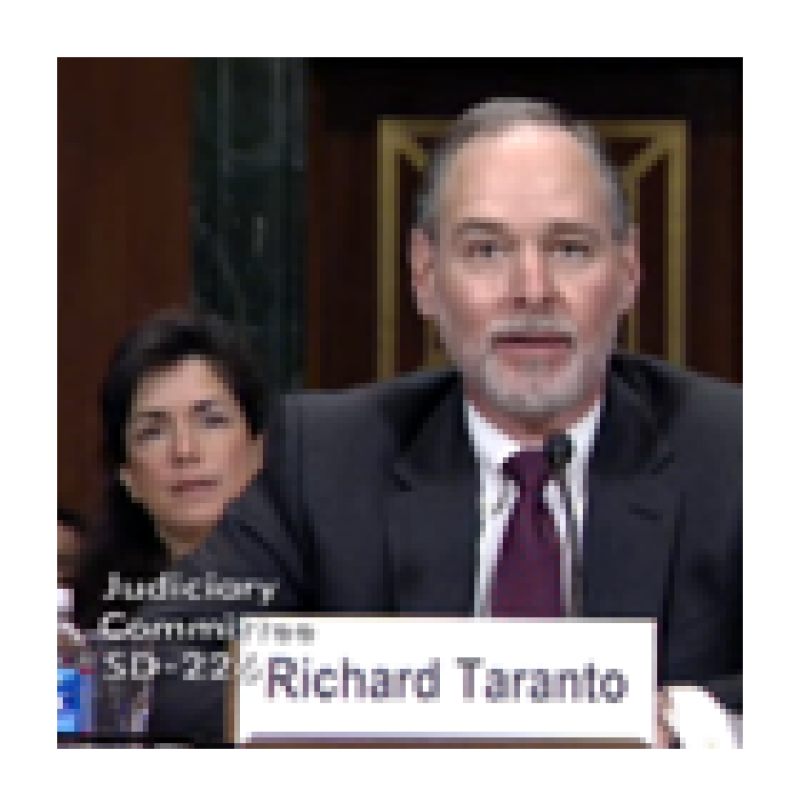
However, as the Patents Post-Grant blog reports, concurring opinions by Judges O’Malley and Taranto (right) both called for the Federal Circuit to sit en banc to review the court’s reasoning in Achates Reference Publishing v Apple in light of Cuozzo. The court in Click-To-Call believed it was bound by Achates, which established that a party cannot challenge the PTAB’s decision to institute an IPR proceedings under the one-year time bar because it is barred under Section 314(d).
Taranto wrote: “314(d). . .refers to a ‘determination . . .whether to institute an IPR under this section’ (emphasis added). As a textual matter, those words clearly encompass the ‘reasonable likelihood’ determination specified in § 314(a), but they leave unclear to what extent they reach determinations of compliance with other statutory provisions bearing on institution … The ‘jurisdiction’ label, while a troublesome one in many contexts, here relates to an Administrative Procedure Act principle that the Court in Cuozzo invoked in stating that, at least sometimes and maybe generally, § 314(d) does not bar review to determine if agency action is ‘in excess of statutory jurisdiction’.”
Patent references rising
The number of references cited per patent continues to rise, but the pace has slowed, reports the Patently-O blog. The average patent issued in 2016 had more than 50 cited references.

“In my view – this is great, although it would certainly help if the examiner was given some clue as to why the reference is deemed relevant or what portion of the reference is relevant,” said Dennis Crouch on the blog. The average patent cites 26 more references per patent on average than 10 years ago, although examiners only cite 1.5 more per patent.
Couch said the increase in references is good because IT systems can easily handle searching through large numbers of references and the more important patents have more references and a better starting point. “If these are well used by the examiner then we also get better examination and a stronger patent system in the end,” he said.
The Patently-O blog also published data this week on patent claim counts.
In brief
- Acacia subsidiaries Saint Lawrence Communications LLC and Saint Lawrence Communications GmbH have entered into patent license agreements with HTC Corporation.
- The estate of Prince is in a court battle with Tidal over the streaming right’s to the artist’s catalogue, reports the BBC.
- That copyright suit over a fan fiction Star Trek film that was said to be “going away” back in June? It’s not settled, according to Law360’s Bill Donahue.
Briefs in brief
- In what she described as “Tamicus” news, Rebecca Tushnet’s 43(B)log reports that IP professors have submitted an amicus brief in Lee v Tam.
- INTA has filed an amicus brief in support of Belmora's FLANAX petition for writ of certiorari that notes the split in the circuits.


