1 minute read |
Many of the disputes in the telecommunications patents wars relate to standard-essential patents, and usually seek to resolve whether the patent is really essential to the standard and whether the patent is valid. However, a further issue underlying many such disputes is determining which level of royalty fees can be can be considered genuinely FRAND: which royalty rate is fair, reasonable and non-discriminatory. Despite the CJEU Huawei/ZTE ruling on the injunctions in the context of SEPs, there is little case law to help parties decide if the licence terms under negotiation are actually FRAND. As a result of the unclear legal environment, licence negotiations can become protracted over issues such as apportionment of revenue, technical contribution and royalty stacking. It is hoped that a forthcoming Patents Court decision in the UK may provide much needed guidance in this respect. |
One of the crucial enablers of the modern telecommunications revolution is the standardisation of technical specifications, a step which ensures interoperability between devices, allowing manufacturers to focus technical research into standards-based technologies. Industry players, despite being competitors, collaborate in the standardisation process and create products that conform to the standards, which due to their widespread market acceptance are difficult to avoid. What happens, then, when a producer finds out that his product, duly designed to conform to the standard, is also infringing a patent, which covers the same technical matter as the standard?
The practice of patent ambush, by which owners of standard-essential patents (SEPs) notified implementers of standardised technologies at a late stage, was sometimes coupled with demands for excessive patent licence fees, effectively a patent hold-up for those unwilling or incapable of paying. These issues were first addressed more than 20 years ago, initially in respect of cellular technologies and later in relation to WiFi and other standards, amid fears that the relevant technologies could be blocked by patent hold-up. The discussion also raised questions in competition law and how intellectual property should work in this context, observers even questioning whether patents were anti-competitive.
A balanced solution was soon devised in which patent owners would obtain a reward for their contribution to the standards, while implementers received guaranteed open access to the standardised technology. Patent owners participating in the standards definition process committed to declaration to relevant standard-setting bodies of their ownership of SEPs, and, crucially, also their willingness to license the patents to all on terms that are fair, reasonable and non-discriminatory (FRAND). At the European Telecommunications Standards Institute (ETSI) such declarations often also identify the SEPs in question. Since these policies were adopted many such declarations and commitments have been made and many licences have been concluded between SEP owners and implementers. However, to this day there is no universal definition of what FRAND means, and telecommunication patents remain an area where legal disputes abound.
Court decisions on FRAND rate determination
The majority of patent disputes in telecommunications address whether the patent is really essential to the standard (is it really an SEP?) and whether the patent is valid, or, in consideration of competition law issues, how the parties should agree on terms. A licence is often agreed in principle, but the FRAND nature of the licence is disputed. The CJEU's decision Huawei v ZTE, for example, determined the circumstances in which a potential licensor could obtain an injunction against a party who received an offer of an ostensibly FRAND licence, the party being willing to licence, without the injunction constituting an abuse of a dominant position.
However, the real issue underlying many of the patent licence disputes in the telecommunications area is often the level of royalty fees that can be can be considered genuinely FRAND: which royalty rate is fair, reasonable and non-discriminatory. In the United States a few court cases (notably Microsoft Corp v Motorola, Inc, No 10-cv-1823, WD Washington, 2013) have given some important guidance, while In Europe the issue of FRAND rate determination has not been conclusively addressed by the courts. This is perhaps understandable, given that the stakes can be very high for both parties, the sums involved being often considerable, such that the parties have generally settled before trial or the case has been decided in confidential arbitration. It is hoped that the forthcoming Patents Court decision in the UK dispute Unwired Planet International Ltd & Huawei Technologies Co, Ltd & others will help clarify the law in this respect, at least for the UK.
An evolving technology and new licensing strategies
Historically royalties in the telecoms sector have been determined on the ex-factory price of end-user devices. FRAND arguments were made by licensors on this basis: if a handset cost $Z to manufacture, royalty rates of X% should be based on this cost, or, alternatively, on a fixed amount $P per handset. In the case of mobile phones this meant that patents tended to be licensed to handset manufacturers – rather than anyone further down the supply chain – and based on the cost of the handset.
The success of mobile telephony has given rise to many FRAND disputes (the so-called smartphone patent wars), and has seen the rise of patent licensing pools as well as patent trolls. However, as prices of cellular-capable chips and modules decline and the big phone manufacturers (sometimes by acquiring their own SEP portfolios to use in cross-licences) proved to be strong defendants, the royalty returns on such portfolios have decreased. As mobile internet access becomes pervasive, with cellular-capable devices appearing now in, for example, cars, refrigerators and homes, amid the Internet of Things (IoT), SEP portfolio holders now approach not only handset manufacturers but also producers of other cellular-enabled devices, such as wireless modules, which may or may not be incorporated into a mobile phone. Now, anyone at any stage in the supply chain for cellular-capable devices may be invited to license SEPs.
In this context the application of the simple concept linking royalties to end price is being challenged more and more, particularly in the area of apportionment.
Apportionment
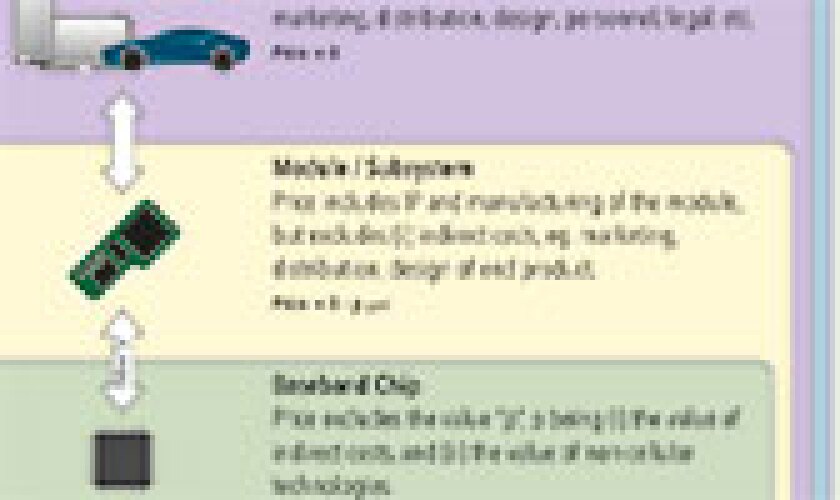
Agreement on an appropriate level to apply the royalty (the whole device or a component) is fundamental in any licence deal. If we consider for example a smartphone retailing at £600 the question is whether the technology protected by the SEP relates to the whole smartphone or just a part of it. In other words, how should that £600 be apportioned? Put another way, is the licensor of the SEP entitled to a share of the whole £600 or is he just entitled to a share of that part which relates directly to the patented technology?
Licensees argue that the price tag on a smartphone reflects much more than the cellular capabilities of the phone, such as the camera, the touchscreen, and even non-technical aspects, such as design, styling, marketing and distribution. Moreover, an SEP portfolio merely protects a number of cellular inventions, but this is much less than the overall cellular functionality of the device, and it is argued that the royalty should only reflect the relevant technical contribution of the portfolio to the overall cellular capability. This, in essence, is the "smallest saleable patent-practising unit" approach (SSPPU), as first outlined in the US judgment Cornell University v Hewlett Packard Co, 609 F Supp2d 279 (NDNY 2009). SSPPU is argued by many implementers as an appropriate approach to apportionment, and a solution to counter alleged excessive royalty demands. By moving the basis for royalty calculations away from the end device onto the component level, it is claimed that apportionment more fairly captures the incremental value of the patented technology. Such views are mostly firmly held by cellular implementers whose products are not phones at all, but still have a cellular capability. Licensees also question the appropriateness of a per unit basis, when prices have been in dramatic decline for many years, and a fixed royalty would erode profits as the end price drops: a percentage-based approach is, they argue, fairer.
When might the entire market approach be appropriate?
SEP licensors deploy arguments in the opposite direction, and frequently support an "entire market" approach: the appropriate basis for the royalty is the price of a notional end user device, for example the cost of a smartphone, rather than the price of some intermediate component thereof, without any apportionment at all. Such arguments are sometimes made even in the absence of any consideration of the actual end user device into which a component may be incorporated.
It is unclear if the entire market approach will ultimately be successful, in the light of the US decisions to date, which seem to favour some sort of apportionment. However, it has many supporters, who argue that the starting point for a royalty discussion should be the price of the end user product, rather than some component thereof.
Their view is that they are entitled to a return on investment on their patented innovation, that the R&D costs are absolute and that the reward for their innovation should be independent of the position of the licensee in the supply chain. Moreover, in order to avoid chasing multiple players in the supply chain the licence royalty should be sufficient to cover use of the patented technology for the whole supply chain irrespective of whether the licensee produces one component of a device or the end user device at the end of the supply chain.
Thus, for many SEP licensors the handset cost $Z (that of a consumer end user product) still remains the starting point for the licensors' royalty offer, as evident, for example, from the websites of major LTE licensing pools which refer to royalty rates based on "per consumer LTE capable product". Some licensing pools additionally identify different end user terminal types, and offer different royalty rates based on these types, recognising that the value the cellular functionality brings to the end user varies by the type of device and its use cases: connectivity is clearly core for phones and dongles, but perhaps less important for digital cameras or white goods.
Their argument is that the success of all cellular devices, including smartphones, is completely dependent on the device's cellular capability and all other functionalities are peripheral to the cellular capability. A smartphone's success rests on its connectivity, even though it has non-cellular functions built in, such as camera and touchscreen capacities: take away that fundamental connectivity and, instead of a smartphone, you just have a camera or an offline MP3 player, stand-alone products that have seen dramatic declines since the advent of the smartphone. They argue that the cellular connectivity of a smartphone is the device's core functionality. In this sense all market value in the consumer end product is derived from the connectivity and the royalty fee should reflect this. To use anything less than the end user price by applying some sort of apportionment would not reflect the contribution made by their patented technology.
Which level of apportionment? Is SSPPU the right approach?
Even if the parties to a negotiation accept the principle of apportionment, the level of apportionment is arguable and how the SSPPU approach may be applied is in itself not clear, as I shall explain.
Typically the SSPPU approach is linked to the price of the baseband chip, because the chip is considered to provide the connectivity and the price of the chip is conveniently identifiable. However, critics point out that the baseband chip is incapable of doing anything in isolation and does not provide the necessary functionality to perform any standards compliant feature. To practise the subject-matter of an SEP requires the chip to interact with a number of other components including radio components, an antenna, a battery and an application processor, so the patent-practising unit would then be a combination of the baseband chip and other components. A basic speech call, for example, requires a microphone, speaker and a basic user interface. One response to this might be to apportion at a level higher than the baseband chip price but lower than the end device price, for example by stripping out the non-cellular components, such as the camera and the touchscreen. Therefore the chip may arguably not be the best candidate for applying an SSPPU method, but does at least define a common, single component that will be present in all devices and has an identifiable price.
Other observers argue that the baseband chip is not too low a level at which to apportion within the device, but too high a level at which to apportion. They note that the baseband chip, possibly in combination with other components, as discussed above, performs not just that standard-compliant functionality which is covered by the patent, but all the standard-compliant functionality. If on this basis we can consider the baseband chip to correspond to the whole of the standard, for example the whole LTE functionality, it would be necessary to identify which proportion of the chip's functionality is within the scope of the licensor's SEPs, and strip out all chip functionality not linked to the patent. A starting point for calculating the royalty for license of a patent should in this way reflect only that proportion of the baseband chip functionality which performs those specific functions covered by the patent, but not other chip standard-compliant functions, which may be covered by other SEPs in the landscape. This approach may apply the smallest patent-practising unit part of the SSPPU concept, but loses the link with the saleable element and may not benefit from a readily determined sale price. Potentially a corresponding price level may nevertheless be determined.
There is a further reason why apportionment to the baseband chip may be too high a level of apportionment, as it fails to identify the subset of the chipset functionality that an end product may actually use and does not take into account the chip's unused functionalities. For example, if a baseband chip is the point of licence then all of the functionality supported by that chip is potentially licensed. However, the end product is likely to use a smaller subset of that set of features. In many cases this subset may be significantly smaller. A machine-to-machine (M2M) or IoT product is unlikely to use voice or video features, but apportionment to the baseband chip will imply a licence to these features too, unnecessary though it may be.
Further complexities of apportionment
The increasing tendency by SEP owners to approach potential licensees at points in the supply chain other than the end product manufacture, as we discussed above, brings additional complexity to the apportionment question. For example, the licensor who approaches an intermediate player, such as a wireless module producer, will be under pressure to secure a high royalty rate reflecting use of the patent across the whole supply chain, and not just use by the wireless module producer. The licensor may argue that in such circumstances the starting point for determining royalty rates should be the price of the consumer end user product, rather than the price of the wireless module, with no apportionment at all. The wireless modules sell, however, at a much lower price than that of the consumer end user product, and the wireless module producer is likely to resist royalty rate based on the consumer end user product price, over which the wireless module producer has no control.
Moreover, as implementers at any point in the supply chain can find themselves in receipt of an SEP licence offer, there may be sometimes a tendency for potential licensees to push the problem to someone else in the supply chain, by arguing that apportionment should occur on a different level, for example an end product manufacturer may seek to push the product to a module supplier.
Further considerations (after apportionment)
Agreement on how to apportion is just the starting point in the negotiation to arrive at a FRAND royalty rate. In addition to agreement on the level of apportionment, that is which proportion of the device's value is licensable, the parties will analyse not only the essentiality and validity of the patents, but will also want to ensure that the patents are of quality and have made an appropriate technical contribution, and that the rate takes into account royalty stacking. These issues are in themselves complicated.
The contribution of a portfolio will depend upon the size of the portfolio and the technical contribution of the individual patents within it. Of course, patents are not equal, with technical contributions of patents from different licensors varying considerably. Expert evidence may be called upon, as well as indicators, such as forward citation rates, third party rankings and benchmarking against other licences.
It is widely accepted that there should be a ceiling for the aggregate patent royalties as a proportion of a licensee's revenue. Without such a ceiling, there is the possibility that if all SEP owners each demanded even a small percentage of the licensee income, the total spending on royalties by the licensee would quickly become a prohibitive proportion of the licensee's revenue or, as Judge Robart pointed out in Microsoft v Motorola, the total royalty spending could even exceed the total income for the product. Thus, the parties to a FRAND negotiation have to take the ceiling into account, adopting a realistic approach to the suitable share of the maximum aggregate royalties.
Then there is the phenomenon of incremental stacking, when royalties are sought at more multiple points in the value chain on the same SEP. Usually indemnity arrangements will eliminate such anomalies, but in an environment where licences may be negotiated at several points in the supply chain, there may be a danger of double dipping. Licensing arrangements, as well as indemnification policies, are rendered yet more complex in situations where a producer uses multiple suppliers, perhaps as a function of geography, and needs to identify which are licensed and which are not.
Another notable development is the enhanced tendency of spinning out parts of an SEP portfolio to allegedly independent licensing entities but in some cases also deriving some revenue from the entity. Some view this practice, criticised as privateering, as an example of double dipping, because of the potential to derive greater royalty benefit by re-assignment of a portion of the portfolio.
In a rapidly evolving SEP market in which end device prices and patent royalties are in decline, the potential for disputes between licensors and licensees is on the increase. It is hoped that the expected UK judgment in Unwired Planet v Huawei & others will provide new guidance in a much disputed area.
|
David Sant |
David Sant is a partner of Pearl Cohen UK