
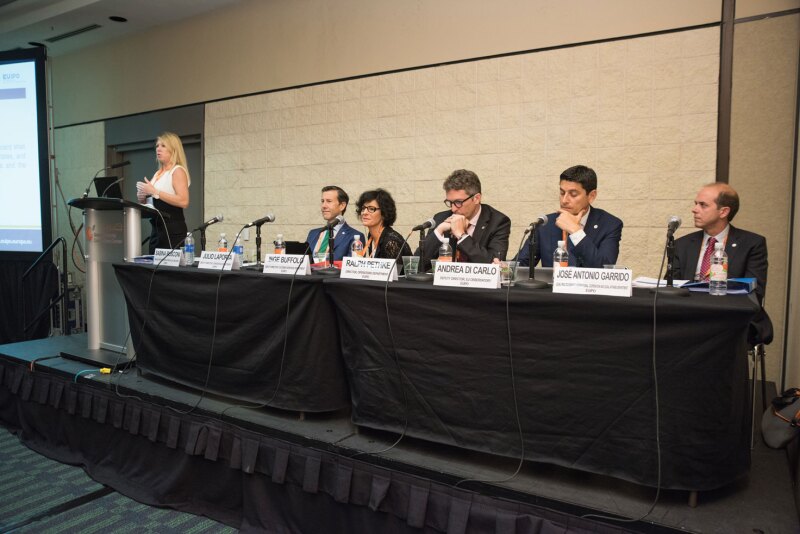
Speakers from the Office said that there have been price reductions across the spectrum of Office actions, including applications, renewals and oppositions. An extra fee is now payable after the first class, bringing to an end the old regime of three classes for the price of one.
There are also changes to some formalities and examination procedures. Absolute grounds of refusal have been expanded to cover, among other things, the functionality prohibition and to specify sui generis rights such as geographical indications (GIs).
Another high-profile change is that the scope of goods and services in a trademark specification will be given its literal meaning, following the IP Translator decision. Article 28(8) of the amended EU Trade Mark Regulation allows EU trademark owners who applied before June 22 2012 in respect of an entire class heading to file a declaration clarifying the goods and services they had intended to protect. Affected owners have until September 23, 2016 to make a declaration. Further procedural changes and the removal of the graphical representation requirement will come into force in October 2017.
The EUIPO is also conducting quality assurance reviews on various aspects of its work, particularly its decisions. There is now an ex-ante product quality audit by senior examiners and ex-post quality checks carried out by senior examiners on decisions. External stakeholders are invited to help with this. The Office also shared with the audience its Harmonized Database, a multilingual database of over 75,000 descriptions of goods and services in 23 languages.
The EUIPO provided five practical tips on how to work through the already implemented changes. They were: (a) With the new fee regime in mind, apply for the trademarks you need; (b) you now have the option to choose if you want to receive EU search report and surveillance letters; (c) beware of the sui generis rights such as GIs, check the database; (d) take note of the new requirement for proof of use; (e) be clear with your class headings and whether an Article 28 declaration is appropriate for you: the Office’s guidelines are available on its website.
Interview: Deputy Director of the EU Observatory Andrea Di Carlo and José Antonio Garrido Otaola of the EUIPO Operations Department
In an interview with the INTA Daily News, Andrea Di Carlo encouraged EU trademark owners to try the Enforcement Database (EDB), a free database available to Customs, Europol and national police forces. “The number of companies using it has increased to over 300,” he said. The Office is holding an EDB Forum from June 28 to 29, where brand owners can meet enforcement authorities.
Di Carlo also said he is pleased with the response so far to the launch of the DesignEuropa Awards, which recognizes those who use RCDs. The deadline for nominations is July 15. Finalists will be announced on October 15, and the ceremony will take place on November 30, 2016 in Milan.
During the session, Di Carlo presented a snapshot of the Observatory’s latest sectoral research, which found that the cost of counterfeiting in the EU is €62.6 billion in lost sales, 670,000 jobs and €11.5 billion in lost government revenues. The Office will be conducting and presenting further socio-economic impact studies, including in the entertainment industry, in the coming months. EUIPO is also supporting Europol with its IPR Crime Centre, which is expected to be launched in July.
The Office is working on various cooperation projects under its Vision 2020 Strategic Plan. Di Carlo told the INTA Daily News that the plan is expected to be endorsed by the Management Board next week.
Otaola said the Office saw a rush of goods and services declarations in the first two weeks following entry into force of Article 28(8) but the total number received so far is in the hundreds. He added: “The challenge is that we are seeing deficiencies in some declarations. You may need to use other procedures as an Article 28 declaration may not be the most appropriate for you.” Otaola urged brand owners and their representatives to carefully study the Office’s guidelines and President’s Communication on making declarations.


