

On January 1 2016, the IP enforcement system in Korea changed significantly. By amending the Civil Procedure Act and the Court Organisation Act, Korea centralised the jurisdiction of both the first instance and the appellate courts of infringement actions.
Centralisation of infringement courts
The most prominent change is that the number of district courts that can receive IP dispute cases at the first instance level was significantly reduced. Before 2016, patent infringement actions could be filed in any one of the 58 district courts around the country. However, as of January 1 2016, only five specialized IP district courts (in Daejeon, Daegu, Busan and Gwangju and Seoul) have exclusive jurisdiction in the first instance over certain IP infringement disputes. The main purpose of the change is to improve expertise of district courts in IP matters. Under the new law, it is still possible for the receiving court to transfer cases to courts other than the five district courts when it is necessary to avoid undue delay or significant harm.
Among the five selected district courts, the Seoul Central District Court is probably the most important and experienced among the infringement courts. Until now, the Seoul Central District Court has received the majority of patent infringement cases from all over the country. According to statistics published in the report "Status Analysis of Patent Litigation Decisions toward Centralization of Infringement Courts (December, 2010)", the Seoul Central District Court received more than half of the whole civil infringement actions in the past 10 years which range from years 2000 to 2009. In this time, the Seoul Central District Court received 213 civil main actions over a total of 413 cases. The new system now allows the Seoul Central District Court to hear any infringement disputes at first instance, even those cases that other district courts already have jurisdiction over.
The new system also centralised the jurisdiction of appellate courts. In the past, decisions from the 58 district courts could be appealed to the 23 high courts or panels of the courts. However, now, they must be appealed to the Patent Court.
At present, this new system only applies to lawsuits involving the five different types of IP rights; patents, trade marks, utility model, designs and plant variety protections (patent-related). The courts for trade secrets and copyright remain the same, and actions can be brought to any district court which has personal or subject matter jurisdiction.
Old court system
Korea1
New court system
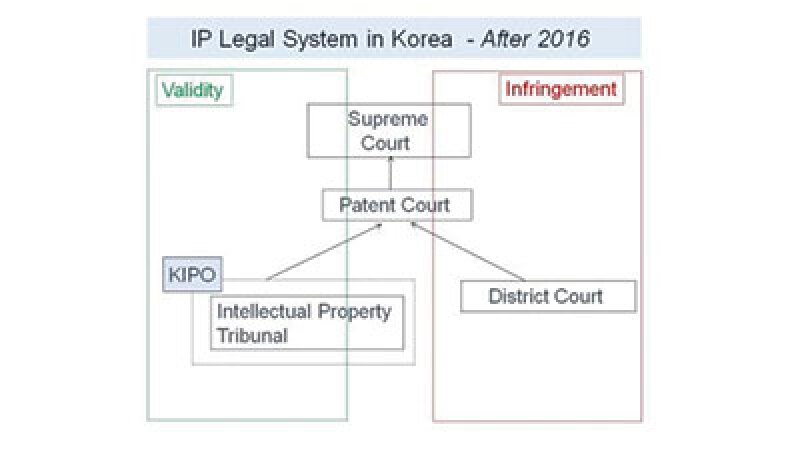
Centralisation and bifurcation
In Korea, patent infringement and validity are determined by different courts. Unlike the infringement lawsuits, a validity action must be filed with the Korean Intellectual Property Tribunal (KIPT) within the Korean Intellectual Property Office (KIPO). The decision from the KIPT can be appealed to the Patent Court. This proceeding has not changed, and will remain functioning as it has before. However, because the Patent Court now receives all infringement appeal cases exclusively for patent-related matters, proceedings for validity and infringement can now merge at the Patent Court. In the past, it was the Supreme Court that harmonised or integrated decisions from the Patent Court and the High Court. As the Korean Supreme Court decides matters only on points of law, this change will give prominence to the role of the Patent Court which is similar to the Federal Circuit in the United States.
New turn in Korean IP system
Like many other jurisdictions, the validity decision has a great influence on the outcome of patent infringement litigations in Korea. In the last five years, nearly one third of patentees lost their patent litigation case because the patent was invalidated.
Due to the bifurcated system, a decision from the validity court and infringement court could, in theory, conflict with each other. Inconsistent decisions from the different courts for the same matter derogate the courts' reputation, and produce discord inside and distrust outside. In rare cases, decisions by the courts conflicting with the other for the same matter do occur in actuality.
To minimise this undesirable result, the infringement court usually stays the procedure until a decision for validity is made, when both validity and infringement proceedings are pending. However, this is not always the case. Further, a recent case (Supreme Court Decision 2010 Da 953390, January 19 2012) ruled that the infringement court can deny injunctive relief and damages when the court believes the patent is obviously invalid, even without a nullification decision from the validity court, which may cause even more discord. The new centralised jurisdiction system gives more power to the Patent Court. Hopefully, the new system will make up for the weaknesses of the bifurcating system by integrating the two different proceedings at the Patent Court level.
The future trend in the IP world appears to be convergence and harmonisation of diverse system and culture. This change may be coming and spreading slowly and whispery like the music of "The fountain of Valle Giulia at dawn" by Respighi, but it may soon develop shiningly like the "The Triton Fountain in the Morning".
Min Son
Partner, Hanol IP & Law
HANOL Intellectual Property & Law
6th Floor, 163, Yang Jae Cheon-Ro, Gang Nam-Gu
Seoul 06302, Republic of Korea
Tel: +82 2 942 1100
Fax: +82 2 942 2600