


Korea requires a number of drawings for design applications showing several views that usually comprise one perspective view and six principal views (e.g. front, rear, right, left, top and bottom view, etc.) such that the design for protection can be clearly identified.
As some countries require fewer views for design applications, when a Korean design application claims priority to an application from such countries, KIPO may request the submission of additional drawings that were not included in the priority application. However, if the additional drawings submitted to satisfy the Korean requirements are not recognised as consistent with those of the priority application, there is a possibility that the priority claim may not be allowed.
Effective from January 1 2019, the Design Examination Guidelines have been revised to clarify the standards for allowing a priority claim under Korean practice.
Design Examination Guidelines now provide criteria for allowing priority claims
According to the revised Design Examination Guidelines, if a priority application contains only one or two drawings (e.g. perspective view only, or front view only, etc.), drawings of other views which are virtually identical to those included in the priority application can be added to a Korean application with priority so as to comply with the Korean requirement for drawings.
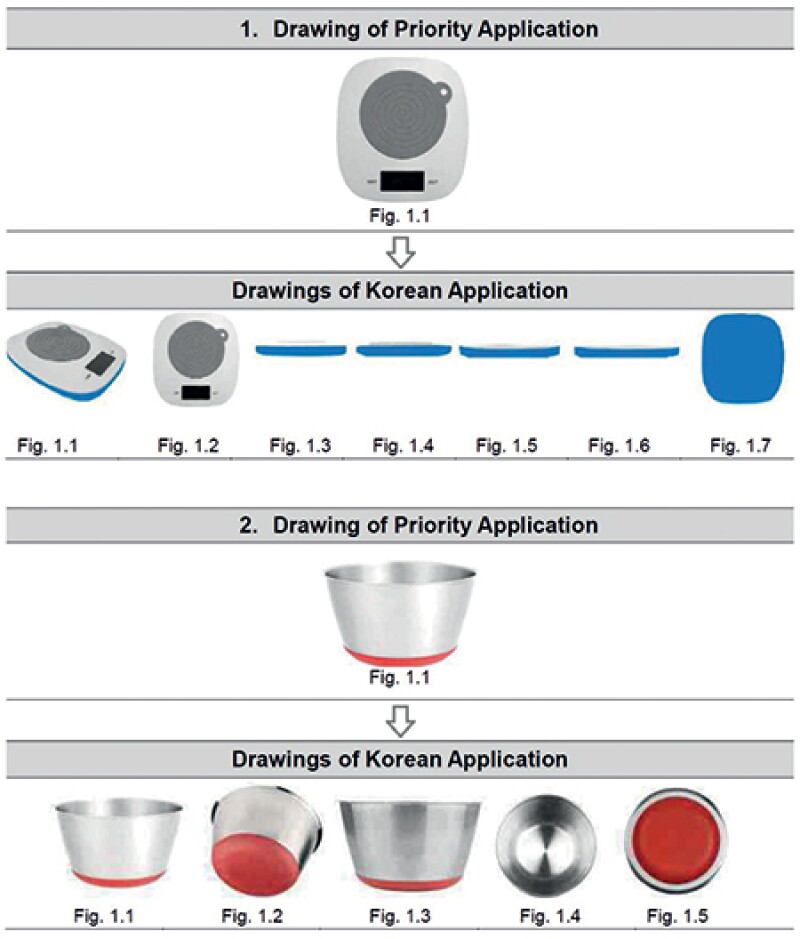
For example, if a priority application has only one drawing and a Korean application with priority contains new additional drawings, the priority claim may be allowable in the following cases:
1) Filing a partial design in Korea
In circumstances where an EU application for kitchen scales includes only one drawing of a front or perspective view, as illustrated below, the priority claim would be accepted when (i) a Korean application is filed for a partial design; (ii) additional drawings of other views contained in the Korean application are substantially identical to the drawing of the priority application; and (iii) the Korean application states in the description of the design that "the blue portion is not subject to registration" (please note that the blue portion is not visible in the drawing of the priority application).
2) Filing an entire design in Korea
If an EU application has only one drawing of a front or perspective view, as depicted below, and a Korean application with additional drawings of other views is filed for an entire design, the priority claim would be accepted if the additional drawings of the Korean application can be clearly recognised or expected from the drawings of the EU application by a person having ordinary skill in the art.
Invalidation action may be triggered based on priority right
In a recent invalidation trial case regarding a priority claim (2018dang2270 rendered on November 8 2018), the Intellectual Property Trial and Appeal Board (IPTAB) of Korea decided that the original decision allowing a priority claim was appropriate because the drawings in the Korean application at issue and its priority application filed in Japan were regarded as virtually identical to each other even though they were not exactly the same.
In this case, a cross-sectional view, an enlarged view, and reference views were included in the priority application. However, these drawings were not submitted in the Korean application claiming the priority right. The petitioner filed an invalidation trial against the Korean design registration on the basis of the discrepancy between the drawings in the priority application and the Korean application. The IPTAB was of the opinion that the drawings additionally contained in the priority application merely illustrated the design in a clear and specific manner. In light of this, the IPTAB dismissed the petitioner's invalidation action since the designs in the priority application and the Korean application were regarded as virtually identical, despite the differences in the number of drawings, and thus ruled that the recognition of the priority right at the examination stage was correct.
As the petitioner appealed against the IPTAB's decision, the appeal is currently pending at the patent court.
Remarks
The criteria set forth in the revised Design Examination Guidelines is based on existing examination practice and does not expand the scope of priority recognition. Under current Korean design practice, priority claims may be rejected when additional drawings included in a Korean application are not deemed to be virtually identical to the designs in the priority application.
In circumstances where additional drawings are required for filing Korean design applications, it is safe to take the following two-step approach: (i) at first, file drawings identical to those of the priority application so that the priority claim can be allowed, and (ii) if an office action is issued on the basis of lack of drawings after recognition of the priority claim, then submit additional drawings when responding to the office action.
Min Son
Partner, Hanol IP & Law
HANOL Intellectual Property & Law
6th Floor, Daemyung Tower, 135, Beobwon-ro, Songpa-gu
Seoul, 05836
Republic of Korea
Tel: +82 2 942 1100
Fax: +82 2 942 2600


