
The awards were presented at a panel hosted by Managing IP at the Hong Kong Trade Development Council’s Business of IP Asia conference. The recipients in attendance also discussed the holdings in each case and what lessons there are for companies looking to do business in the region.
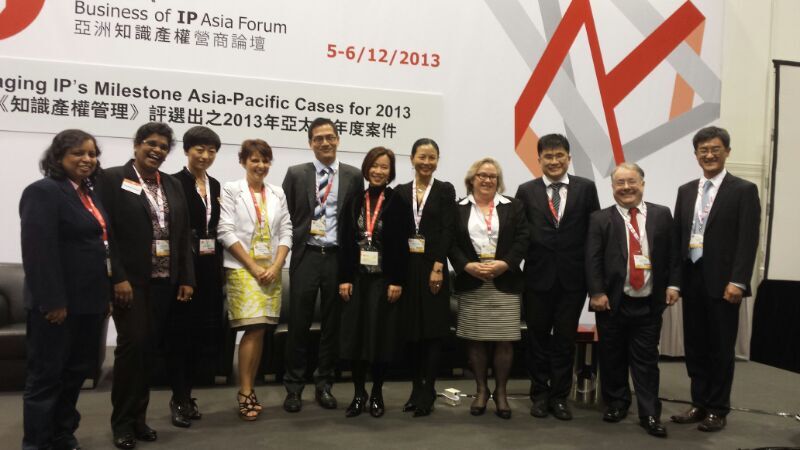
|
From L-R: Alka Mehta (Cipla), Prathiba Singh (Singh & Singh), Amy Gao (Huawei), Marilyne Serafin (Longchamp), Peter Leung (Managing IP), Winsome Chan (HKTDC), Charmaine Koo (Deacons), Colleen Platford (Gilbert + Tobin), Ye Zhao (King & Wood Mallesons), David Llewelyn (King’s College London) and Ik Hyun Seo (Cho & Partners) |
Australasia - Google v Australian Competition and Consumer Commission
In this case that cleared up the liability of publishers for misleading statements made by third parties, the Australian High Court held that Google was merely a conduit for the statement of others and not responsible for misleading ads.
The winning party Google was represented by Gilbert + Tobin.
Hong Kong - Tsit Wing Coffee v TWG Tea
This dispute before the Hong Kong High Court demonstrates the importance of a coordinated global strategy. The High Court found the TWG Tea’s registration of the TWG mark should be blocked because it was confusingly similar to the TWG mark already held by Tsit Wing Coffee. The court in particular noted that TWG Tea had taken contrary positions in jurisdictions where it had registered its mark before Tsit Wing and arguing in those markets that the marks were similar, and that this damaged its case in Hong Kong.
Tsit Wing was represented by Deacons.
India - Novartis v Union of India
The India Supreme Court found that Novartis’s blockbuster Glivec drug was not patentable because it was in violation of section 3(d) of the Patents Act, which states that new forms of known substances are not patentable unless the new form shows enhanced efficacy. The application was successfully challenged by generic manufacturer CIPLA and Ranbaxy, both represented by Singh & Singh, and Cancer Patients Aid Association, represented by the Lawyers Collective.
Mainland China - Huawei v InterDigital
The Guangdong High Court in two related cases found that InterDigital, the US-based patent assertion entity, abused its market position when negotiating the licensing terms for its standards-essential patents involving 2G and 3G data transmission violated China's Anti-Monopoly Law, awarding Rmb20 million ($3.3 million) in damages and setting a royalty rate. It found that InterDigital’s bundling of patents, as well as its filing of cases before the ITC in the US, ostensibly to put pressure on Huawei, to be improper use of its market power.
Huawei was represented by King & Wood Mallesons.
North Asia - Longchamp v AI International
The Korean Supreme Court adopted the ruling of the Seoul High Court in finding that AI International’s handbag violated unfair competition laws because it was confusingly similar to Longchamp’s Le Pliage bag. Longchamp used surveys of relevant consumers to prove that the Le Pliage design was distinctive and associated with it, a technique not often used in Korea.
Longchamp was represented by Cho & Partners.
Southeast Asia - Staywell Hospitality v Starwood Hotels & Resorts
In a decision handed down less than a week before the event, The Singapore Court of Appeal ruled that Staywell’s Park Regis mark was confusingly similar to Starwood’s Saint Regis, rejecting Staywell’s argument that because there would be no likelihood of confusion because the Saint Regis hotel is considerably more upmarket than the Park Regis. It noted that this standard is improper at the opposition stage because once the mark is registered, Staywell can choose then to open a luxury hotel using the Park Regis name.





