

The Standing Committee first met in full at the last Congress, in Toronto in 2014. At that meeting, it identified two important issues as the transitional regime applicable under Section 83 of the UPC Agreement, and the applicable law. As Committee chair Alan Johnson of Bristows said: “It was felt to be right that AIPPI should push toward harmonisation in these areas.”
Confusion and uncertainty
Annsley Merelle Ward, secretary of the Committee, said that Article 83 had led to “confusion and uncertainty” in particular regarding European patents that are opted out of the UPC during the transitional period. “If you don’t opt out, where can you litigate that patent, or where can litigation be forced on you?” she asked. There is a risk, said Merelle Ward, of conflicting decisions and a race to court. “The system is in danger of becoming the very thing it was intended to avoid. There is a fear of being ensnarled in procedural hearings about which court has jurisdiction.”
The Committee has published two papers in the past year, concerning jurisdiction of patent issues and substantive law issues under Article 83, and has made two proposals: that AIPPI members should urge participating member states (1) to take effective measures to clarify the meaning and effect of Article 83 (at least with an interpretative note) and (2) to take effective measures to amend their national patent laws to harmonise with those provisions of the UPC Agreement that differ from national laws “to the maximum possible extent”.
The panel also featured Niclas Morey of the EPO, Judge Peter Meier-Beck of the German Federal Court of Justice, Tina Chappell of Intel, Lawrence Welch of Eli Lilly and Michael Frohlich of BlackBerry. Welch highlighted the “legal and political questions” raised by supplementary protection certificates in the UPC. Chappell said judges in the UPC needed to have more discretion on the awarding of injunctions, and that there should be a clearly stated test for an injunction to be awarded. “We need to prevent an incentive to engage in abusive tactics,” she said.
The timetable
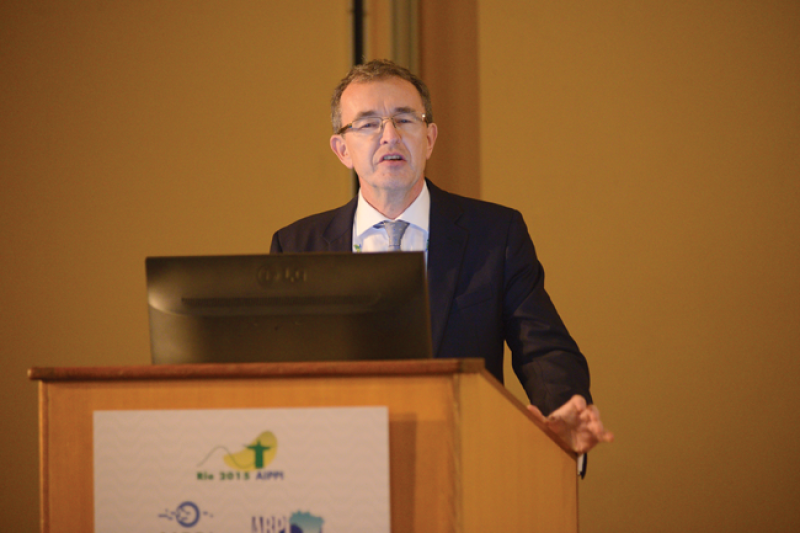
Morey confirmed that the EPO expects to issue the first Unitary Patent at the end of 2016, based on when ratifications are expected: 13 member states need to ratify the Agreement before it can come into effect, including the three largest filers of European patents. Of the 28 EU member states, 26 are taking part in the enhanced cooperation (the exceptions at present are Croatia and Spain). However, Poland’s government has indicated it is unlikely to join at the beginning. That means the Unitary Patent system will initially cover up to 25 countries. The EPO will soon be ready to undertake the additional responsibilities it will have for Unitary Patents, including administering translations, renewals and licences of right, said Morey. The select committee had held 15 meetings so far, and has another scheduled this week, at which the difficult issue of the distribution of renewal fees will be discussed. He also said that the Office will hold workshops in countries with many users of the European system, such as the United States and Japan, in the latter part of 2016 once the date of implementation is closer.
Judge Meier-Beck stressed the importance of having panels with a balance of experienced and inexperienced judges, so that the latter can learn on the job. He also emphasised the importance of the UPC Court of Appeal, saying: “It’s an open question what will happen at second instance level.” While the Court is expected to include some experienced judges from countries that have a lot of patent litigation, such as Germany, the Netherlands and the UK, the number of divisions (see map) and rules specifying impartial panels mean there will inevitably be judges who have less familiarity with patent disputes. Some potential judges have already begun courses at the Training Centre in Budapest.
AIPPI has two consultations underway, said Committee co-chair Thierry Calame of Lenz & Staehelin. One concerns the relationship between UPC and EPO opposition proceedings, in particular in situations where an injunction has been granted on a patent that is subsequently found to be invalid. The other concerns UP renewal fees and UPC court fees. Details have been sent to national and regional groups, with responses due by November 16, and anyone interested is urged to take part. As Alan Johnson asked the packed audience last night: “Within the next 18 months this will be a reality, and decisions will have to be made. As a committee, what can we do to improve things and make it as good as it can be; how can you help us?”





