One of our aims when we launched this blog, just under a year ago, was to be provocative, so here goes: there are good reasons to think that the continual and impressive growth in patent filing reported in the latest IP5 report will not continue, and that before long the number of applications will decline.
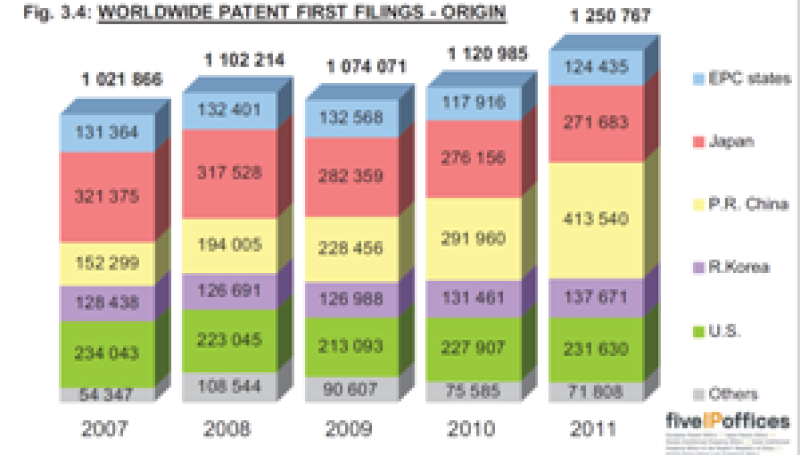
That proposition is counter-intuitive. Filings grew 11% in the five biggest IP offices in 2012. And, despite the economic downturn and R&D cuts, the trend over the past five years has been solidly upward: it’s been party time for patent investors, attorneys, offices and lawyers. Surely that trend is bound to carry on? Well, there are a few reasons for doubt.
First, note that the growth in the past few years has mostly been a story of emerging Asian economies catching up. According to the IP5 data (figure 3.4, above right), first filings in China increased by 271% between 2007 and 2011, while they actually declined in the EPC states, Japan and the US. This is largely a story of Chinese industry making up lost ground (spurred on, to some extent, by tax breaks and other incentives), a trend that is likely to plateau at some point, particularly if China tightens up on patentability (see China moves to curtail low quality patents and China looks to go beyond patent numbers). Admittedly, there may be a new China coming up behind (Africa, maybe?) but I doubt it will have the same impact on global filings.

Second, consider which industries use the patent system. Across the IP5 (with, surprisingly, the exception of SIPO), the biggest sector for patent applications in 2012 was electrical engineering, which accounted for 29% of EPO applications, 36% at the JPO, 37% at KIPO and an astonishing 50% at the USPTO (figure 4.3). But I suspect much of this has been driven by high-tech companies patenting defensively to prepare for cross-licensing and infringement suits. Allen Lo of Google said as much in the interview I did with him last month.
Patent practitioners in these companies would not put it like this, but I will: it is effectively an arms race, where each combatant needs to have a patent arsenal – even though everyone knows that much of that arsenal is impotent (that is, invalid) or ineffective (not likely to be infringed). It’s the numbers rather than the quality that matter, which is why we saw mind-boggling sums paid for the Nortel and Motorola portfolios (“It’s the chips, not the cards”). With the reforms introduced by the America Invents Act such as the CBM procedure, and the changes proposed in the Innovation Act, we might expect patenting in this field to slow down. If it does, I predict many corporate executives – and their accountants – will breathe a sigh of relief.

But (you might say), at least we can always rely on the pharmaceutical industry to keep filing patents. However, I wonder if that too may slacken? With compulsory licensing, challenges to blockbuster drugs (such as Glivec) and the difficulty of protecting second medical uses, some companies may conclude patents are more trouble than they’re worth. Post-patent cliff, it wouldn’t be completely surprising if companies look to other economic models and means of protection, such as trade secrets. One senior executive in the industry told me that he would happily stop filing patents altogether if there was effective regulatory data protection worldwide. I’m still not sure if he was joking.

Another challenge to the patent system is Big Data, which Joren de Wachter (left) has discussed in detail on his website and in a TEDx presentation. He argues that the exponential growth in information available as prior art should mean that, if offices do their job right, 100% of patent applications will be rejected: “A novelty-based patent system is unsustainable in an environment of exponentially growing prior art or publicly available information.” The result, he says, is that “businesses will have to become much more selective in applying for and using patents. Conversely, investors will have to re-assess their view on the value that patents add to a business.”

Finally, there are three business trends that could pose fundamental challenges to the patent system. One is 3D printing, which could make patent rights much harder to enforce. The second is crowdsourcing: if more inventions arise from community efforts, that raises questions about the principles of patenting, such as who is the inventor, what is the priority date, where did the invention take place and when was it first disclosed? The third is artificial intelligence: there is the prospect that some inventions in the future will not involve any direct human input at all. Where a computer comes up with an invention, who is the inventor – the person who programmed it, the one who wrote the code or the computer itself? In that situation, is there even a patent or an invention as such? Karl Pilny (right) raised some of these questions at the MARQUES conference in September.
I am not arguing that the patent system will or should cease to play an economic role, nor that it will suddenly stop being used by many inventors and companies, nor that all patent specialists are going to be out of a job overnight. But it is worth reflecting on some of these big trends: one thing we’ve all learned in recent years is that booms rarely last forever, and it is best to be prepared before they come to an end.
Do you agree? We’d love to hear your comments.