
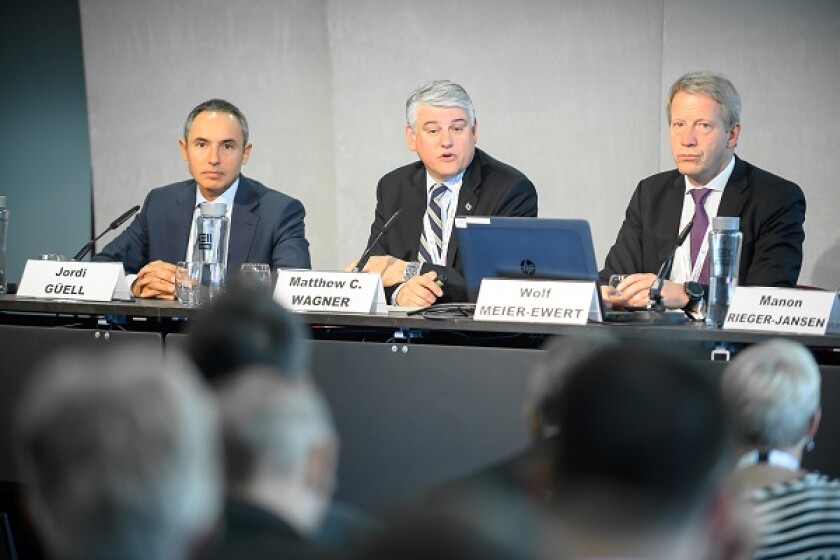
Matthew Wagner, general counsel at PDC Brands, discussed strategies for recording IP rights with US Customs and Border Protection (CBP) and shared stories from China. He was speaking at the 2019 AIPPI World Congress in London.
During the session, “Seize the Day – Customs and Border Control”, Wagner began by saying that between 4.2 million and 5.4 million jobs could be lost by 2022 as a result of counterfeiting and piracy.
Just 38,000 of the millions of US brands have active trademark or copyright recordations in the CBP system, said Wagner. “Industry doesn’t take enough advantage of the programme,” he added.
Providing tips on using the system, he said that pending copyright applications – but not pending trademark filings – can be submitted. He also advised companies to “get to know your CBP office and educate them about your goods”.
Sharing a challenging recent experience, Wagner explained that CBP detained some of his company’s goods for which there was no recordation – as the brand in question had not suffered from counterfeiting. PDC then had to prove ownership of the brand, hire outside counsel and even incur penalties from vendors because of late delivery.
On a more positive note, he recalled a story from China, which is still the world’s primary counterfeiting source. PDC had received information that someone was trying to record its brand with Chinese customs before seeking to export counterfeit goods. By recording its rights first, “we beat them to the punch,” Wagner said.
He explained some strategic recommendations that the CBP could implement to clamp down on counterfeiters. These include permitting exclusive licensees to submit and record IP rights, accepting design patents, using up to date technology to access databases used to track legitimate goods, and improving the sharing of data.
The session then heard from Wolf Meier-Ewert, counsellor at the World Trade Organization’s IP Division. He said that one of the “obscure provisions” of TRIPS is that signatory countries are supposed to maintain contact points for exchanging information on trade in IP-infringing goods.
However, “it’s a terribly underused system,” he said, as the contact points are “hardly ever” contacted. “It’s a great loss of something that could be quite useful,” he added.
Jordi Güell, of Güell IP in Barcelona, also spoke on the panel. He explained that Spain is in the top 10 EU countries for counterfeit seizures, also pointing out that Spanish (and EU) territory stretches close to Africa in the form of the Canary Islands.
He urged brands to be proactive and responsive, saying that an application for customs action should be used, “but if you really want customs to be active, maybe visit them, the spots where counterfeits come in, and train them”.
He added that, while budgetary limitations are understandable, brands should avoid having a minimum threshold of counterfeit goods seized before being willing to take action. This is because, he said, customs count the number of products they detain and may be less inclined to help the brand in future if it chooses not to follow up on a seizure.
The Congress finishes today.
Image credit: Simon Callaghan Photography





