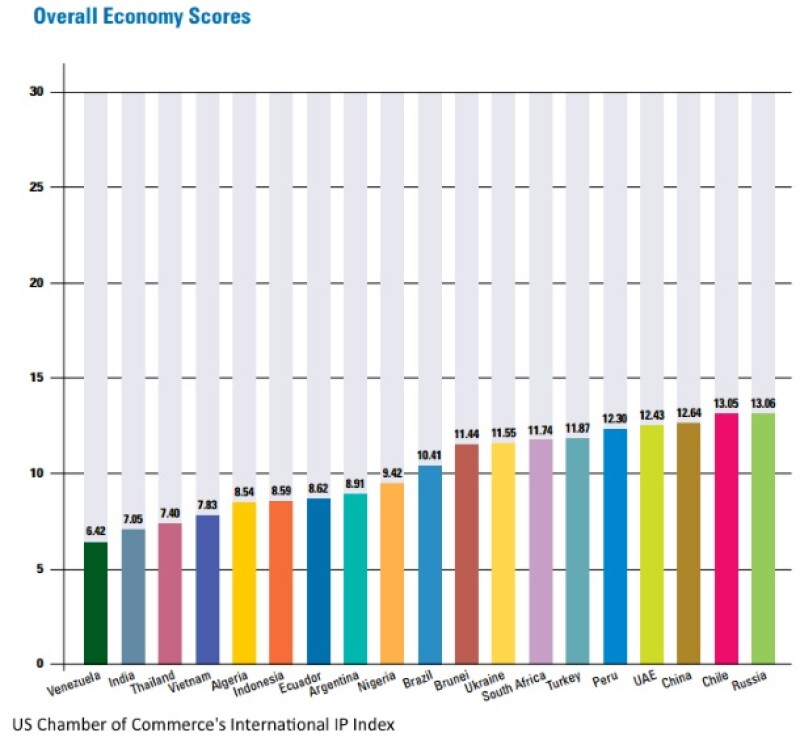
The US Chamber of Commerce this week released its 4th annual International IP Index. While the report can hardly be taken as an impartial view on the state of the global intellectual property landscape, it does give an insight into how the US views different countries and some of the changes that have been made in the past year.
The report is produced by the Chamber’s Global Intellectual Property Center (GIPC), and can be viewed here.
The least-shocking news, given the source, is that the United States ranks first in the list. Venezuela finished last out of the 38 economies studied, which account for nearly 85% of global gross domestic product (GDP).
The US believes half of the 38 economies benchmarked strengthened their IP system. This improved their overall score from last year’s Index. The index is based on 30 criteria including patent, copyright and trade mark protections, enforcement, and engagement in international treaties.
“This year’s Index illustrates that many countries embraced the upward momentum in the global intellectual property environment, and continued to take steps to improve their IP systems,” said David Hirschmann, president and CEO of GIPC.
Some examples of the positive momentum Hirschmann identified include: Canada extending the copyright term for sound recordings to 70 years from 50; Indonesia implementing regulations for the 2014 Copyright Act that creates an online notification system for rights holders to request action against alleged infringing websites; Israel introducing patent restoration for biopharmaceuticals and regulatory data protection for submitted clinical data; and Malaysia gradually improving its IP environment over the past four years.
The report also highlighted some economies the US Chamber of Commerce believes have “ample room to improve their IP environment”:
- The report said a number of economies, including Brazil, Russia, China, India and Indonesia, introduced or maintained policies tying market access to sharing of IP and technology.
- It said copyright protection remains a challenge in many high income economies in Europe including Poland, Switzerland and Sweden, particularly in the absence of policies to more effectively combat online piracy.
- Australia weakened the patentability of isolated-genetic material and biotechnology inventions when the Australian High Court reversed the Federal Court ruling in D’Arcy v Myriad Genetics.
- The US Chamber of Commerce believes Ecuador continues to actively pursue an innovation policy that in large measure undermines or weakens the protection of IP including the active use of compulsory licences for biopharmaceutical products.
- The US’s enforcement related to trade secrets theft and counterfeit seizures remains a weakness.