At a press conference on Monday for the release of the GII, questions arose regarding the exact definition of innovation. It was clarified that researchers adhered to the OECD’s Oslo Manual, which defines innovation as “the implementation of a new or significantly improved product (good or service) or process, a new marketing method, or a new organisational method in business practices, workplace organisation or external relations”.
The report compiled by WIPO, Cornell University and INSEAD, ranked national economies by measuring innovative activity within five pillars: (1) institutions, (2) human capital and research, (3) infrastructure, (4) market sophistication, and (5) business sophistication.
Time to refocus
Bruno Lanvin, INSEAD Executive Director for Global Indices, described the growth of global economies as “slow and remains even”, adding that this will likely to be the case for a number of years.
WIPO Director General Francis Gurry said one of the objectives of the report was to “renew focus on innovation”. For “its potential to open up new avenues of economic growth”, Gurry said the field of innovation deserves policy attention from individual governments.
Lanvin encouraged national governments to promote a culture in which innovation can thrive by reinforcing global governance and anticipate regulatory obstacles, adding: “Innovation is an area in which stop and go policies can be very damaging. If investment slows down from one year to the next, the benefits accrued from previous years might be erased very quickly.”
Who are the leaders?

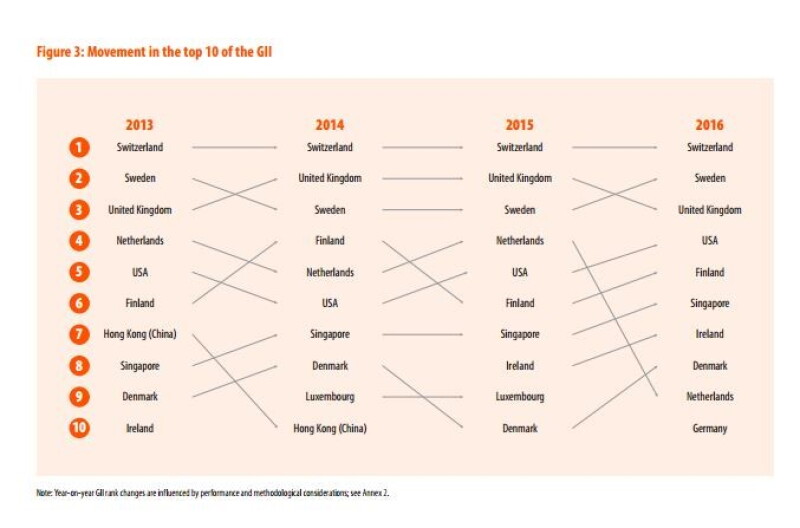
There was little variation between GII’s top 10 economies last year and this year; Luxembourg drops from 9th place to 12th in the Global Innovation Index rankings while Germany rises from 12th place to 10th. Switzerland has maintained its top position in the rankings for the past three years. The United Kingdom and Sweden have also maintained stability during this period of time, appearing either second or third in the rankings (figure 1). This year, Sweden ranks second and the United Kingdom third, followed closely by the United States in fourth position.
Kenya and Brazil are among a list of economies labelled ‘innovation achievers’, for performing at least 10% above peers on the same GDP level. Other countries in this group include Armenia, India (which notably jumps from 81st place to 66th) and ASEAN members including Vietnam and Singapore.
China, which has enjoyed steady economic growth for years, rises to the 25th spot on the Index, becoming the first middle-income country to join this group. The country scored highly for innovation in R&D, business sophistication and knowledge and technology, also appearing in the top 25 for quality patent filling.
Adapting policies
The Association of Southeast Asian Nations (ASEAN) stepped into the spotlight last year for its efforts in the field of innovation. Last November, the group issued the ASEAN Economic Blueprint 2025, outlining targets for the next 10 years which include plans to “foster robust productivity growth through innovation, technology and human resource development, and intensified regional research and development”.
During the GII release press conference, Gurry urged governments not to pay too much attention to year-on-year results, but to focus on ways to encourage global economic growth through cooperation with other economies. Last September, the UN released a 2030 Agenda for Sustainable Development which includes plans to “build resilient infrastructure, promote inclusive and sustainable industrialization and foster innovation”.
Lanvin said: “We are going to see more from emerging countries in the field of innovation in years to come.” The degree to which this will happen, Lavin said, depends on the approach of individual national governments to their existing policy frameworks.
“We live in a world where emerging countries need to invent their future and mature economies need to re-invent their models. Innovation in both cases is critically important.”
The full report is available here.