
The Patent Office considered an appeal filed by Brouwerij L Huygne company, Belgium on the decision of the examiner to refuse recognition in Russia of International Registration number 1141648 for goods in class 32 and services in class 43. The trade mark according to the International Registration is a depiction of a decapitation device, the guillotine, brought into general use by Dr Guillotin. For those who do not immediately understand there is also the word element "La Guillotine" across the device.
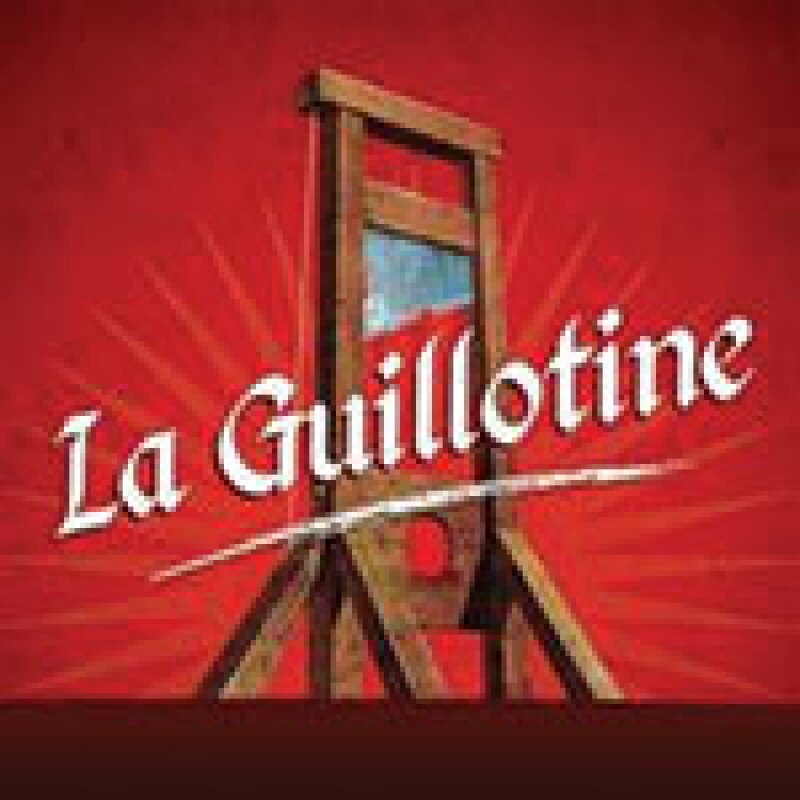
Initially the examiner refused registration in Russia arguing that the word and the picture of guillotine abuse public interest, the principles of humanity and morals when applied to goods such as mineral waters and juices (often consumed by children).
The applicant did not agree to the decision of the Patent Office and argued that the beer La Guillotine is produced by one of the famous breweries in Belgium with 500 years of history. He also argued that the beer was timed to coincide with the 200th anniversary of the French revolution and that the beer was of high quality. The applicant explained that the trade mark also carried a humorous meaning, namely it could be understood as "cutting off" thirst.
The Patent Office could but did not engage in repartee to state that a more appropriate connotation could be that the beer could "cut off' the mind after cutting off thirst, if consumed to excess. Anyway the Patent Office did not develop this idea and was satisfied with the request of the applicant to limit the goods to beer (thus "cutting off" children from the picture). Additionally the applicant stated that the trade mark, even if not registered, was used in Russia from 2009 to 2012 and was distributed by Russian companies Force Trade Ltd and Westbridge Ltd. Besides, the trade mark in question is registered in a number of countries where French is the official language including Benelux, France and other European countries.
The fact of registration of the trade mark in European countries is of special importance because Russia ratified the Agreement on Partnership and Cooperation with the European Community. Article 54 of the Agreement obliges Russia to ensure the same level of protection of intellectual property as exists in the European Community.
The Collegium of the Patent Office while accepting the appeal noted that depiction of a device for beheading people on the products such as waters, juices and other non-alcoholic drinks could indeed elicit negative emotions among consumers especially if such products could be consumed by children. However, since the applicant limited the list of goods and services to class 32 – beer the collegium decided that it was possible to grant protection for the trade mark.
The liberal attitude of the Patent Office in this case may be compared to a harsher approach of the OHIM in its decision on the appeal by Couture Tech Limited from BVI (case number 1509/2008-2). The applicant in that case sought to register the coat of arms of the former Soviet Union for some goods, such as perfume, jewellery, leather and badges. The registration was rejected because it could 'be perceived as an offence to the basic values and principles of the European Union". Even though the Soviet symbol was not understood by young people over 30 the Office rejected the appeal of the applicant.
In contrast to that, the US Federal Circuit's en banc reversal of In Rem Tam of December 22 2015 decided that refusal to register disparaging marks is unconstitutional and provided a detailed discussion to that effect. Different patent offices. Different decisions. They only testify to the fact that examination of trade marks and perception of trademarks by patent offices, by ordinary people and experts may be quite different. The conclusion: never surrender and fight to the end.

|
Vladimir Biriulin |
Gorodissky & PartnersRussia 129010, MoscowB. Spasskaya Str25, stroenie 3Tel: +7 495 937 6116 / 6109Fax: +7 495 937 6104 / 6123pat@gorodissky.ru www.gorodissky.com



