
Tech wars
A five-woman panel of in-house counsel, private practitioners and ITC judges shared their experiences of litigating technology in the first session of the day.

Joan McGillycuddy, chief IP counsel, Avon Products (centreof panel, right), explained that it is vital that litigators do not get lost in the technology. “Litigation is really about talking to people. Talk to people early. Your engineers and scientists are the ones in your business who know what the relevant documents are, even if they don’t know the names of them.”
But she emphasised that documents on their own do little to win a case. “It is the people who explain them. If you don’t appreciate that, then you won’t be litigating, you’ll be managing paper.”
McGillycuddy added that it is important for in-house counsel to train their business’s staff to understand the importance of maintaining documents, and of letting them go.
“Teach the new guys. It’s hard to let go of things but it’s important. Implement routine checks on people’s computers. Tell people: ‘Look, you have to take a Friday to deal with this’.”
Irene Kosturakis, chief IP counsel, BMC Software, outlined her experiences of managing document production at BMC. “Software developers are the biggest pack rats in the world,” she said.
The panellists also underlined the importance of maintaining professional relationships with opposing counsel during disputes.
“To protect you, private practice can sometimes get too aggressive and I have to stop them,” said Avon’s McGillycuddy. “We operate in a small community and we need to continue a relationship with these people.”
Monisha Deka, an investigative attorney at the US International Trade Commission (a venue that moderator Holly Engelmann of McKool Smith described as “litigation on crack”), provided a third party view on the importance on maintaining cordial relations.
“Part of my job is magistrating discovery calls. It never works if people start being unpleasant,” she said.
Bita Goldman, general counsel & VP of operations at Quantum Networks, said that lawyers should try to be kind to one another during litigation. “Don’t be hostile for the sake of it and never try to embarrass another attorney in court. Remember this is just one case in what I hope will be long careers.”
But she added: “Saying that, some attorneys are just unbearable. My theory is over-prepare and then go with the flow. Document everything you talk about but stay pleasant.”
NPE latest
Lawyers in two sessions dealt with the issue of non-practising entities.
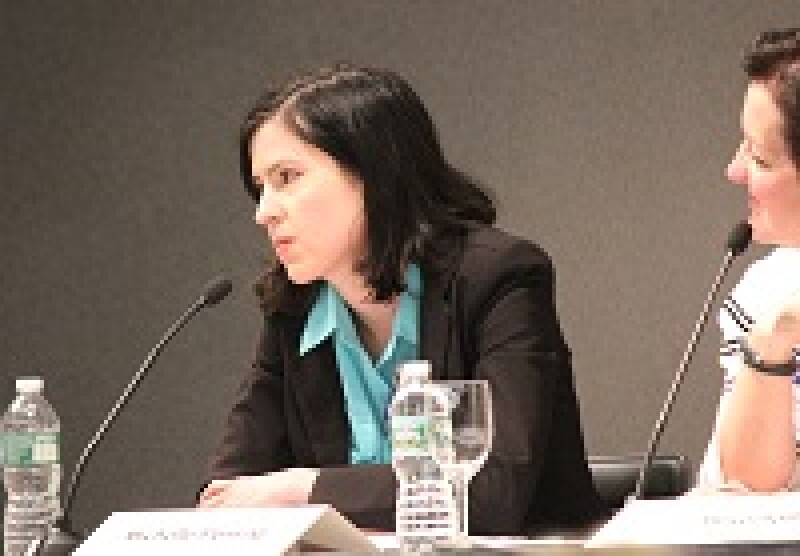
“When my company comes out with a new product I brace myself. It won’t just be attractive to consumers but also to NPEs,” said Michelle Fleming, general counsel at Digium (pictured on left), during a session moderated by lawyers from Baker & McKenzie. Fleming outlined some of the latest legislative proposals in the US to tackle what many regard as patent trolls’ potentially chilling effect on business arguing that more comprehensive proposals had stalled due to lobbying from the bar.
“Trial lawyers don’t like anything that smells like tort reform,” she said.
Fleming advised law makers to reject most of the piecemeal attempts to reform the law governing the behaviour of NPEs and back the Innovation Act. “It is comprehensive and strong. The risk is that if legislators don’t do that then NPEs will pick one of the other bills to support and say: ‘Look, we support patent reform’.”
In a session on the Unitary Patent and the Unified Patent Court, Catherine Lacavera, director of litigation at Google, suggested that one reason why NPE activity is higher in the United States than in Europe is because plaintiffs in Europe often need to pay a filing fee based on the size of their claim.
“Here, everyone asks for $1 billion,” she said.
But she voiced concern that European policy makers are considering setting lower court fees for SME users of the new UPC system. “We have seen in Texas than when carve-outs are on offer entities restructure as SMEs.”
Katie Blakley, global patent counsel at Bayer HeathCare Diabetes Care, concluded the session, moderated by lawyers from Powell Gilbert, by reminding the predominantly American audience that they need to prepare a strategy for the Unitary Patent and UPC.
“You need to revisit your licence agreements in the light of the opt-out provisions and consider the kind of arrangements you will put into co-development deals in the future.”
“There’s a lot to do,” she said.
More information about the International Women's Leadership Forum can be found on the dedicated page.