Deanna Okun |
||
|
|
Title: Chairman, International Trade Commission Budget outlook: “No one knows what will happen when the super committee [the 12-member committee of Congress that must make the budget cuts mandated by the debt deal] comes back, but the Commission has had a very good record with Congress explaining the work we do. I think they recognise the importance of the IP part of our work.” Biggest challenge: “The cases themselves are complex, the technology is complex. The number of patents and the number of respondents has increased. So while we’ve made good resource choices, being able to do these within the target dates is a challenge.” |
The International Trade Commission is an unusual beast. An independent, quasi-judicial branch of government, its commissioners are appointed by the president and arguably provide the most effective IP enforcement in the US. Nestled in the heart of Washington DC's Southwest Federal Center district, the ITC reminds visitors of its government ties with airport-like security and strict rules against walking around without an escort.
On the day Managing IP travelled there, the Commission's chief administrative law judge, Paul Luckern, had just resigned unexpectedly. The atmosphere was buzzing with change, and desks piled high with case documents bore witness to a looming problem: as the ITC's workload continues to grow, resources are being cut or capped, presaging a crisis for an agency many view as the last US rocket-docket for patent cases.
Unlike district courts, the ITC has power over products, rather than people, and can order Customs to take action directly at the borders to block infringing technology. That broad power, coupled with lightning-fast judgments compared with district courts, has resulted in a steady increase in IP filings since about 2000, when globalisation and advances in technology led to smaller, smarter products, incorporating more IP rights and distributed by many different companies around the globe.
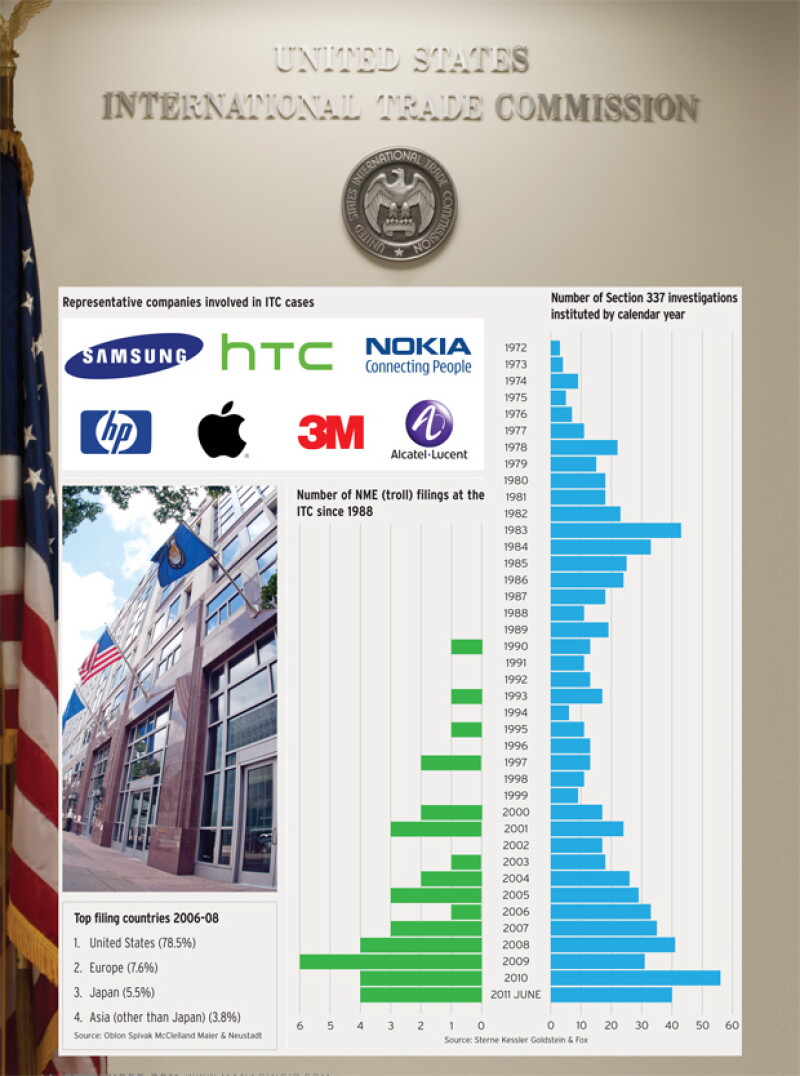
This has increased both the complexity of cases and the number of cross-filings. In 2010 there were 56 new section 337 investigations at the ITC, compared with only 31 in 2009. As of August 2 this year there were already 43, with no indication of a slowdown. The words 'record year' were dropped frequently during Managing IP's interviews for this article.
Add to all of this two fewer administrative law judges (ALJs) – the judges who preside over section 337 investigations – a cap on hiring in the ITC's Office of Unfair Import Investigations (OUII), diminishing courtroom space and a budgetary future as bleak as the rest of the US government's, and it's hard to understand how the agency plans to keep up.
Deanna Tanner Okun, ITC chairman and the person responsible for keeping the agency humming, admitted it has been a bit of a struggle during an interview with Managing IP from her corner office on E Street southwest. "The Commission has had to make hard choices in an environment where the budget's not likely to grow," she says.
The ITC edge
While many IP-related ITC investigations feature some of the biggest global companies (see box), the Commission categorises its cases according to technology, or articles, as designated by the governing statute, Section 1337 of the US Code. If articles are deemed infringing, the Commission has the power to bar those products from being imported into the US – and in some cases can extend the order to any infringing product, even if its manufacturer was not named as a respondent in the investigation.
In a recent case brought by American footwear company Crocs, for example, the Commission issued a coveted general exclusion order barring all footwear incorporating features covered by Crocs' two asserted patents from entering the US, arguably marking the end for any business seeking to import foam footwear. More often, however, the Commission issues a so-called limited exclusion order, which only bars products named in the investigation – essentially a permanent injunction in half the time, and enforced with the help of US Customs and Border Protection.
A second ITC benefit is the absence of juries. This is particularly helpful for foreign companies, which have brought a record numbers of filings in recent years. "It's very hard to explain to companies from countries that do not have a jury tradition that there will be 12 people who are neither subject-matter experts nor know anything about the case deciding it," says ITC administrative law judge Theodore Essex, whose desk is crowded with briefs. "It's hard to explain to them why that's a good idea."
Theodore Essex |
|
Title: Administrative law judge Case load: 12 active cases Biggest challenge: “Creating a record in such a way that the Commission can make a reasoned decision and, if I do my job really well, so that the Federal Circuit can. And I think as we go forward, doing that at a faster pace will be important.” Advice to parties: “We do things very, very rapidly; we have to in order to keep up. Firms need to make allowances for that. I’ve had parties come to me and complain that depositions were scheduled in two different sites on the same day. My answer to them is: “How many attorneys are in your firm? Well, put one in each spot.”. |

And of course there's the need for speed – probably the single biggest factor in deciding to use the ITC. With so-called rocket-dockets like the Eastern District of Texas backed up after years of being flooded with cases, the ITC may be a company's only hope for speedy resolution. "Speed is a major attractive feature of the ITC," says Eric Schweibenz of Oblon Spivak McClelland Maier & Neustadt. The Commission is mandated by the statute to resolve cases at the "earliest practicable time after the date of publication" of an investigation. Generally, the target timeline is 16 to 18 months, compared with the typical two years (often much more) it takes in the courts.
But lately, sticking to that timeline has become a challenge. The Office of Administrative Law Judges was whittled down from six to four in two months, following the departures of ALJ Carl Charneski in July and former chief ALJ Paul Luckern in August. Luckern's exit seemed unexpected – acting chief Charles Bullock says "it was a surprise", and Okun seemed equally stunned the day of Managing IP's visit. The two courtrooms devoted to section 337 investigations are no longer enough, so the Commission's main hearing room has been opened for use by ALJs – but scheduling is still tricky. Plans for construction of a third courtroom, for which the Commission received funding last fiscal year, are in flux until the budgetary outlook becomes clearer. "I think in the fall there will be a decision and we will have to revisit the courtroom," Okun told Managing IP. "I feel that as chairman you can't guarantee anything, but right now we are giving it a lot of importance."
Despite such impediments, most seem to think the ITC has been coping quite well. "The Commission's been doing an excellent job," says Daniel Yonan of Sterne Kessler Goldstein & Fox. "Even when it lost a number of ALJs it really geared up nicely."
But there is no denying that meeting its statutory mandate for speed is beginning to require compromise.
We are not a law firm
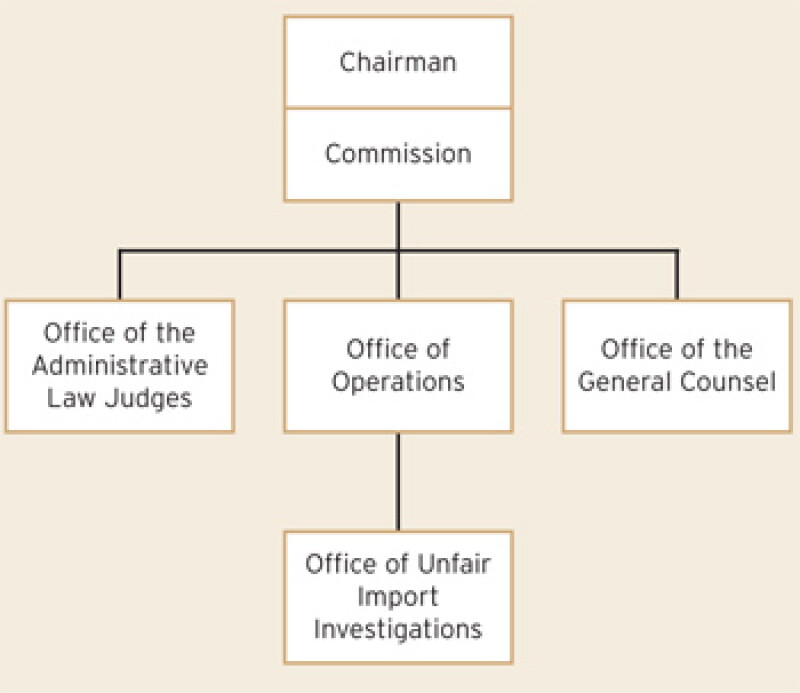
One of the "hard choices" Okun has had to make was to limit the number of cases in which the OUII staff participates. Referred to by practitioners and the Commission alike as the staff, the OUII is an independent office within the Commission that represents the public interest in ITC cases. Its role is to provide a complete record for the Commission – but since January it has had to make some tough decisions of its own about how to allocate resources.
Traditionally, OUII has participated in every investigation instituted by the Commission. But as part of the Supplement to the Strategic Human Capital Plan 2009-2013, published in January, the Commission decided "that an increase in the share of agency resources devoted to OUII is not feasible or warranted in light of government-wide budgetary limitations and the need to adequately fund other agency operations".
As a result, OUII's staff was allowed to fall from an over-hire of 17 attorneys to 15 where it is now capped, plus three supervisory attorneys and director Lynn Levine. But a bigger change is that the Office is experimenting with a number of "alternative staffing approaches", including not participating in cases at all.
Lynn Levine |
|
Title: Director, OUII Case load: The 15 OUII staff attorneys are juggling 53 cases between them. In three of those cases, the staff is only participating on some of the issues. Biggest challenge: “Trying to deal with the increasing number of new matters and implement the new staffing models in a way that allows us to make the most significant contributions we can, in as many cases as we can.” Advice to ITC litigants: “One thing I’ve seen is a tendency to put in more and more patents and claims in a case. The expectation should be that this will lengthen the case. Choose your patent and claims wisely, from the beginning.” |

"It's still evolving," says Levine, speaking with Managing IP from a conference room in OUII headquarters – a bustling agency-within-an-agency located on one of the the lower floors of the Commission: "This has been in place for a limited amount of time." The system is so new that none of the practitioners Managing IP spoke with for this story have yet had a case without OUII on board. And they don't want that to change.
"I think it's a big deal [that OUII participation is being limited]," says Eric Schweibenz. "And clients think it's a big deal." The prevailing view is that the staff adds a unique and impartial perspective that can help parties to shape their arguments. "In every case they add value, even when they don't agree with us," says Schweibenz.
Since the staff attorneys work with the same judges consistently, they know their individual rules better than most. Each ALJ can set his own ground rules for cases, which can play an important part in helping things to run smoothly. For instance, Essex prefers written direct examination to live examination. "I prefer it because it lets a witness lay things out in his own time, and it saves time," says Essex, who at one time banned coffee during his proceedings: "I changed that when I realised it might keep some of them awake."
And in a venue with such tight timelines, no rule should be viewed as trivial. Levine says "it is critical for anyone who gets into an ITC case to read the ground rules. You want to go through them line by line". Being able to consult with the staff on procedural issues is one of the key benefits of their participation to both parties and judges, says Essex. "The OUII will often make its biggest impact in ways that never appear on the record," says the judge. This is particularly the case with respect to procedures like discovery, which is a very different process at the ITC than in district court.
For that reason, Essex would prefer a future that includes the staff. "If we were not talking about realistic budget and personnel limitations, my preference would be to have them in each case," he says. But Essex, like his colleagues, is all too aware of the reality: "The Commission is doing a good job at allocating resources at a time of scarcity, at a time when we're having problems," he says.
Practitioners seem similarly uneasy, if understanding. "[The staff] serve a very important role," says Adam Seitz of Shook Hardy & Bacon, who dubs the Commission's decision to limit staff participation "unfortunate": "Parties get entrenched in their own positions; they're a very good check and an independent voice."
Schweibenz points out that now may be a particularly bad time to take staff off cases, since the Commission's increasing popularity means more new faces from general practice rather than ITC specialist firms trying investigations. "It's certainly an area where they could save a lot of resources, but there's also a risk to it," he says. "Attorneys may try to get creative without the staff there."
Yet others feel the plan is a good one. Former ALJ Carl Charneski, who joined Brinks Hofer Gilson & Lione after leaving the ITC in July, says that the new staffing model could be "a good experiment in a sense": "Staff are stretched just like the judges. It makes sense to focus the resources."
And Okun says sense is what the Commission's decision was all about. Unless the Commission could increase its budget every year, she knew something was going to have to give. Even before the debt deal agreed by the US government in July, which promises $2 trillion in cuts to government spending, Okun says the Commission knew it could not secure a rising budget. "OUII was playing the role of staffing every case that comes in the door. We decided that we don't need to become a law firm staffing these cases," says the chairman.
Levine seems confident in the Commission's and her own ability to judge which cases the staff are needed on most. As of press time, the staff was not participating in 17 of the 70 pending cases that were before the Commission, and was only selectively participating in another three. "This office is going to participate on cases in which there are public interest issues at a minimum – at least selectively," says Levine.
Judges are the priority
Instead, Okun and her colleagues – there are six ITC commissioners in total, who are appointed by the president – decided to focus their increasingly limited resources on the ALJs, who are under more pressure than ever. Each judge has typically had access to one clerk, plus a pool of so-called floating clerks. Soon, however, each will have two attorney-advisers expressly devoted to his case load. Acting chief judge Charles Bullock and Essex got their second clerks last month, and the rest will be added in order of seniority. The hope is that these additions will "ensure the continued efficient operation of the growing office", according to the Commission.
But Charneski says he's not sure having two attorneys will speed things up. "The work may be higher quality, but I don't think it's going to translate into what they think," says Charneski, who was with the Commission when the decision to add clerks was made. "When they announced that, I thought: 'It's just going to give me more work to do'."
Charles Edward Bullock |
|
Title: Acting chief administrative law judge Case load: 11 (plus seven cases carried over from retired chief judge Paul Luckern) Biggest challenge: “The number of cases. We’ve just become so popular.” Advice to ITC parties: “(1) Come to the proceeding prepared to work hard to meet the procedural deadlines; (2) expect there to be consequences for not meeting procedural deadlines; and (3) do not expect deadlines to be extended except for the most extraordinary of circumstances.” |

That's because judges must review everything produced by attorneys and are ultimately responsible for the quality of determinations. With the Commission – and possibly the Federal Circuit if the final ruling is appealed – depending on judges for a solid decision, they can't just "sit back", says Charneski: "You have to roll up your sleeves and get dirty."
Acting Chief Judge Bullock says he's hopeful that the attorney additions will get cases moving faster. Additionally, he intends to help streamline cases by holding more claim construction proceedings and requiring parties to use mediation more often. But will that be enough to keep up with the rate of filings? "It's hard to say what the future is," says Bullock, who is being considered for the chief judge position along with other candidates. "Clearly the US budget in general is tight."
ITC office-level organisational chart |
|
Cracking down
Is the ITC reacting by trying to curb the number of filings? In one final determination issued last month regarding GPS navigation technology, the Commission said that parties must show a sufficiently strong nexus between licensing efforts and the asserted patent in order to establish domestic industry – one of the crucial factors for successful institution of a section 337 investigation. Under the statute, parties must demonstrate significant investment in the US "in plant and equipment; employment of labor or capital; or its exploitation, including engineering, research and development, or licensing". Prior to 1988, complainants had to have manufacturing plants in the US, but that was changed in anticipation of the transition to licensing-based business models. As a result, it has been exceptionally easy for non-practising entities to use the ITC. Complaints filed by so-called non-manufacturing entities (NMEs) have increased steadily since 1990 (see chart).
In the GPS investigation brought by Pioneer against Garmin, the determination further noted that complainant Pioneer's licensing model appeared to be "revenue-driven", rather than the "industry-creating, production-driven licensing activity that Congress meant to encourage". Many see this as a direct criticism of so-called patent trolls, who have been taking up much of the agency's docket lately.
"The Commission seemed to be pulling the reins back," says Seitz of Shook Hardy, who represented Garmin. "The flood of cases coming in based on licensing was getting substantial. It was a way to curtail those cases."
While Seitz is confident that the decision will ease the case load in the long term, the effect won't be immediate, and it could still be appealed to the Federal Circuit. However, since the Federal Circuit might defer to the ITC on a policy issue such as domestic industry, Seitz says he is hopeful the determination will stick.
"That's so new that we are going to have to wait and see," says Bullock. "Anything that would simplify the case load is a good thing."
The secret's out
Trolls aside, the real reason for the increase in ITC cases may be simply that "the cat's out of the bag", says Yonan. "General counsel at all of the major corporations are talking about the ITC," he adds. And with the word out, companies will continue to flock to this forum year after year, whether or not the agency is ready. "This enhanced level of section 337 activity is expected to continue for at least the next several years," wrote the Commission in its Human Capital Plan.
Despite the tax on its resources, the Commission does not view this onslaught of cases as an abuse of the system. While there are those who feel the smartphone industry in particular has made the ITC a patent battleground, "that's the law", says Okun.
Instead, she says it is the Commission's job to keep up by hiring effective ALJs who can weed out the bad actors. "It's important to have ALJs in place that understand the judge's role is to help move these cases along," adds the chairman, who was in the process of hiring two replacement ALJs when Managing IP met with her in Washington.
But without the ability to hire more judges, how will Okun and her fellow Commissioners meet the demand? The Human Capital Plan notes that the Commission may need permission to hire a seventh ALJ "if target date extensions reach unacceptable levels" – a request that is likely to be denied in the context of the US government's debt crisis. In past years, the Commission has expanded the ALJ staff from three to six as necessary.
Practitioners have begun to feel the effects of this struggle. "Timelines have been pushed out," says Maureen Browne of Covington & Burling. "There are lots of retaliatory actions taking up a lot of the docket." While Browne notes that many of the cases are between the same few parties, which means several can be knocked out at once if a settlement is reached, she and others have noticed the delay.
While timing may not be the only attractive feature for ITC plaintiffs, in a world where the latest technologies can become irrelevant in a matter of months, it is arguably the most important. "You'd expect the ITC to become less attractive if timings push out," says recent ALJ Charneski. "Everywhere I go, you hear that the speed of the ITC is a very attractive commodity; so who knows what's going to happen?"
With space, staff and budgets all crunched, it seems that timings will simply have to give, and patent holders will have to find new ways to enforce their patent rights quickly. And, while its efforts to reallocate resources and keep up with the workload have been valiant so far, the Commission knows it. Says Essex: "At some point, if they keep filing at the rate they are, are we going to have more cases than we can handle? The answer to that would have to be yes."