PTAB “arbitrary and capricious” in denying motion to amend – CAFC

Managing IP is part of Legal Benchmarking Limited, 1-2 Paris Gardens, London, SE1 8ND

Copyright © Legal Benchmarking Limited and its affiliated companies 2026

Accessibility | Terms of Use | Privacy Policy | Modern Slavery Statement

Cookies Settings

PTAB “arbitrary and capricious” in denying motion to amend – CAFC

taranto.jpg

The Federal Circuit has remanded the Veritas v Veeam Software case back to the Patent Trial and Appeal Board, finding its reason for denying a motion to amend “unreasonable”

federal-circuit-court300.jpg

The Federal Circuit has vacated the Patent Trial and Appeal Board (PTAB)’s denial of a motion to amend in an inter partes review, and remanded the case back to the Board to address the patentability of two proposed substitute claims, in its Veritas Techs v Veeam Software decision.

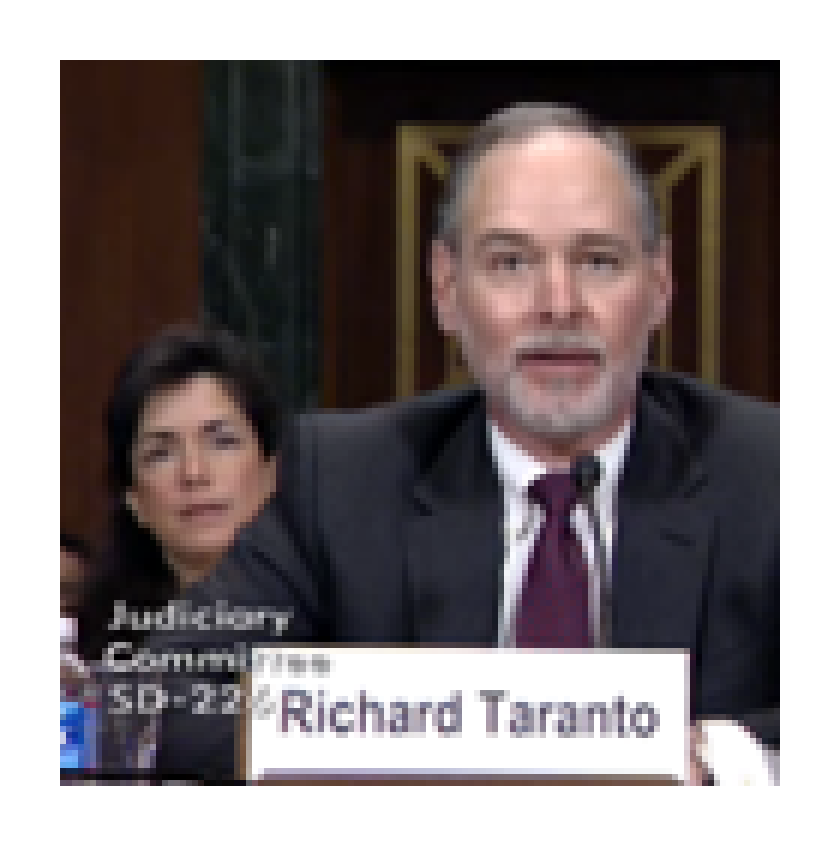
“We vacate the Board’s denial of Veritas’s motion to amend because the Board was arbitrary and capricious in its sole ground for denying the motion,” said the appeals court in an opinion written by Judge Taranto, and joined by Judges Lourie and O’Malley. “We remand for the Board to consider the patentability of the proposed claims, which, Veritas asserts, have the narrower claim scope (limited to file-level background restoration) that Veritas unsuccessfully urged for the original claims.”

The court affirmed the Board’s construction as the broadest reasonable interpretation of the claims and therefore uphold its obviousness determination.

An unreasonable conclusion

The case involves a computer patent owned by Veritas Technologies that describes and claims systems and methods through which, while certain processes for restoring computer data are in progress, particular data sought by an active application may be given priority for restoration and made immediately accessible to the application.

The central issue addressed by the Board and presented in the appeal was whether the claims are restricted to file-level restoration or are broad enough also to cover block-level restoration.

After institution, the patent owner (Symantec at that time) filed a conditional motion to amend, seeking to add new claims 26 and 27 if the Board ultimately concluded that the challenged existing claims are unpatentable. In its April 2015 final decision, the Board resolved the parties’ claim-construction dispute at the heart of the proceeding, concluding that the claims were not limited to file-level background restoration processes but could reasonably be read as also covering block-level restoration processes.

Based on that construction, the Board rejected all of the challenged claims for obviousness. The Board also denied Veritas’s motion to amend, though without making an evidentiary determination of patentability of the proposed claims 26 and 27. It concluded only that Veritas and its expert declarant had failed to address something the Board said must be addressed, namely, whether each newly added feature in each proposed claim, as distinct from the claimed combination of features, was independently known in the prior art.

taranto.jpg

The Board denied the motion based on its insistence that the patent owner discuss whether each newly added feature was separately known in the prior art,” wrote Taranto. "The Board concluded that the motion and the declaration of Veritas’s expert, Dr Levy, do not discuss the features separately but discuss only ‘the newly added feature in combination with other known features.’ … That conclusion, the sole basis for denying the motion to amend, is unreasonable and hence must be set aside as arbitrary and capricious.”

It concluded: “We do not see how the Board could reasonably demand more from Veritas in this case.”

K Lee Marshall of Bryan Cave argued for Veritas.

Bryon Leroy Pickard of Sterne Kessler Goldstein & Fox argued for Veeam. 

Playing hard to get

The PTAB has been notoriously reluctant to grant motions to amend. A USPTO report released in May revealed that six of 192 motions to amend had been granted or granted in part. The Board had been ultimately required to review 118 of those, with 5% granted or granted in part. A seventh motion to amend has since been granted, to ContentGuard in July.

In a surprising move, the Federal Circuit in August granted an en banc rehearing of In re Aqua Products to address two issues related to the claims amendment process during PTAB trials, neither of which were at issue in the Veritas case.

The two issues are:

- (a) When the patent owner moves to amend its claims under 35 USC § 316(d), may the PTO require the patent owner to bear the burden of persuasion, or a burden of production, regarding patentability of the amended claims as a condition of allowing them? Which burdens are permitted under 35 USC § 316(e)?

- (b) When the petitioner does not challenge the patentability of a proposed amended claim, or the Board thinks the challenge is inadequate, may the Board sua sponte raise patentability challenges to such a claim? If so, where would the burden of persuasion, or a burden of production, lie?


more from across site and SHARED ros bottom lb

More from across our site

Anita Polott, who is celebrating three decades at Morgan Lewis this year, reflects on career progression, stepping into unfamiliar territory, and leadership frameworks
Technical excellence remains essential, but many firms are discovering that packaging IP with complementary practice areas can unlock new clients and a stronger competitive position
As international interest in Southeast Asia grows, Sheng Rong Tng discusses how changing client demands and the firm’s multidisciplinary model are helping it compete for complex regional mandates
Todd Hopfinger, director in Sterne Kessler’s electronics practice group, says IP owners are contemplating how patent rights will be enforced as commercial activity expands beyond Earth
Christopher Stothers' arrival strengthens the firm's life sciences, technology and UPC offering as competition for top European litigators intensifies
Armstrong Teasdale’s Jim Heinen Jr discusses the challenge of balancing billables, business development and family life and explains why not all patent lawyers are science nerds
From cross-border jurisdiction to the end of the transitional period, Powell Gilbert’s Ioana Sabau and Bryce Matthewson predict the biggest talking points ahead
A wave of office launches and lateral hires reflects the draw of patent disputes, but booming AI, semiconductor and data centre markets are offering an even bigger IP opportunity
The hire of Frederick Nicolle as a partner continues Pinsent Masons' expansion while reducing Simmons’ patent prosecution offering in London to zero
The expansion into Granada forms part of a national ‘decentralisation’ strategy focused on providing proximity to research and tech businesses away from traditional hubs
Gift this article