Three ways Leahy's retirement could shake up IP

Managing IP is part of Legal Benchmarking Limited, 1-2 Paris Gardens, London, SE1 8ND

Copyright © Legal Benchmarking Limited and its affiliated companies 2026

Accessibility | Terms of Use | Privacy Policy | Modern Slavery Statement

Three ways Leahy's retirement could shake up IP

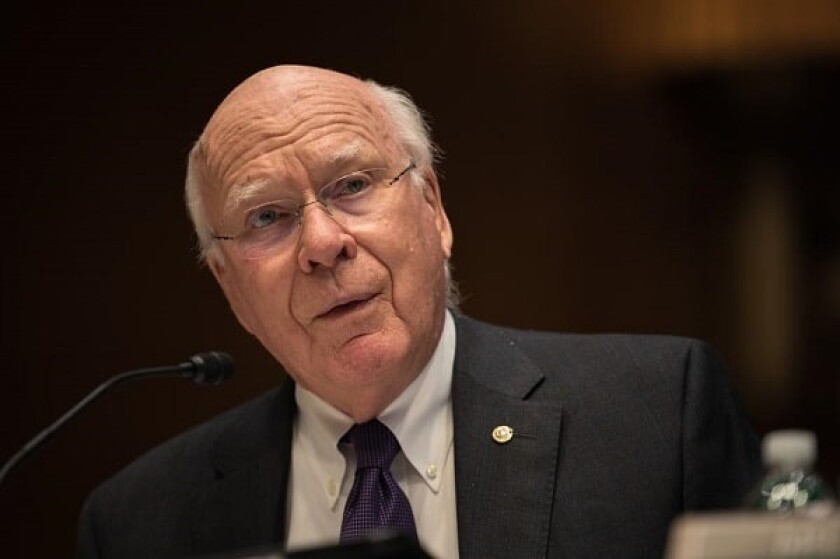
 Senator Patrick Leahy

Leahy’s departure will leave Congress with less direction on IP matters, but could also speed up PTAB reform and hand more influence to pro-patent people

When Senator Patrick Leahy retires next year, the US Congress will have lost one of its most important intellectual property champions – but different IP stakeholders could lose more than that as a result of his imminent departure, according to in-house and private practice counsel.

Leahy announced on Monday, November 15 that he would not seek re-election in 2022, bringing an end to his long career as a senator for Vermont, which he started in 1975.

Among his IP-related achievements, the senator, 81, introduced the Leahy-Smith America Invents Act, which came into effect in 2011 and established the Patent Trial and Appeal Board (PTAB). He currently serves as chair of the Senate judiciary IP subcommittee.   

Related stories

·Counsel predict Leahy’s PTAB bill will pass, but with changes

·Every IP subcommittee senator wins re-election – what now?

·Counsel expect STRONGER Patents Act to drop again soon

Manny Schecter, chief patent counsel at IBM in New York, says the loss of Leahy’s leadership is very unfortunate.

“With any strong leader, you’re always going to face changes when they leave,” he says. “That might affect things going forward, but what you miss the most is the wise advice they imparted upon the system.”

Sources say that as well as creating an absence of a key IP advocate, Leahy’s retirement might shake up IP in at least two other ways.

Senator Chris Coons could take Leahy’s position on the subcommittee if the Democratic Party maintains its majority, handing back control of the group to those more critical of the PTAB and the so-called watering down of patent rights.

But before that, Leahy and other pro-PTAB stakeholders might make the passage of the Restoring the America Invents Act a priority. The sooner the bill passes, the sooner patent owners will lose their advantage at the PTAB afforded to them by the Fintiv rule.

Leahy acts as the Senate’s president pro tempore, which means he’s third in line to the presidency. He is also chair of the Senate Appropriations Committee and presided over former president Donald Trump's second impeachment trial.

One: Less direction

Counsel say they valued Leahy’s prioritisation of IP even when they didn’t agree with him.

Marc Ehrlich, an IP consultant in Connecticut, says he wasn’t on the same side as Leahy on every issue, but it was good that the senator got IP discussed in legislative circles, nonetheless.

“We’ve lost a big IP champion,” he says.

He notes, however, that there are other senators who are interested in IP, such as Coons, Thom Tillis and Mazie Hirono. Any one of those might step into Leahy’s shows and serve as a more critical driving force on IP matters in the future.

The head of patent litigation at a generic pharma company says it’s important to keep reaching out to these senators, and others too, to explain why IP is important and why they should follow in Leahy’s footsteps.

Two: Come back STRONGER

The person who could well step into Leahy’s shoes at the Senate’s IP subcommittee, of course, is Coons – a prospect that will thrill some stakeholders and infuriate others.

One reason counsel expect Coons to take the chairmanship is he was previously the ranking member of the IP subcommittee.

He held this position from the subcommittee’s reformation in 2019, when the Republican Party held the majority, until 2021.

Plenty of onlookers thought Coons would become the chair after the Democrats won a majority in the Senate, and many were surprised at the start of the year when Leahy was picked to lead the subcommittee instead.

If Coons takes the position, advocates for a more patent-friendly regime might get more sway in the Senate.

Coons favours strong patent rights and has on several occasions introduced legislation that would buttress patent protection, including the STRONGER Patents Act.

Coons first introduced STRONGER (Support Technology & Research for Our Nation’s Growth and Economic Resilience) more than six years ago in March 2015 (S632). He reintroduced the bill in 2017 (S1390) and again in 2019 (S2082).

Each time, the bill has sought to “restore and strengthen the US patent system by implementing measures to make it easier and less costly for patent holders to enforce their patents”.

As Managing IP reported in October, Coons is expected to release a new version of STRONGER soon, though it isn’t known what the latest iteration would entail.

The generics head of IP litigation says he expects Coons would want STRONGER to take a more prominent role if he became head of the subcommittee. “That would be a little bit concerning because there are a lot of problems with that particular bill,” he says.

Other counsel are less certain that Coons would change the IP subcommittee’s agenda.

Scott McKeown, partner at Ropes & Gray in Washington DC, says there have been attacks on drug pricing in the Senate. Even though Coons has been pro-biopharma in the past, that doesn’t mean he will promote unpopular legislation that favours innovator companies. And he may not get much support from others in his party if he does.

More attorneys point out that it’s far from certain that the job will go to Coons.

The Democrats could – and according to some predictions, probably will – lose their Senate majority in the 2022 midterms, handing the position to a Republican (most likely Thom Tillis, who served as chair under Trump).

Other democrats more senior to Coons could also take the chairmanship, if they were so inclined.

And there’s no guarantee that there will still be an IP subcommittee after the elections –  although there probably will be.

Joseph Matal, partner at Haynes and Boone in Washington DC, points out that the continued existence of the subcommittee will depend on the relationships among members, who’s in the majority and who’s chair of the Senate Judiciary Committee.

If the Judiciary Committee chair (currently Dick Durbin) changes hands, and that new person has a different set of views on IP than the chair of the IP subcommittee, he or she might move to disband said subcommittee.

But Matal adds that if the Democrats retain the majority, Durbin will likely remain as chair of the judiciary committee – which could actually improve Coons’ chances of getting the chair position because Durbin has co-sponsored STRONGER in the past

Three: PTAB reform ramp up

Coons’ STRONGER Patents Act has yet to pass, but Leahy’s latest bill may have more success in his final year as a senator – especially if he pushes for its passing, as some predict he will.

Leahy and Republican senator John Cornyn introduced the Restoring the America Invents Act bill in September, which would eliminate discretionary denials under the Fintiv rule among other things if enacted.

The Fintiv rule sets out that administrative patent judges (APJs) can deny institutions on the basis that parallel proceedings in the district courts will finish first.

The head of patent litigation at the generic pharma business says his company will likely step-up advocacy for this bill now that Leahy is set to leave because the senator will be an important advocate for the change. “You need every vote you can get,” he says.

A lot of the push to get this bill passed may come from Leahy himself, say sources.

McKeown at Ropes & Gray says Leahy will want to pass the bill that builds on his namesake legislation before he leaves. “I don’t know whether his retirement makes it any more or less likely that it will pass, but it certainly communicates urgency,” he says.

Not all counsel expect Leahy’s retirement to affect the passage of the bill, however.

Schecter at IBM says he hasn’t seen anyone make strategic changes to their lobbying strategies so far, but it’s too hard to say at this point whether they will.

A strategy change may not be needed because the bill could still pass even if Leahy is no longer in office. The bill’s co-sponsor Cornyn won’t face re-election until 2026, after all.

Jonathan Stroud, chief IP counsel at Unified Patents in Washington DC, says that even if lobbyists manage to delay the passage of the bill, other senators will likely revive parts of it in the future and try to get it through in some form.

“You can always find a sponsor for something. Leahy’s probably a better champion than others but he may not be the best one. It could be that the Restoring the AIA has a better advocate in a new senator.”

Even if Leahy doesn’t push this bill through, it won’t take away from the fact that he has been enormously influential in IP matters. The IP community will feel his absence – but if other senators can champion IP like he did, it might soften the blow. 

more from across site and SHARED ros bottom lb

More from across our site

Apple’s lawsuit against OpenAI, which features Tier 1-ranked disputes firms on both sides, reflects how trade secrets litigation is becoming a prominent competition feature
Drew & Napier’s leadership appointments show one way full-service firms can back up claims about the strategic importance of IP
Strike-out application will hear claims that the copyright aspect of an IP infringement claim brought by a gambling and sports betting group should be dropped
Amongst a sea of mergers, Lathrop GPM and HG Law have set out plans to combine, positioning themselves to compete with both IP boutiques and full-service firms
Patrícia Paias explains why she loves the science and business behind an idea and why potential rights owners must avoid the ‘file and forget’ philosophy
Lawyers eagerly await news of what IP specialist Sir Colin Birss will bring to one of the England and Wales judiciary’s most important roles
María Aurora García of Berken IP explains how intellectual property rights holders can use customs monitoring and online enforcement tools to identify parallel imports and support compliance with consumer protection rules
The Jakarta-based firm says personal networks and a distinctive strategy can help it guide foreign clients through what can be a tricky IP landscape
Munich litigation boutique formed by former Taylor Wessing partners continues expansion as it seeks to cement its position in the UPC market
Yvonne Tang and Siau Wen Lim, the second and third IP specialists to sit on the firm’s management committee, say IP is ‘uniquely positioned’ to support cross-practice work
Gift this article