
Patent Trial and Appeal Board (PTAB) proceedings celebrated their second birthday on September 16. Two years in, with the popularity of inter partes review (IPR) and covered business method (CBM) reviews taking most by surprise – including the Board itself – it is clear there is increasing pressure to meet the 12-month deadline for a final written petition from when a petition is granted.
A new report from Goodwin Procter – called “The Patent Trial and Appeal Board Second Anniversary: Reflections and strategies for the years ahead” – assesses the state of play two years in and finds that there has been a big adjustment process over that period.
In the first year of proceedings, one IPR petition was filed a day on average. But after the first written decision on an IPR in November 2013, an average of two petitions were filed a day, or about 60 a month. Now, more than four petitions are filed a day on average.
This has led to “trimming” of trial schedules, according to Goodwin Procter. When the proceedings began, the PTAB gave patent owners a full nine to 10 months to prepare the papers exchanged during the trial and present an oral hearing. This has lately been cut down as a result of the Board putting pressure on participants to complete proceedings in five to seven months to give more time to prepare the final written decision before the 12-month statutory deadline to complete proceedings set out in the America Invents Act (AIA).
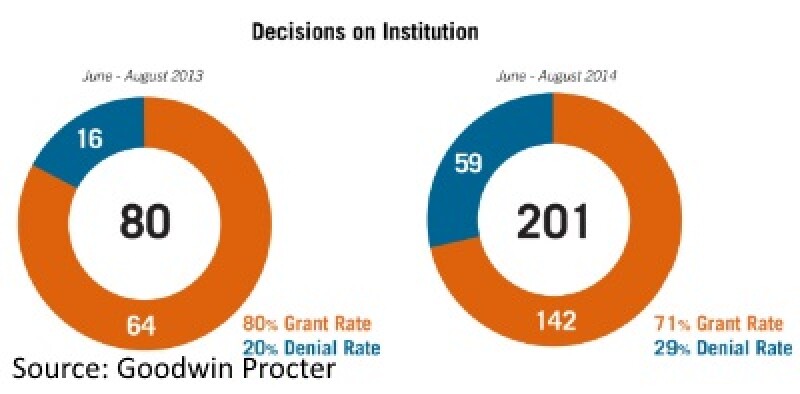
The institution rate has also shifted over the two years. Early on, more than 80% of IPR and CBM trials were instituted. This high “success” rate encouraged others to file petitions. In the past six months, however, the institution rate has dropped 10 percentage points. For example, from June to August 2013 the institution rate was 80%. For the same period this year, it was down to 71%.
Goodwin Procter notes that more than 70% of all petitions filed as of September 11 this year were for electrical or computer patent claims, with 15% for mechanical patents, 13% for chemical/bio/pharma and the remainder accounted for by design patents.
“But this distribution will undoubtedly change in the months and years to come, as PGR proceedings kick-off in earnest and the number of chemical/bio/pharma related petitions are expected to substantially increase,” says the report.
“A PGR challenge is available for a wide variety of grounds (including indefiniteness). Pharmaceutical companies, and generic producers in particular, who may wish to invalidate a patent more quickly than is possible in most district courts, are likely to ramp up their filings. Second-filer generics that enjoy no Hatch-Waxman exclusivity may have nothing to lose by filing a PTAB proceeding.”
Settlements are rising, and are now close to 200 a month. About 12% of all claims under review were disclaimed by the patent owners by filing a terminal disclaimer or request for adverse judgment.
Staying power
One of the biggest concerns among those looking to use the PTAB is whether district courts will stay cases until the AIA trial is completed. More than 80% of patents challenged in PTAB trials are involved in co-pending district court litigation.
According to Goodwin Procter, 72% of IPR or CBM motions to stay are granted, excluding orders denying motions without prejudice. While it was expected stays would be almost a foregone conclusion, judges have not agreed.
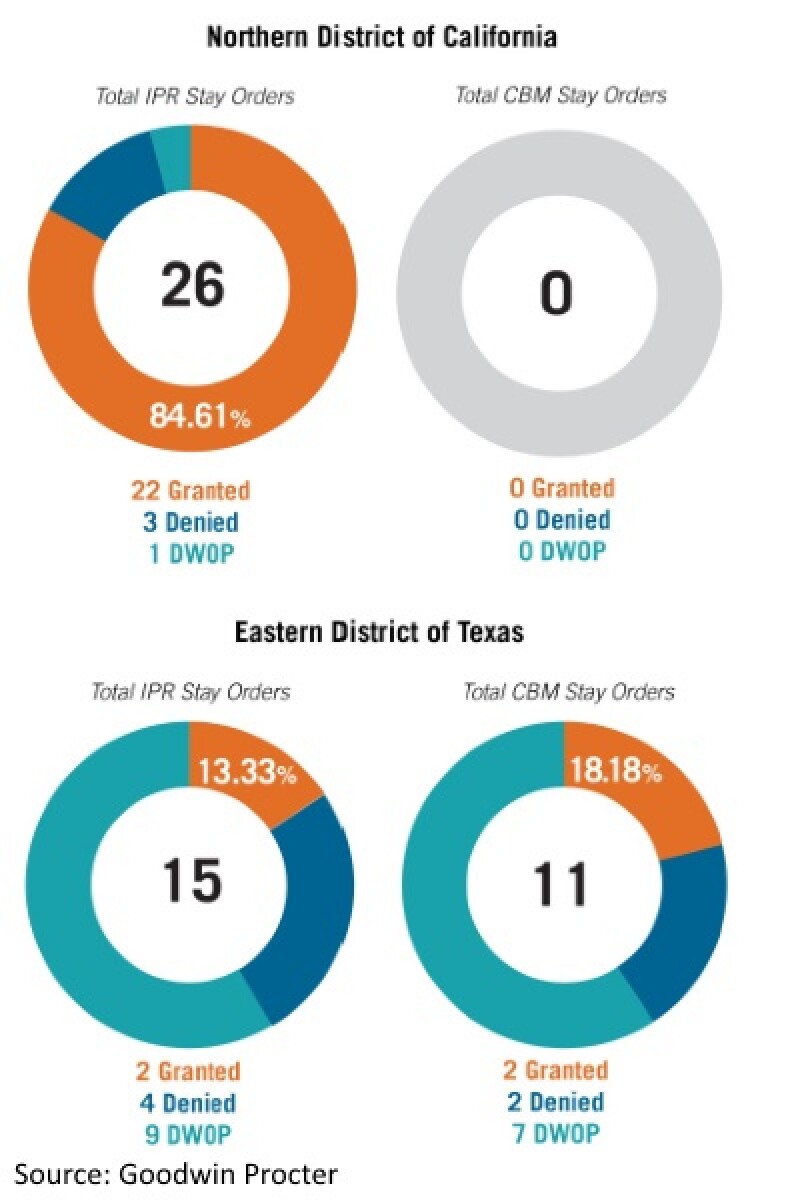
The Northern District of California is the most “stay-friendly” court, according to Goodwin Procter, while the Eastern District of Texas is the least. Courts such as the District of Delaware and the Central District of California are somewhere in the middle.
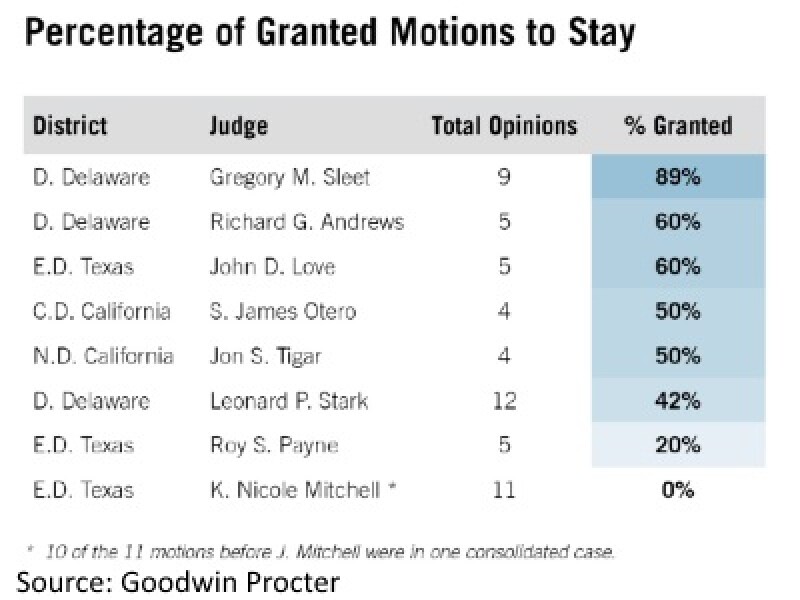
A look at a selection of judges reveals that you better hope John Love is your judge if you are looking to get a stay in the Eastern District of Texas. His 60% grant percentage compares with 20% for Judge Roy Payne’s and 0% for Nicole Mitchell, Rodney GIlstrap, Leonard Davis, Michael Schneider and William Bryson.
Another popular patent court, the District of Delaware, shows an interesting split between judges, with Judge Gregory Sleet granting 89% of motions to stay, Judge Richard Andrews granting 60%, Judge Christopher Burke granting 50%, Judge Sue Robinson granting 50%, and Judge Leonard Stark granting 42%.
For IPRs, district court weigh three factors: whether discovery is complete and whether a trial date is set; whether a stay will simplify the issues and trail of the case; and whether a stay would unduly prejudice or present a clear tactical disadvantage to the non-moving party.
For CBM reviews, district courts consider the same three factors as for IPRs but must also consider a fourth: whether it would reduce the burden of litigation on the parties and the court. When the AIA was being discussed Senator Charles Schumer claimed this fourth factor should place a “a very heavy thumb on the scale in favour of a stay”, making it “nearly impossible to imagine a scenario in which a district court would not issue a stay”.
The report identifies a ray of hope for those nervous about getting a stay – even in courts deemed as unfriendly to stays. The Federal Circuit issued a strong smack down to the Eastern District of Texas earlier in July. It said the district court was wrong not to stay infringement proceedings in VirtualAgility v Salesforce pending the conclusion of a CBM review.
The Federal Circuit said: “Under the statutory scheme, district courts have no role in reviewing the PTAB’s determinations regarding the patentability of claims that are subject to CBM proceedings. Indeed, a challenge to the PTAB’s ‘more likely than not’ determination at his stage amounts to an improper collateral attack on the PTAB”s decision to institute CBM review, allowing it would create serious practical problems.”
The Federal Circuit decision was expected to make stays easier to obtain. It did not initially pan out like that, though.
“The Federal Circuit’s decision did not immediately cause an increase in grants of stays pending AIA trials,” says the report. “In fact, certain courts even refused to stay CBM proceedings following the VirtualAgility decision – despite the Federal Circuit’s clear instruction to ‘weigh heavily’ the special CBM-specific fourth factor. It is possible, though, that stays may be easier to come by in the year ahead as more litigants rely heavily on the Federal Circuit’s language in their motion papers.”
Petitioners will hope that predicted developments such as it becoming easier to get a stay mean PTAB proceedings will be able to avoid the “terrible twos” as they go through their third year.


