How long have you been with Jaguar Land Rover?
What does your work cover and how big is your team?
I have a small team here in China and we work closely with, and as part of a larger team of lawyers who deal with trademark matters on a global basis. We are a great team. I am responsible for the Greater China region.
I oversee all IP matters throughout the region except for invention patents and utility model patents. This includes trademarks, copyrights, and designs. My team in Shanghai is responsible for all aspects, including advice, filings, enforcement (both administrative and criminal), litigations, cross-border protection and dealing with online infringement.
About 80% of my work concerns trademark-related matters and we are seeing an increasing number of matters related to design patents.
We have some copyright work as well, which we view as a supplementary form of IP protection backing up our registered trademarks and designs. In mainland China, there is a voluntary recordation system so you get copyright protection automatically, but we still record our copyrights for enforcement purposes.
What are the main brands you have?
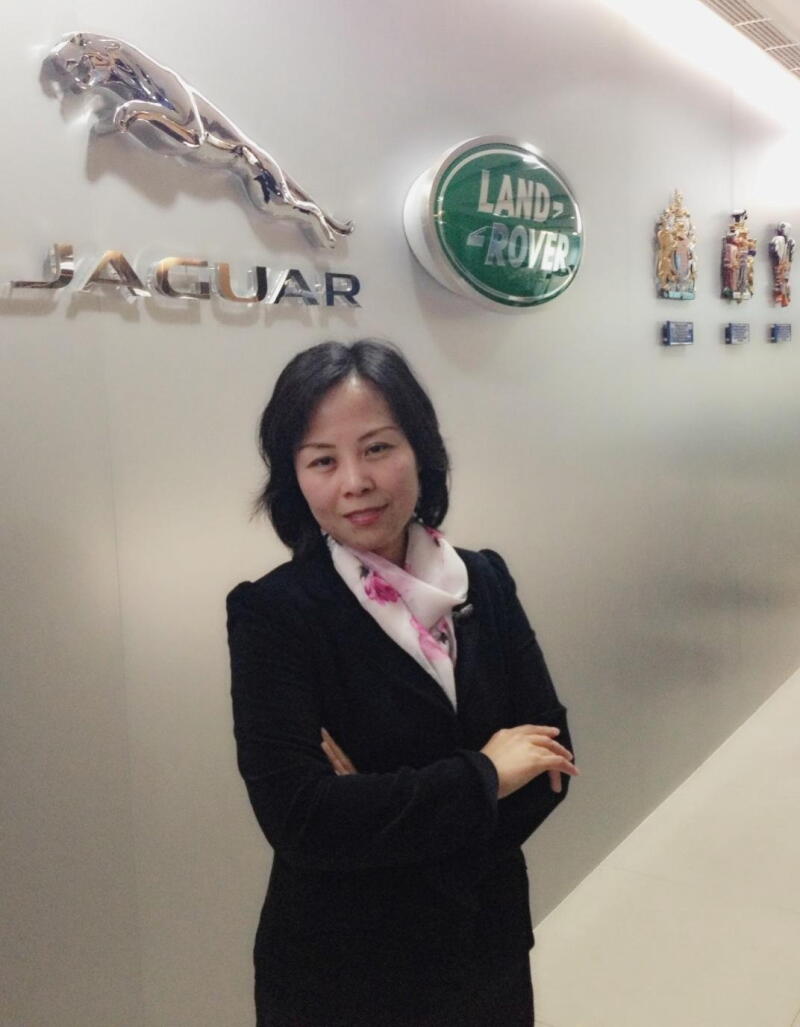
Jaguar Land Rover is the UK’s largest automotive manufacturing business, built around two iconic British car brands: Land Rover, the world’s leading manufacturer of premium all-wheel drive vehicles and Jaguar, one of the world’s premier luxury sports saloon and sports car marks.
Under each brand, we also have several key marks. For Jaguar, we have the JAGUAR word mark. We also have the Leaper device and the Growler device, which are very important for the brand. For Land Rover, the LAND ROVER word mark, the LAND ROVER with oval logo and RANGE ROVER are our key marks. We have several other marks that are also important such as the model names, including Evoque, Discovery, Freelander and Defender, XJ, XK, XF and F-Type.
Are there any geographical regions that are particularly troublesome for Jaguar Land Rover’s brand?
It is hard to pinpoint a specific region, since we face similar challenges in different regions all over the world. As the IP counsel in China, I can only share with you what I have experienced in the different regions of China.
In many parts of China there are factories, and where you have factories together with massive legitimate manufacturing, the threat of counterfeit manufacturing is always present. However, such problems are not confined to China or to just our business – it is an issue faced by all manufacturers of high value goods on a global basis.
What sorts of counterfeiting challenges do you face?
As mentioned above, the manufacturing of counterfeit goods, such as counterfeit parts and accessories, is a common problem for producers of high quality items. Preventing sales of those counterfeit items can also be challenging at times, particularly with the advent of the internet which provides an accessible global platform for onward sale and export.
You earlier mentioned design patents becoming a bigger part of your work. Can you give me an example?
We invest millions of dollars in creating unique, innovative and beautiful designs for our vehicles. Technology, design and innovation are continually evolving and expanding areas and we invest appropriately to protect our work in these areas. The use of design patents is an increasing part of that protective work.
Has the brand protection environment improved in China? Does the new Trademark Law help?
China is definitely improving in terms of both the legal framework and the quality of enforcement and I am happy to see this. One of the most significant improvements in deterrence is the increase of the maximum statutory damages, from RMB 500,000 to RMB 3 million ($80,000 to 480,000). I anticipate that there will be further increased levels of enforcement and deterrence against infringers in the future as well.
I also think that the provisions on well-known trademarks are good. For example, historically there were inconsistent views about the function of well-known trademarks. Local companies tended to use the well-known trademark in their own business advertising. This resulted in some marks being given well-known status even though the marks were not well known at all. The competent authorities became reluctant to grant recognitions as a result.
The new law addressed this situation by prohibiting the use of well-known trademark status for advertising, enabling truly well-known marks to be granted well-known status and enjoy their corresponding protections.
What qualities do you look for in outside counsel?
I look for two things: commercially focused, high quality advice and proactive, helpful service and client care.
What activities do you recommend to INTA attendees visiting Hong Kong for the very first time?
I would recommend the going to the Peak. Just as how visitors to Beijing should go climb the wall, visitors to Hong Kong should go up to the Peak to get the birds’ eye view of the Harbor and the city.