
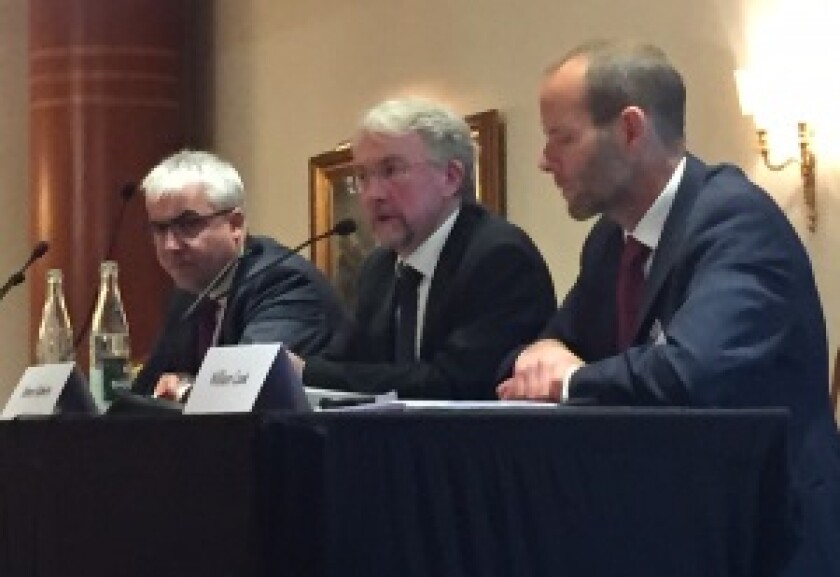
The Forum was held at the Marriott Champs Elysées in Paris on September 10, and followed a similar event that took place in Munich on Tuesday.
The only certainty is uncertainty
The various in-house counsel on the panels agreed on one thing: the introduction of the UPC would make business forecasting and budgeting more difficult.
“It’s so scary,” said Simon Roberts of telecoms company BT (pictured middle), noting that the UPC could be “a happy hunting ground” for patent trolls. “Businesses hate uncertainty. They are willing to pay more for certainty,” he added.
Even those who expressed broad enthusiasm for the system, such as Gavin Lawson of Gilead Sciences, said that “the uncertainty is starting to have real implications” as companies have to decide whether or not to opt out their European patents.
In the day’s final session, Bobby Mukherjee of defence company BAE Systems explained that if, as expected, each opt out costs €80, then a company with 10,000 patents is facing a one-off charge of €800,000 in addition to the business time and inconvenience involved in administering the payments, checking ownership details and so on.
“Budget is a key driver,” he said, adding: “We need to be having these discussions with the business now and be ready … Business craves more certainty.”
Weird and wonderful creatures
In a panel on the court procedures, Alex Brodie of Wragge Lawrence Graham & Co described how the UPC will introduce two “weird and wonderful creatures” to many litigators: the judge rapporteur and the technical judge. The former will play a vital role in case management, including addressing so-far unanswered questions such as what the rules are regarding witness counselling and what experiments can be used.

“The judge rapporteur is a key player in the system,” said Judge Sam Granata (right) of the Court of Appeal in Antwerp, and will need to combine “patent knowledge and managerial competence”. His/her role is potentially so important that Granata even added that there could be “judge rapporteur shopping”. (Read an interview with Granata at managingip.com/upc).
Xavier Seuba of CEIPI brought news about the technical judges: up to 40 of them are due to attend a training programme starting in Strasbourg on September 24. They too could play a vital role, he said, noting that in Switzerland, where the Federal Patent Court has had technical judges for about two years, one study suggests they can provide technical reports 12 times faster and up to 70% cheaper than legal judges.
In, out, shake it all about
One of the continuing challenges for followers of the Unitary Patent and UPC system is which countries are actually involved. Of the 28 EU member states, 24 are now on board and a 25th – Italy – has said it will join them (its inclusion is expected to be formalised next month).
The three that are absent are: Spain, which has long opposed the system; Poland, which was part of the enhanced cooperation but subsequently undertook a study that led to it pulling out (at least for the time being); and Croatia, the EU’s newest member state that was not in the club when the patent package was agreed but may choose to join at some point.
Speakers from Spain and Poland provided some insight into their government’s positions, though the motivations of politicians were not fully fathomable and prompted considerable debate among the audience. The consensus was that, while neither country was being fully pro-European in its policy, Poland was quite probably making the best decision for its own economy, at least in the short term.
incidental.jpg Spread the word
While European companies are increasingly anxious at the prospect of the new system, those in the US are all too often ignorant, according to Edward Kelly of Ropes & Gray. The UPC is minimally covered at US conferences and barely mentioned in the US legal media or blogs. That is partly, he explained, because US companies are dealing with their own domestic problems resulting from the introduction of the PTAB and the Alice v CLS Bank and Octane decisions. But it’s also because of a failure of communication by European practitioners.
“We’re now getting visits from European lawyers saying ‘get ready’,” said Kelly. “Often these visits are from the same people who until recently were saying ‘don’t worry, the UPC will never happen’.”
He added that the UPC presented a “fabulous opportunity” for American companies (and by extension their European representatives) but it needs to be sold to them: explaining how it will save money and help small businesses is likely to carry more weight than discussing in detail the difference between the local, central and regional divisions.
Pot of gold
Discussing the possibility of a “gold rush”, keynote speaker Pierre Véron of Véron & Associés explained how the law on damages in the UPC could differ from national laws, while the scope of its jurisdiction could lead to high awards.
Uncertainty over the limitation period might also mean “there could be a much longer period for recovering damages than under national law”, he added.
Now that’s something that really might get the attention of US companies.



