
The Unitary Patent and Unified Patent Court: An update

· It is expected that all divisions will have English as the lead language
· A European Patent with Unitary Effect is a single patent right, examined and granted by the EPO. It does not cover non-EU EPC states (such as Switzerland, Norway, Turkey)
· It's a unitary right, not a bundle of rights. Patent owners will be unable to opt out from some jurisdictions and stay registered in others, as with the current system. It is “more extensive, less expensive” – according to Penny Gilbert of Powell Gilbert
· It is possible to opt-out from the UPC jurisdiction, at the cost of €80 per patent (price tbc)
· Factors to consider in selecting UPC division: language, convenience for parties and cultural approach of local judges to procedural tools
· UPC proceedings are expected to be heard within a year. “Time is of the essence,” said Sabine Agé of Véron & Associés.
Patent Enforcement in Europe: Deciding on your strategy

· Consider cost, success rate and what your party will gain from a decision
· Possible effects of the decision include injunction as a matter of right, damages for infringement and revocation or limitation of the patent
· The UPC promises to be more efficient than some national forums: hearings will be restricted to a single day
· Fees for infringement set at €11,000 with additional fees applicable if value of litigation exceeds €500,000.
· Must sue for infringement in local or regional division where infringement occurred or where defendant is domiciled
· If one defendant is outside the contracting member states, or infringement occurred in a territory where there is no local or regional division – refer to Central Division
Frand: Licensing and litigating standard essential patents in Europe
· FRAND = fair, reasonable and non-discriminatory
· FRAND terms agreed through bilateral negotiation between SEP owner and implementer
· The IPR policy of the SSO will typically require patent owners to declare any patents that they consider are, may be, or may become SEPs
· Patent owners participating in SSOs must resolve to grant irrevocable licences for their SEPs on FRAND terms (the “FRAND commitment”)
· FRAND terms must be agreed through bilateral negotiation between SEP owner and implementer
· Anna Johns of Inventergy addressed the potential challenges that patent licensors face when trying to license their SEPs and how the Huawei v ZTE decision might affect some of these challenges
Litigation planning and forum shopping in Europe
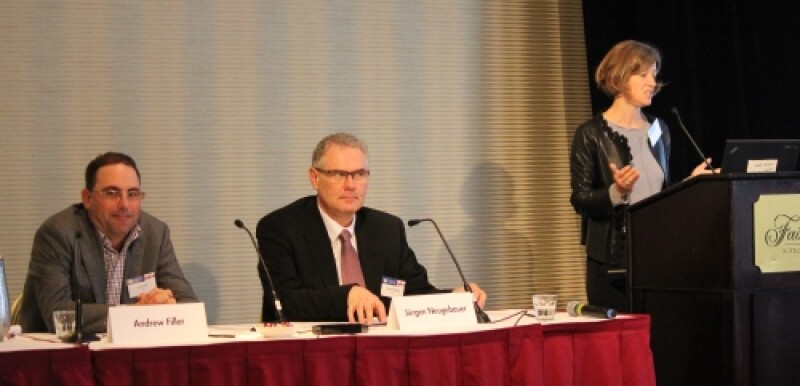
· Consider the objectives of your party and adversary, possible tactics of the opposition and your reactions, timing and cost constraints
· Any European patent/application granted or filed during the transitional period can be opted out of the UPC for the life of the patent
· National patent systems remain and will act alongside the UPC
· Not all member states have signed the UPCA (Spain, Poland have not) and all may not have ratified by the time the court goes live (expected early 2017)
· Joachim Feldges of Allen & Overy described litigation as “a dance at least for two – or maybe three with the court dancing with you”.
Working with your European Patent Attorney
· At present, three different types of patent protection available in Europe: European patents, national patents, utility models
· National court is main forum for litigation in each state
· Understand the effects on your existing European patents and pending European patent applications, develop filing strategy accordingly
· Opposition and appeal available at EPO
· Request unitary patent within one month from grant of European patent
· Pros of opting out: avoid central attack and avoid third parties forcing you to untested court
· Cons: cannot obtain pan-European injunction, nor obtain pan-European damages
Opposition proceedings before the UPC
· AIA opposition proceedings (PGR, IPR, CBM) must be completed within 12 months from institution decision by PTAB, with six-month extension possible for good cause
· Final PTAB decision prevents further challenge in USPTO, ITC or district court
· Prepare prosecution in anticipation of post grant challenges
The impact of the UPC on IT & technology
· Outcomes of EPO oppositions will take effect in all EPC states
· DNI proceedings will take place in Central Division
· Large-scale cross-licence negotiations extended in TMT
· Determination of essentiality not within UPC’s exclusive competence, remains within the national courts
· FRAND deployed as defence to infringement or in licensing disputes
FOCUS: Life sciences & pharma
· In injunctions, in contrast to the US, no need to prove irreparable harm. Damages can be awarded simultaneously
· FDA Safe Harbour/Bolar Exemption: UK has a restrictive interpretation limited to generics while other EU members (Germany, Ireland) have a broader interpretation
Alternative dispute resolution strategies
· Parties control: identity of arbitral seat, location and start date of hearing
· Arbitration is jurisdiction-specific
· Patent disputes can be arbitrated, but revocation cannot be ordered
· Court proceedings, not open to the public and decisions are usually confidential
· Arbitration concludes in one decision which will apply to multiple jurisdictions. This is particularly effective when dispute focuses on damages.
Additional reporting by Natalie Canter





