
Trade marks
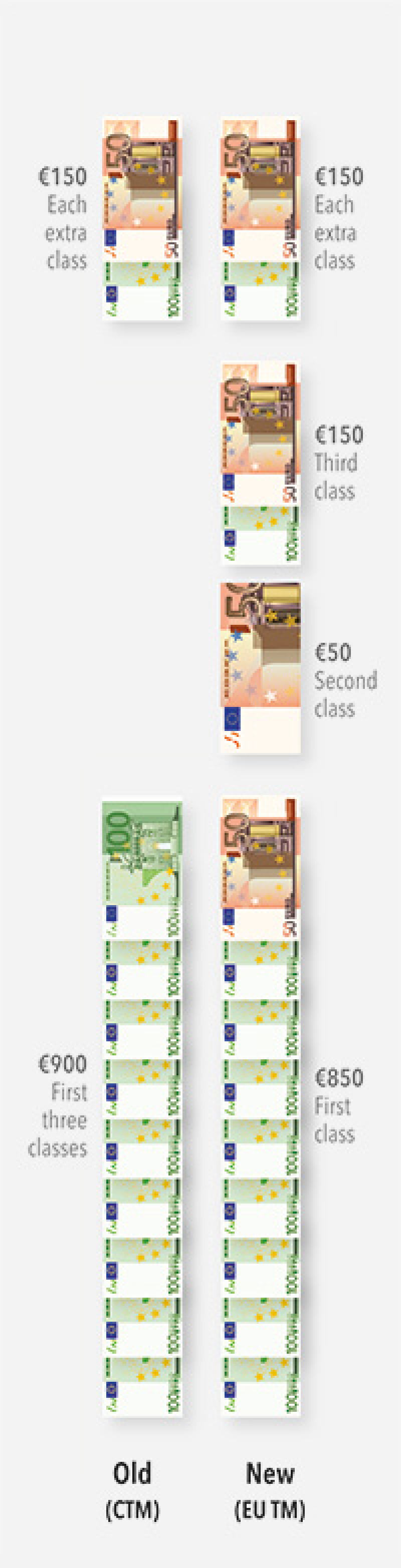

The most imminent and wide-ranging reforms affect trade marks. Although the changes were more than seven years in the making (see our article from March 2008 on “Community rights; growing pains”), their publication may have taken some people by surprise: the new Directive was published on December 23 and the new Regulation on December 24. Note that the latter renames CTM as EUTM and OHIM as EUIPO with effect from March 23. We have summarised some of the key changes in an article and graphics, focusing on the more pressing issues, including those relating to goods and services classification, goods in transit, absolute and relative grounds and fees (see image), and on the practical steps that trade mark owners need to take.
But there are many changes in total, some of which will not be implemented until 2023, so readers are well advised to study them in more detail and consider how they apply to their own portfolios or plans.
If you do want to find out more, we recommend the dedicated page on the OHIM/EUIPO website, where there are also links to video resources and webinars and where the latest information on implementation will be posted. Associations such as INTA and MARQUES also have abundant information. And a number of IP and law firms have posted useful analyses, for example:
New EU Trade Mark Regulation – what’s important to users (Wragge Lawrence Graham & Co)
The EU trade mark reform package (King & Wood Mallesons)
EU trade mark reform update (Hogan Lovells)
The changing landscape of the CTM application - EU trade mark reforms (Marks & Clerk)
Get ready to boost your trade mark portfolio (Simmons & Simmons)
New EU Trademark Directive in force (Cohausz & Florack)
EU trade mark reform legislative package published (Herrero & Asociados)
Design rights

It is not advanced as the work on trade marks, but there is also a European Commission study on design rights, which was started in 2014. The latest news on this is that the economic review is complete, and a legal review (including interviews with users) has been finished, but is not yet published.
Any concrete reform proposals are likely to be some way off, particularly given the controversy around spare parts (on which topic see this position paper just published by ECTA). However, designers and their advisers will want to monitor the discussions and contribute where appropriate.
Geographical indications
In 2014 the European Commission consulted on expanding protection to non-agricultural products, and it held a conference on the topic in 2015 (see this article by Miguel Angel Medina of Elzaburu in the HouseMARQUES newsletter for more detail). There is some momentum behind this initiative, but little detail at the moment.
Should there be further developments, they will be of interest not just to GI owners but also to trade mark applicants and owners (given that the new EUTM Regulation provides that a protected GI may block a trade mark application).
Copyright
The DSM reforms will promote portability, clarify exceptions and tackle large-scale infringement, according to the Commission.
Whether the reforms will be as fundamental as promised remains to be seen. There are powerful lobbies on both sides of the debate in Europe, and the Commission has a history of tinkering with issues such as orphan works and collective rights management one at a time rather than taking on wholesale copyright reform. Who knows whether this time will be different?
Trade secrets
Earlier this week, a European Parliament committee endorsed a draft directive on trade secrets. This must now be approved by the full Parliament and EU Council – likely to be a formality.
Assuming all goes to plan, the directive could be published later this year and would provide pan-EU definitions and rights for owners of confidential commercial information. Member states would have to transpose it into national laws.
For the latest details on the draft directive, see this article by Mark Ridgway of Allen & Overy published on the IPKat blog, and for more discussion on why it is needed read the guest post on Managing IP’s blog by Alain Berger of Alstom.
Enforcement
Finally, IP owners should not forget that a consultation on the modernisation of the IP enforcement framework runs until April 15 this year. There are five questionnaires, each aimed at a different stakeholder group.
The EU Enforcement Directive is now more than 10 years old, and the Commission has said it wants to address commercial-scale infringement and cross-border applicability.
There is likely to be support for this among IP owners. On the other hand, the other changes discussed above may address many enforcement issues, such as goods in transit and intermediary liability, so the Commission may conclude that urgent action is not needed.





