Highlights from the European Patent Forum in Paris

Managing IP is part of Legal Benchmarking Limited, 1-2 Paris Gardens, London, SE1 8ND

Copyright © Legal Benchmarking Limited and its affiliated companies 2026

Accessibility | Terms of Use | Privacy Policy | Modern Slavery Statement

Cookies Settings

Highlights from the European Patent Forum in Paris

Paris

In-house and private practice lawyers discussed driverless cars, protection strategies in a digital world, compulsory licences, the UPC and FRAND at the European Patents Forum in Paris

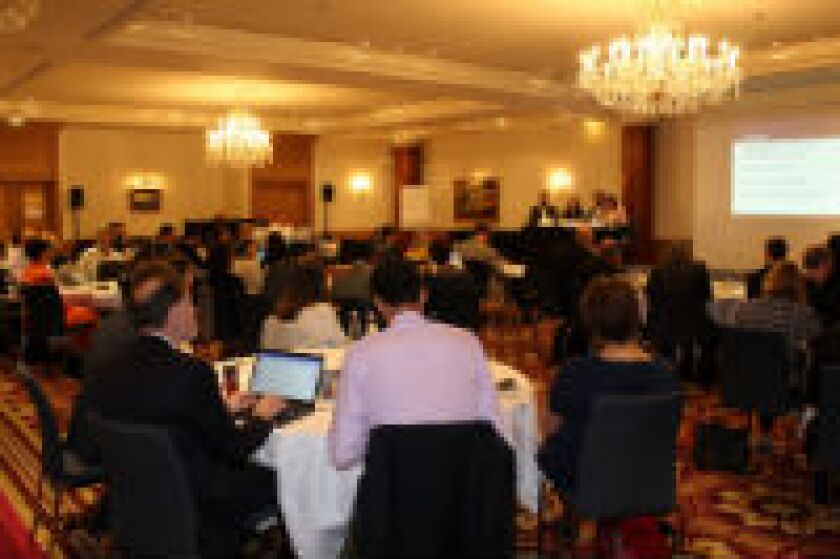
The European patent landscape is becoming more difficult to navigate every day. Technologies such as driverless cars, personalised medicines and artificial intelligence have exploded onto the scene along with new considerations for how to protect them. The UK has a doctrine of equivalence, an SPC waiver may soon come into effect and the Unified Patent Court is inching steadily into existence – if Brexit does not derail it first. All of these developments and many more were discussed at the European Patent Forum at the Marriott in Paris on September 11 2018.

The automotive industry

Protection strategies for fourth industrial revolution technologies were key talking points during the day. Counsel at Nissan, Nokia, and Viaccess-Orca, a subsidiary of Orange, delved into challenges and changes to the automotive industry that may emerge from driverless cars, including the convergence of technologies and how that will introduce new players with different attitudes to IP.

“There are so many players with different licensing habits,” said Christine Maury-Panis, general counsel at Viaccess-Orca. “Companies such as Apple, Facebook and Google will be involved and I wonder how they’re going to use their patents, because these are companies that are used to monetising their assets for high amounts.”

Artificial intelligence

Artificial intelligence was another much-discussed technology on the day and delegates were keen to understand the prospects of patenting the hot-topic technology. Yannis Skulikaris, operations director at the European Patent Office, helped to do that with his talk on patenting AI. He explained that the crux of whether AI is patentable is whether it is seen purely as mathematical methods.

“The extreme view is that AI is pure mathematical methods and nothing else because it is based mainly on algorithms,” he said. “The implication would be that it would be excluded from patentability.

“But others could argue that these methods are used to achieve a technical purpose.” He added that that technical use element would make the invention protectable under the European patent system.

The digital world

But patenting new technology is the not the only big digital IP concern businesses are facing, as the CEO of a steel producer’s IP arm pointed out. Thyssenkrupp’s Stephan Wolke told delegates that it is important to learn to protect and develop assets in an increasingly digital world and took them through his strategy.

“We have to think about the whole range of IP rights for digital and broaden the discussion from patents,” he said. “We ask everyone to think about trade marks, designs, copyright and even trade secrets to help protect our digital ideas.”

A unified system

Of course, legislative, regulatory and case law developments have to be incorporated into a business’s IP strategy, and speakers were on hand to tell delegates which changes they need to consider. Marianne Schaffner at Dentons, Maximin Gourcy at DS Smith and Olivier Corticchiato at Nestlé got the ball rolling on the subject with a discussion of the Unified Patent Court Agreement and the EU’s Trade Secrets Directive.

The panel pointed out that while Brexit is causing significant uncertainty when it comes to the UPC, the fact that the UK is seeking to amend the UPCA so it can stay in the system means the harmonised project could be opened up to non-EU member states.

“Anything that simplifies the system and gives a core unified system in Europe is a good thing for the world and our operations,” said Corticchiato, patent lead for nutrition at Nestlé, which is based in Switzerland. “It is key for us to benefit from such a unified system.”

The doctrine of equivalents

Celine Bey, Alisa Carter and Felix Wunderlin at Gowling WLG and Pete Wilson at BT went on to compare patent infringement by equivalents in France, Germany and the UK.

They explained that, while France’s doctrine of equivalence emerged in the 1960s and Germany’s in the 1980s, the UK’s doctrine was only established last year by Actavis v Eli Lilly and each country has a different approach. That fact raises some concerns for patent-heavy businesses.

Commenting on the impact of equivalents on European filing strategies, Wilson, senior patent attorney at BT, said: “You must draft your patents properly. If the claims are too narrow, you can always fix that in prosecution. If you start off with disclosure that is too narrow, there’s very little you can do to fix that problem.”

Compulsory licences and permanent injunctions

Lawyers at Linklaters and in-house counsel at Intel went on to talk about challenging compulsory licences and permanent injunctions. Pauline Debre, partner at Linklaters, pointed out that the likelihood of another party obtaining an injunction varies wildly between Europe’s key jurisdictions and in the US.

The panel compared and contrasted recent case law to illustrate the circumstances for granting permanent injunctions, including this year’s Nikon v ASML from the Netherlands, where an injunction was granted, and Edwards v Boston Scientific from the UK, where it was denied.

SEPs

Time was also taken on the day to delve into more industry-specific legislative and case law developments. Caroline Casalonga and Francis Zapalowicz at Casalonga, Olivier Thirard at Orange and Clemens Heusch at Nokia spoke about standard essential patents and licensing them under the evolving definition of fair, reasonable and non-discriminatory terms (FRAND).

Heusch, head of IP litigation at Nokia, pointed out that it might be considered as discrimination if a large company pays £1 for a part and a smaller company with few resources has to pay the same.

“If you weigh half as much and still have to pay the same amount, is that discrimination? I’m not sure. In that case, two companies are treated equally even though they are not.”

Life sciences

Looking towards the life sciences sector, Ina Schreiber and Denis Bourgarel at Cabinet Plasseraud and Lawrence Cullen at the UKIPO discussed developments such as second medical use patents, Article 3A of the SPC regulation and the proposed SPC waiver from the EU Commission.

“The SPC system is evolving,” said Cullen, the UKIPO’s deputy director of biotechnology, pharmaceuticals and organic chemistry. “We get one answer and try to understand it, and as an examining office our job is to understand how to apply the changes to the granting of rights and advise users of the best way to go forward.”

The US

But the day was not completely Europe focused – despite the title of the forum. Ed Kelly and Regina Penti from Ropes & Gray and Radha Murphy from Imerys gave delegates a step-by-step lesson on US patent law and the impact it can have on European IP strategies.

By the end of the day it had become clear that patent-heavy businesses and IP firms have their work cut out for them. But if these organisations continue to share their experiences with one another, as they did at the European Patent Forum, they can stay one step ahead.

more from across site and SHARED ros bottom lb

More from across our site

The firm launched a San Diego office earlier this month, but California investment and expansion is far from complete
The industry’s response to AI requires an unfamiliar ingredient as firms battle to shape their futures
The firm is looking beyond replacing recently departed talent, betting instead on senior leaders to strengthen and expand its patent litigation platform
Olga Partington, director in Sterne Kessler’s biotechnology and chemical practice group, shares why a patent's vulnerability peaks when it is young, rather than when it is most valuable, under the PTAB's new framework
IP experts gathered in San Francisco last week to discuss the changing global SEP landscape and new licensing models for AI infrastructure
SKW Schwarz partner Daniel Kendziur explains how new green claims rules are changing his workload and bringing him into direct contact with marketing, PR and government affairs teams
The government is targeting earlier resolution of SEP disputes while ruling out a standalone IPEC rate determination track and restrictions on injunctions
Ana Castedo, who brings a strong focus on patent litigation, will help build the firm’s IP litigation offering in Madrid
A former scientist, inventor and now a patent practice leader, Hanane Fathi Roswall shares her views on leadership, diversity, the rise of AI and the promise of the UPC
With rumours that a third IP judge could yet join the England and Wales High Court, we run through some potential names while practitioners outline the importance of a well-stocked bench
Gift this article