Patent Trial and Appeal Board (PTAB) proceedings celebrated their second birthday on September 16. The more than 2,000 petitions filed with the Board by the end of this September is far higher than was envisaged during discussions over the America Invents Act (AIA) – the legislation that unleashed inter partes reviews (IPRs) and covered business method (CBM) reviews onto the intellectual property world.
In the first year of proceedings, one IPR petition was filed a day on average. This steady drip soon turned into a flood following the first written IPR decision in November 2013. After that, an average of two petitions were filed a day, or about 60 a month. Now, more than four petitions are filed a day on average.
With numbers like that, it would seem filing a PTAB petition when someone accuses you of infringing their patents is a no brainer. Yet recent months have provided cause for caution. PTAB practitioners say the choice of whether it makes sense to file a petition is not as obvious as it seems.
“People make binary assumptions – either always file or never file,” says Steven Baughman, partner at Ropes & Gray, “but it is not that kind of question.” He continues: “The AIA created some powerful, complicated, nuanced weapons for a patent challenger. Appreciating what surfaces are sharp, what surfaces are blunt and how an individual challenge can get the job done in a particular skirmish is critical. It is not an always file or never file decision. People tend to flip back and forth between those without understanding the setting.”
These new weapons can easily blow up in patent challengers’ faces. Against this backdrop, a potential petitioner has to weigh up a number of considerations.
The odds of institution
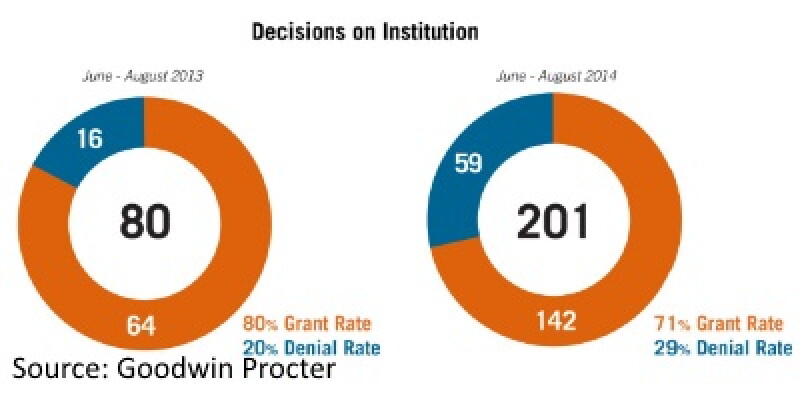
The percentage of petitions that are instituted is falling. This means the choice of whether to initiate PTAB proceedings seemingly carries more uncertainty now than a year ago, when then Chief Judge Randall Rader labelled the PTAB a “death squad” for patents.
Early on, more than 80% of IPR and CBM trials were instituted, as noted in a Goodwin Procter report released in September called “The Patent Trial and Appeal Board Second Anniversary: Reflections and strategies for the years ahead”. This high success rate encouraged others to file petitions.
In the past six months, however, the institution rate has dropped 10 percentage points. From June to August 2013 it was 80%; for the same period this year, it was down to 71%.
“At this time last year, the statistics on institutions were so decidedly one sided in favour of the petitioner it would be bad strategy with those kinds of odds not to recommend going to PTAB with an invalidity case,” says Eleanor Yost, a partner in Goodwin Procter’s IP litigation group. “The interesting thing now there is a ray of hope for the patent owners. The advice last year for those looking to go to the PTAB if they were a defendant in a lawsuit was: ‘Run to the patent office.’ Now a little more thought has to go into it.”
Petitioners need a good validity case, but they also need to be well prepared. They can wreck their odds of a petition being instituted through their own actions. The PTAB proceeding is an unforgiving process, with its strict deadlines offering little chance for second chances. The past two years have taught PTAB practitioners that they must be selective.

“The Board has been fairly strict about the number of grounds you can raise or propose,” says Yost. “You have to be sure you are bringing with you a limited amount of prior art and that it is a really solid case. You are not going to get another bite of the apple back in district court,” says Yost.
Jim Myers, a partner at Ropes & Gray, says a big challenge is choosing which claims to challenge. Whereas in a district court case a company will generally claim infringement of an entire patent, a challenger at the PTAB must identify individual claims.
“You have got to bring your A-game,” says Myers. “You can’t win at the PTAB if you don’t have solid prior art and solid arguments. One of the most important pieces is evaluating the strength of your arguments before you make a filing.
“A number of petitioners have gotten themselves into trouble because they have approached it like district court and filed a ‘good enough’ petition and thought they can backfill it,” says Myers. “The Board doesn’t let you do that, not very often and not without a very good explanation. So this concept of having to put all your cards on the table at the beginning dramatically influences whether you want to file or not.”
The odds of doing more harm than good
This may lead to worries that presenting a case in front of the PTAB will weaken their chances in district courts. But Wayne Stacy, partner in Cooley’s litigation department, points out there is a better chance of winning an invalidity case in front of the PTAB than in front of a jury. PTAB proceedings are normally a defendant’s best shot at winning. PTAB judges are far more technical and more knowledgeable about IP-specific subject matters than district court judges who rely more on expert testimony.
“If you truly have information that the patent is invalid or many of the clams are invalid, the Board should do a better job than the jury,” says Stacy. “They know what facts matter and what facts don’t. The fear many have is if you take validity to the board then you won’t have the validity case to present to the jury. There are some practitioners that like to try validity and infringement together as part of the overall story. But if you are looking at the validity decision itself, the best chance of getting a validity decision is in front of the Board.”
Being unsuccessful at the PTAB can hand a rival an advantage. Having a PTAB petition denied is allowed as evidence in district court litigation. Even having some claims instituted and other claims not could be a disaster for petitioners, warns Ropes & Gray’s Myers.
“In a number of instances, if the PTAB institutes on some of the asserted claims but not all of the asserted claims then the challenger is suddenly faced with paying for a PTAB proceeding that is not going to influence the outcome,” he says. “The district court case is going to proceed and the judge is sitting saying, ‘Wow, the defendant went to the PTAB and they didn’t even bother to institute, so this patent must be strong.’ This has profound implications for the patent owner. Avoiding institution in that first six months can be very powerful for patent owners.”
The type of review is also an important factor. Ropes & Gray was the counsel on the four CBM petitions filed the first day the proceeding was available, and is the largest participant in CBM reviews. It represented clients in eight of the PTAB’s first 10 final written decisions on CBM petitions, winning each one. One of the advantages of CBM reviews is that they have more limited estoppel provisions than IPRs. “One of the underappreciated aspects of the AIA was the power of the covered business method review,” says Baughman. “They have been extraordinarily effective.”
The odds of getting a stay

One of the biggest concerns among those looking to use the PTAB is whether district courts will stay cases until the PTAB proceeding is completed. More than 80% of patents challenged in PTAB trials are involved in co-pending district court litigation.
According to Goodwin Procter, 72% of IPR or CBM motions to stay are granted, excluding orders denying motions without prejudice. It was expected that stays would be almost a foregone conclusion when the PTAB proceedings were being created. But judges have not agreed.
“Depending on where the client is, where their case is located and the judge, the likelihood of getting a stay can be wildly different,” says Yost at Goodwin Procter. “A lot of our clients are concerned about fighting on two fronts at the same time. If they are fairly confident they can get a stay in litigation, they are more likely to go the PTAB proceeding.”
The Northern District of California is the most “stay-friendly” court, according to Goodwin Procter, while the Eastern District of Texas is the least. Courts such as the District of Delaware and the Central District of California are somewhere in the middle.
The chances vary greatly even within a district, however. If you are looking to get a stay in the Eastern District of Texas, for example, you better hope John Love is your judge. His 60% grant percentage compares with 20% for Judge Roy Payne’s and 0% for Nicole Mitchell, Rodney Gilstrap, Leonard Davis, Michael Schneider and William Bryson.
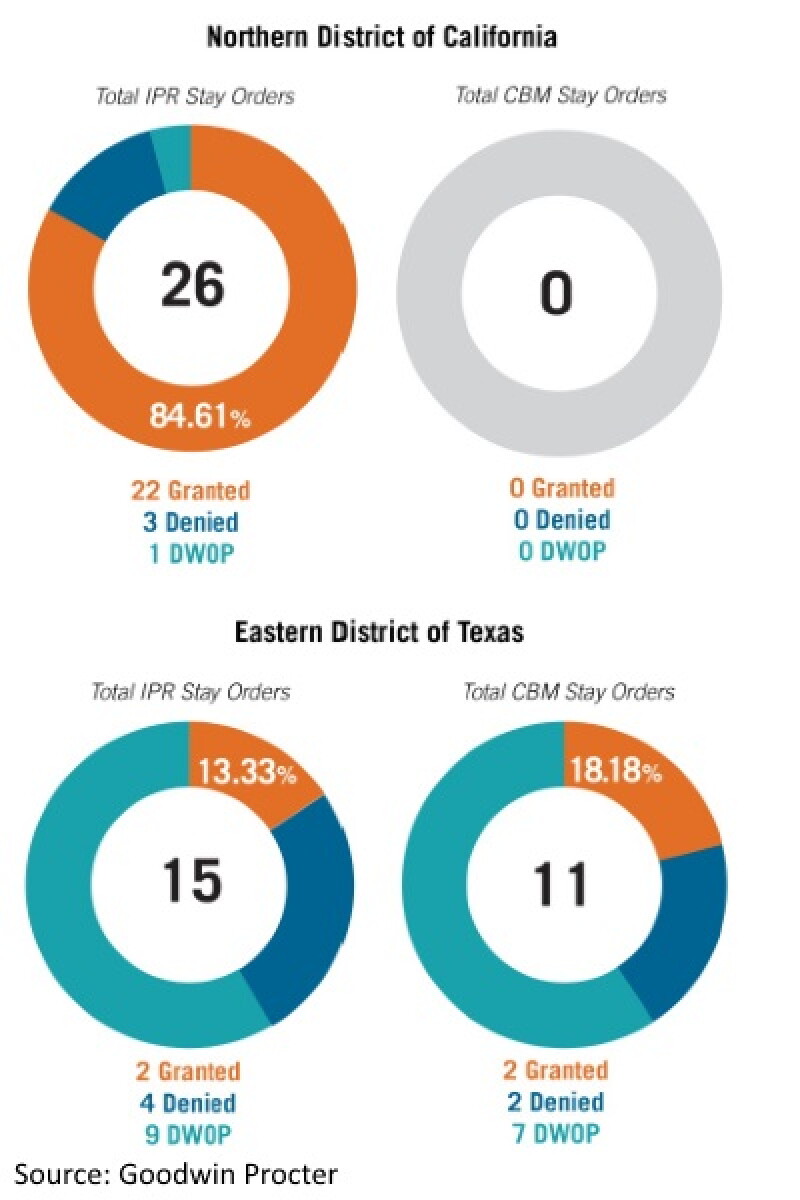
The District of Delaware, another popular court for patent disputes, shows an interesting split between judges. As of mid-September, Judge Gregory Sleet had granted 89% of motions to stay, Judge Richard Andrews 60%, Judge Christopher Burke 50%, Judge Sue Robinson 50%, and Judge Leonard Stark 42%.
For IPRs, district courts weigh three factors: whether discovery is complete and whether a trial date is set; whether a stay will simplify the issues and trial of the case; and whether a stay would unduly prejudice or present a clear tactical disadvantage to the non-moving party.
For CBM reviews, district courts consider the same three factors as for IPRs but must also consider a fourth: whether it would reduce the burden of litigation on the parties and the court. When the AIA was being discussed Senator Charles Schumer claimed this fourth factor should place “a very heavy thumb on the scale in favour of a stay”, making it “nearly impossible to imagine a scenario in which a district court would not issue a stay”. This claim proved optimistic.
The Federal Circuit issued a strong smack down to the Eastern District of Texas over stays in July. It said the district court was wrong not to stay infringement proceedings in VirtualAgility v Salesforce pending the conclusion of a CBM review. This was expected to make stays much easier to obtain. But this has not been borne out so far.
“Since then we have seen stay decisions even in covered business method reviews, which was the particular proceeding at issue in VirtualAgility, where the courts are still not staying,” says Yost.
Stacy at Cooley notes that judges may be wary because of their experiences under the old inter partes re-exam system. These did not have the strict deadlines that IPRs do, and could take five years or more. This meant granting a stay could put a case on hold for an unreasonable amount of time.
“You’ve got a history of being burned at the old re-exam,” says Stacy. “Judges are little bit leery because of what happened in the past. The patent office continuing to focus on the 12-month decision timeframe has helped that. It has shown judges that it is not really a long indefinite stay.”
It is not only who the judge is that influences the chance of getting a stay. One big lesson from the first two years of PTAB proceedings is to file early. Petitioners can ruin their chances of getting a stay by leaving it too late. IPRs have to be filed within 12 months of a suit being served.
“You have seen some judges be reluctant to grant the stay if people have filed for it 11 months and three weeks in because the stay could be another 18 months on top of that. So those accused of infringement need to be prompt about their filings,” says Stacy.
Bart Eppenauer, partner at Shook, Hardy & Bacon, and chief patent counsel at Microsoft when the AIA was being discussed, agrees that moving for the stay late in litigation – for example, when discovery is near closure or there has already been a claim construction hearing – makes it much more likely to be denied. Making your move early can also save some expense because you are not focused on district court litigation.
However, Eppenauer notes that petitioners will not always want stays.
“Some will say that maybe they don’t want a stay,” he says. “They like the dynamic it creates to have a push in the district court as well as a parallel proceeding in the PTAB, particularly if it is a court that is going pretty rapidly. There is a dynamic where you are moving the ball on two fronts and that can create some additional leverage depending on the case. Most of the time the conventional wisdom is that you want to try to get a stay but every case is unique and there might be a good reason to put added pressure on with a parallel proceeding at the district court.”
Keeping an eye on cost
Those looking to use the PTAB must also keep a close eye on how proceedings are evolving. Lawyers for patent owners are becoming smarter about how they approach the Board.
“Lawyers who are representing patent owners are only beginning to think about how to use these proceedings in an effective way,” says Myers. “Everything that the patent owner says has to be on the record and there is an opportunity in the proceeding for the challenger to respond. So I predict that those representing patent owners are going to learn how to use these proceedings more effectively.”
Myers believes the balance will tip more in favour of patent owners than it is now.
“You will see a more normal win rate at the PTAB over time that will be more of the order of 50%, closer to European opposition proceedings,” he says. “That will be a function of two things. One is people will learn more, the PTAB judges will learn more, the lawyers will learn more. In addition, the reputation and growing prominence of the PTAB has resulted in a lot of filings where the challenges are not as strong, the patents are stronger and the people who are presenting it are candidly doing it on the cheap. The consequence of going in unprepared, not really thinking through the arguments, not putting forth your best effort, is you’re going to get just slaughtered by the PTAB.”
Myers mention of some petitioners “doing it on the cheap” touches on another important consideration. While PTAB proceedings are touted as an extremely efficient and relatively quick process, they are not free. Edmund Walsh, chair of the post-grant practice at Wolf Greenfield & Sacks, says cost is particularly important if you think your case would settle pretty quickly in district court.
“As a petitioner you have to put a lot of your money upfront to go to the PATB, which is not necessarily the case in litigation,” he says. “It is very front loaded. You have got to put a lot of energy up front and make sure you have a good case and think through all the oddball strategies [ the patent owner comes up with], and just hope that if you miss one that they won’t institute so you don’t have 18 months of torture.”
Yost at Goodwin Procter also says PTAB petitions may not be viable for companies that typically favour contingency fees. “I would have to imagine that firms that would take up a matter on a purely contingency basis are going to be less enamoured of the idea of taking on a patent office proceeding on the same basis,” she says. “There is no pot of money at the end of that proceeding. There is only downside: you could lose your patent entirely, and even if you win you still have to go back to court and try and make your money.”
Myers reports that the first reaction of many in-house counsel when PTAB proceedings became available was try to force the lowest price. Myers more often represents patent owners, while his colleague Baughman more often represents petitioners.
“There are cost savings,” says Myers. “Steve and I go back and forth of how much: I like to say it is about one tenth of the cost to be in the PTAB and Steve says it is probably one fifth. But to say there is a cost saving is not to say it is free or you can afford to do it on the cheap. You would find over the last two years that the first reaction of in-house counsel was to try to place this litigation into an existing bucket. It was either district court litigation or it was my patent office counsel, and once I placed it in to that bucket my job was to get the lowest price. We need to explain to our clients that this is a different animal and it is an evolving proceeding that we need to develop a bespoke tailoring for.”
Baughman agrees, saying the successful in-house team recognises there is one overall strategy to win– not a litigation strategy and a PTAB strategy – and builds a team that maximises the possibility of a win.

Keeping an eye on potential changes
Another concern for potential petitioners is that patent owners may also benefit from changes to procedures by the USPTO. The Office published a request for comments on 17 facets of PTAB proceedings. The deadline for written comments is October 16. Experienced USPTO observers are convinced changes will be made. The lack of ability to amend claims, the limited discovery and rare granting of live testimony have been particular sore spots for patent owners.
Some potential changes may benefit petitioners, however. Eppenauer notes that Congress could possibly pass some legislation that will help. It is possible that changes to estoppels provisions may be made.
“The provision says in a district court or another proceeding the party is estopped from using evidence actually used or that reasonably could have been raised,” he says. “That ‘reasonably could have been raised’ can come back to bite challengers later on in some other proceeding where a judge may say, ‘You should have raised this in this proceeding, you didn’t, so I am not considering it so off you go.’ That’s been a real concern for quite a few years. That’s why it is front and centre in the patent reform legislation, particularly the next round.”
Eppenauer even floats the possibility of Congress broadening the grounds of rejection under the IPR process. For example, issues tied to Section 112 of the Patent Act are not available on an IPR now, whereas they are under post-grant reviews.
“I do think expanding the grounds for rejections might be something interesting to explore in an IPR because it seems like the PTAB is equipped to handle it,” says Eppenauer. “It is going to require legislative change, so I don’t think it is likely to happen soon.”
Potential petitioners, then, have much to consider when weighing up whether a PTAB proceeding makes sense for them.
Walsh at Wolf Greenfield concludes: “I still think it is a good process for many, many cases. I would definitely always consider it; I wouldn’t always use it.”