

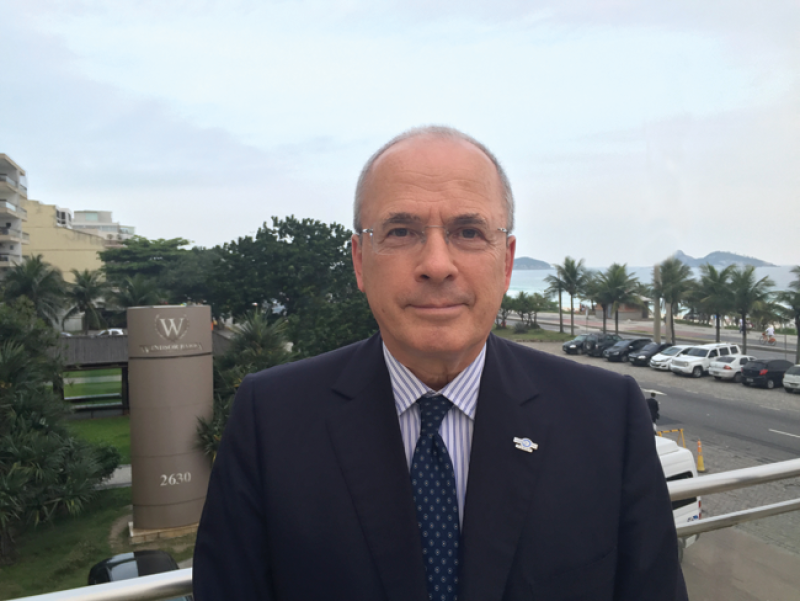
“It’s like being a student again!” says John Bochnovic, who has been introduced in Rio as AIPPI’s new Executive Director. The former AIPPI President has retired from Smart & Biggar in Canada, where he was a partner for 29 years, and on September 1st relocated to AIPPI’s headquarters in Zurich, where he now occupies an office on the third floor. “It’s the first time in over 25 years I’ve been able to open my office window!” he says.
The role of Executive Director was created and advertised following the 2012 AIPPI Strategy Objectives Project, conducted by Robin Rolfe Resources. The Project made a number of recommendations to improve the functioning and communication of AIPPI, ranging from updating the website (something that will happen later this year) to streamlining the organisational structure. It was discussed at the Seoul Congress in 2012 and subsequently, and a number of reforms to AIPPI’s complex structure have been agreed by Executive Committee.
“It’s a different kind of challenge, and I’m anxious to see how I can contribute to help the association. I’m here in a kind of transitional role and hopefully it will be an attractive role for a successor to take on in the not-too-distant future,” says Bochnovic. He adds that the AIPPI Executive Director role is different from equivalent jobs in similar associations that have a significant centralised infrastructure. AIPPI will remain based around the national and regional groups, with just a small secretariat, and much of the work will continue to be done at the national level.
Ramp up the buzz
In fact, says Bochnovic, part of his role will be to help the national/regional groups and independent members grow and “ramp up the buzz and attendance” at events, both the Congress (which as of this year becomes an annual event) and other AIPPI meetings. He notes that there are already some initiatives, such as the annual Japan/Korea/China trilateral meeting, and a two-day meeting held by the Israeli group every other year, that can be built on. “Not everyone can go to a Congress every year. People may not be able to go the Congress, so regional meetings might make sense for some people.” For example, in a year when the Congress is in one hemisphere, it might be desirable to host an additional regional event in another hemisphere of the world. There will also be cooperation with other associations: for example, AIPPI is jointly hosting a meeting on design law with INTA in Singapore in February/March next year. “I’m hoping we can stimulate more involvement from people. Groups may not have been able to be as active as they would like in the past, and that may be something I can help with,” says Bochnovic.
In addition, the Executive Director emphasises the need to “change the look of the Association” with a new website, some changes in terminology and in the role of the Council of Presidents and Executive Committee, and a more modern appearance. “In part my role is administrator,” he says, and indeed in the weeks leading up to the Congress he says he has been closely involved in the planning and organising.
Another hat he will wear is as representative of the association, attending events and meetings with national and regional offices, particularly in Europe. This role has traditionally been fulfilled principally by the Secretary General, but having someone working full time will help ensure that AIPPI’s voice is heard and it remains at the forefront of IP policy worldwide.
A streamlined AIPPI
The changes are a recognition, says Bochnovic, that “the association and the decision-making needs to be streamlined”. He adds: “It will never be truly top down because you have to take into account the interests of national groups, but I think we can build a better identity for ourselves and what we do as an association.”
Moving to an annual Congress is part of that mission and also a reflection, says Bochnovic, that “the membership wants that kind of regularity in their calendars”. In fact, AIPPI had already been organising an ExCo and Forum in the non-Congress years, both of which were well attended, so the change is not that significant in terms of organisation. The next step, he points out, is to have a discussion about the best time in the year at which to hold the Congress.
For this year, Bochnovic says he is looking forward to seeing delegates enjoy both the intellectual discussions and the social activities in Rio, a city where the Congress was last held in 1998. He notes that this year’s meeting was originally slated to be an ExCo and Forum, but the Brazilian Group stepped up and offered to host the first annual Congress. It is in many ways a transitional time for AIPPI, and Bochnovic predicts that much of the mechanics of the association – if not its principles and purpose – will evolve over the next few years. “For me, it’s an adventure,” he says.
Recent AIPPI activities
At the ExCO yesterday, Secretary General Laurent Thibon summarised recent events hosted by AIPPI groups and members:
• Independent Members meeting in Penang, end 2014
• Seminar of the Sri Lankan Group and European Chamber of Commerce of Sri Lanka, end 2014
• Bureau visit to the Thai Group
• Tri-lateral meeting of the Chinese, Japanese and Korean Groups in Nara, June 2015
• Argentinian Group Seminar, August 2015
• Baltic Conference in Tallinn (Estonian, Latvian, Lithuanian Groups), September 2015
In addition, AIPPI was represented at the 2015 ASEAN IP Association Conference & Bureau Meeting in March 2015; was represented by a Bureau Member at meetings of sister organisations; and took part in annual visits to WIPO, EPO and OHIM (where AIPPI has observer status).


